

If you’re an OT professional with a security clearance, now is the perfect time to transition into the growing field of ICS security. The demand for ICS Security Specialists is surging, with the market projected to reach $23.7 billion by 2027 and a 41% growth rate. These roles are critical for protecting infrastructure like power grids and transportation systems, where failures can have serious consequences.
Key highlights:
- Salary potential: Average U.S. salary is $90,000, with specialized roles offering $100,000–$150,000 annually.
- Certifications: GICSP and CISSP are highly valued, with GICSP aligning with DoD standards and boosting earnings by up to 25%.
- Skills required: Expertise in industrial protocols (e.g., Modbus, DNP3), network segmentation (Purdue Model), and OT-specific security tools like Dragos and Nozomi Networks.
- Security clearance advantage: Opens doors to high-stakes roles in defense, nuclear energy, and federal government sectors.
This field combines OT expertise with cybersecurity skills, prioritizing availability, integrity, and safety over traditional IT confidentiality concerns. With the right training, certifications, and leveraging your clearance, you can excel in this high-demand career path.
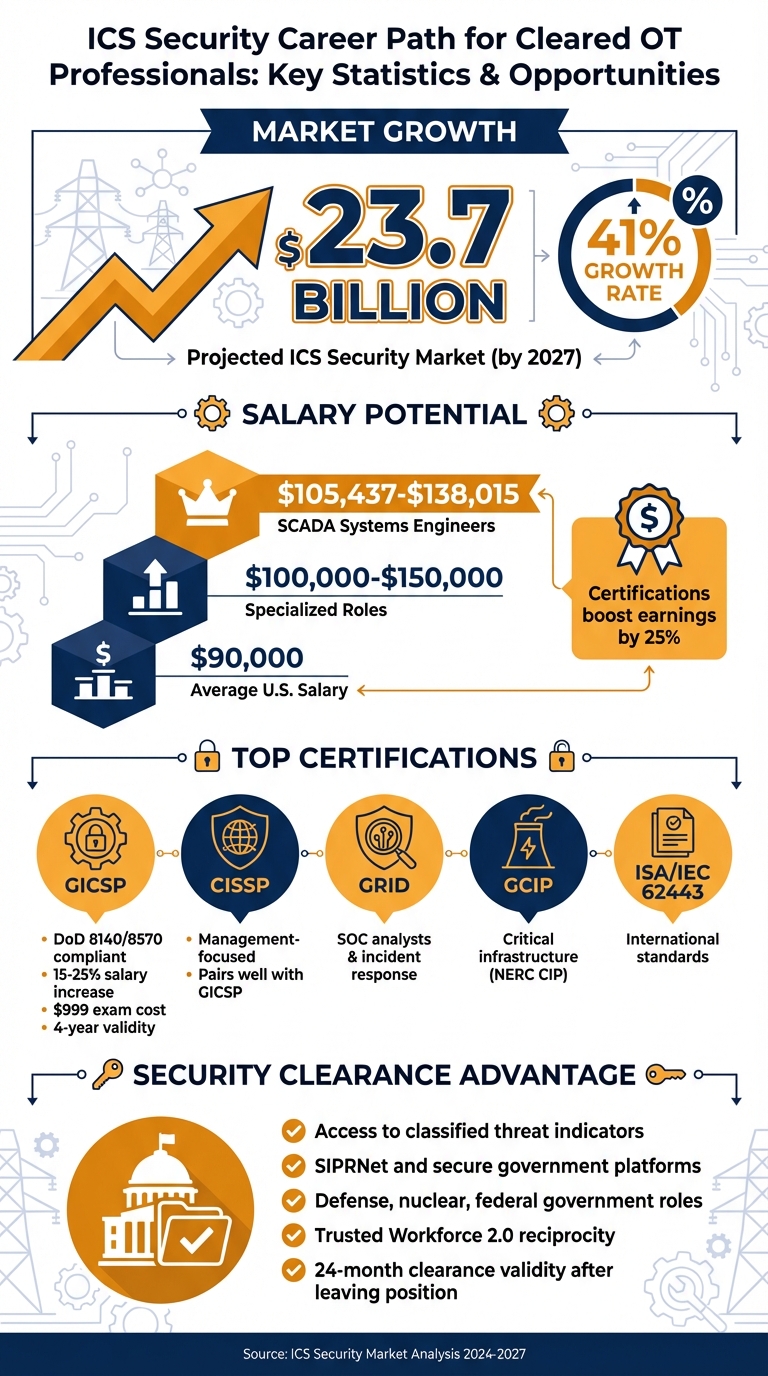
ICS Security Career Path: Market Growth, Salaries, and Certification Benefits
OT/ICS Cybersecurity Career: Skills, Certs, & Critical Infrastructure – CyberCast After Dark – Ep.17
sbb-itb-bf7aa6b
What Is an ICS Security Specialist?
An ICS Security Specialist protects the hardware and software that control critical infrastructure, like power grids and transportation systems. Their goal is to ensure these systems stay operational and safe. It’s not just about stopping data breaches – it’s about preventing disruptions that could lead to physical harm, environmental damage, or even loss of life.
This role combines two areas that traditionally operated separately: operational technology (OT) and cybersecurity. Supratik Pathak, a Senior Cyber Security Professional, explains this shift in focus:
"In OT cybersecurity, the mission is different. The priority stack flips from IT’s CIA triad to Availability → Integrity → Confidentiality, anchored by Safety" [5].
In simpler terms, keeping systems running safely takes precedence over securing sensitive information. This unique mix of OT and cybersecurity calls for a specialized set of skills, which we’ll dive into further.
Daily Responsibilities of an ICS Security Specialist
As an ICS Security Specialist, your daily responsibilities reflect the delicate balance between maintaining system availability and ensuring security. A significant part of your role involves monitoring industrial systems for both physical and digital threats. You’ll work with critical components like Programmable Logic Controllers (PLCs), Remote Terminal Units (RTUs), and Human-Machine Interfaces (HMIs) – the devices that control industrial machinery. This includes conducting vulnerability assessments during operations, where making security updates must be carefully managed to avoid interrupting essential processes.
Network security plays a unique role in this field. You’ll review and enforce firewall rules between IT and OT networks, often using the Purdue Model to segment networks. This setup ensures that a breach in a corporate system doesn’t cascade into the operational network. If an incident occurs, your response will follow OT-specific playbooks designed to minimize detection and response times, all while prioritizing safety and uptime.
Access control in ICS security goes beyond digital permissions. You’ll manage both physical and digital access to critical systems, ensuring only authorized personnel can interact with sensitive devices. Threat detection also requires a hands-on approach, as traditional IT tools often fall short in industrial environments. You’ll use behavior analysis to manually hunt threats, focusing on specialized protocols like Modbus, DNP3, and PROFINET. These daily tasks are essential for building the expertise and certifications that are crucial in this field.
Why ICS Security Matters for OT Professionals
The risks in ICS security are far greater than those in traditional IT. For instance, a study of 125,000 OT assets revealed that nearly 13% of HMIs are insecurely connected to the internet, and 36% contain at least one publicly exploited vulnerability [4]. These aren’t just numbers – they represent real vulnerabilities that attackers are actively targeting. A recent example is the Chinese state-sponsored group Volt Typhoon, which has been embedding cyber weapons in U.S. critical infrastructure to potentially cause disruptions during military conflicts [4].
As someone with an OT background, you understand the high-stakes consequences of even small errors. Patching a system isn’t as simple as clicking "update" – a minor software change could invalidate months of safety testing. Many industrial systems were designed to last decades and weren’t built with modern security in mind. This practical knowledge gives you an edge over IT professionals who may lack insight into how these systems truly operate. Recognizing these risks highlights the importance of the skills and certifications discussed in the next sections.
Required Skills for Cleared OT Professionals
Transitioning into ICS security builds on your existing OT expertise, requiring a blend of technical skills, cybersecurity knowledge, and the unique advantage of a security clearance for specialized roles.
Technical Skills for ICS Security
At the core of ICS security are industrial protocols. Familiarity with Modbus TCP, DNP3, PROFINET, OPC UA, Ethernet/IP, and IEC 61850 is essential. These protocols are the backbone of ICS operations, replacing the IT-centric protocols like HTTP or SMTP.
A key focus is network segmentation using the Purdue Model, which separates IT and OT environments. Following ISA/IEC 62443 standards, segmentation creates barriers to prevent threats from spreading between corporate and operational networks. Strengthening the IT/OT boundary can mean the difference between a localized issue and a facility-wide system failure.
Managing vulnerabilities in OT environments requires a different mindset than in IT. Francis Cianfrocca, CEO of Insight Cyber Group, highlights the complexity:
"Even if you change an operating system just a little bit to patch it, you’ve invalidated all your safety testing" [1].
This means you’ll need to conduct assessments without disrupting production, focusing on long-term remediation plans that prioritize safety over speed. Implementing OT-specific vulnerability management programs can significantly lower critical risks.
To monitor and secure OT networks, tools like Nozomi Networks, Dragos, and Tenable.ot are invaluable. You’ll also work with technologies like data diodes, industrial-grade firewalls from vendors like Palo Alto and Fortinet, and SIEM systems tailored for industrial use. Building skills in virtualized lab environments – using tools like pfSense, open-source HMI software, and Modbus simulators – can help you master these technologies. The effort is worth it: well-configured OT detection rules can cut Mean Time to Detect (MTTD) for anomalies on a DCS network from 6 hours to just 15 minutes [5].
These technical capabilities, combined with your security clearance, position you as a critical asset in ICS security roles.
How Security Clearances Help in ICS Roles
Beyond technical expertise, your security clearance offers access to sensitive environments and classified information, giving you a distinct edge. Cleared professionals can work with classified threat indicators and national security data [6], providing insights into threats that are unavailable to uncleared individuals. This exclusive intelligence allows you to safeguard systems more effectively.
Many ICS roles – such as those involving weapon systems, nuclear power plants, or critical energy infrastructure – require clearances by default. With clearance, you’ll gain access to classified networks like SIPRNet and secure government-only platforms such as AWS GovCloud and Microsoft Azure Government [6]. These aren’t optional credentials; they’re essential for working in high-stakes environments.
The Trusted Workforce 2.0 (TW 2.0) framework, fully operational by 2026, enhances the value of your clearance. This initiative simplifies clearance reciprocity, allowing you to transition between federal agencies and defense contractors without reapplying [6]. Combined with Continuous Vetting (CV), which replaces periodic reinvestigations with real-time monitoring, your cleared status makes you a highly dependable resource for organizations that prioritize security.
The demand for cleared professionals is also reflected in the numbers. The ICS security market is expected to hit $23.7 billion by 2027, with OT security roles projected to grow by 41% during this period [1]. While the average salary for an OT security practitioner in the U.S. is around $90,000, specialized roles like SCADA systems engineers earn between $105,437 and $138,015 [1]. Your clearance can position you for the higher end of this range, especially in government and defense sectors where cleared talent is in short supply.
Certifications for ICS Security Specialists
If you’re looking to stand out in the competitive world of ICS security, earning recognized certifications is a crucial step. These credentials not only validate your expertise but also pave the way for higher-paying roles. For professionals working in government or defense sectors, certifications demonstrate your ability to secure critical infrastructure while meeting stringent requirements.
GICSP: Global Industrial Cyber Security Professional
The GICSP is often considered the benchmark certification for ICS security experts. It bridges the fields of IT, engineering, and cybersecurity, covering the entire lifecycle of industrial control systems [9]. This certification emphasizes industrial protocols and the Purdue Reference Architecture, which is key to securing ICS environments.
For professionals with security clearances, the GICSP is especially valuable as it aligns with DoD 8140/8570 standards for IAT Level II and CND-A/IS roles [9]. Certified individuals typically earn between $100,000 and $150,000 annually – 15% to 25% more than their uncertified counterparts [9].
The exam itself includes 82–115 questions, has a three-hour time limit, and requires a passing score of 71% [9]. It’s open-book (hard copy materials only), so creating an organized, alphabetized index with definitions and page references is highly recommended. The SANS ICS410 course is tailored to help candidates prepare for the exam, with training costs ranging from $7,000 to $9,000 [9]. The exam attempt costs around $999, and the certification remains valid for four years, requiring 36 Continuing Professional Education credits for renewal [9]. After earning the GICSP, you might consider furthering your credentials with broader certifications like CISSP.
CISSP: Certified Information Systems Security Professional
The CISSP certification focuses on key security management concepts such as governance, risk management, and security architecture. While it applies to a broad range of cybersecurity roles, it becomes particularly valuable in ICS security when paired with specialized certifications like GICSP or ISA/IEC 62443. This combination is ideal for professionals aiming for management roles that oversee both IT and OT environments.
Additional ICS Security Certifications
If you’re looking to specialize further, several other certifications cater to specific areas within ICS security:
- GRID (GIAC Response and Industrial Defense): Tailored for SOC analysts and incident responders, this certification focuses on active defense, network security monitoring, and incident response in ICS environments [8].
- GCIP (GIAC Critical Infrastructure Protection): Perfect for those working with NERC CIP standards, this certification centers on protecting the electrical grid and other critical infrastructure [7].
- ISA/IEC 62443: This certification highlights international standards for securing industrial automation and control systems, making it a great fit for compliance officers and engineers working in global operations [2].
These certifications allow you to tailor your expertise to specific niches, helping you align your career path with your interests and the industries you wish to serve.
How to Transition into ICS Security
Transitioning from general OT work to ICS security is all about strategy. Your background in operational technology gives you an advantage – you already understand the physical systems and safety priorities that many IT professionals find challenging. The next step is to translate that experience into a security-focused framework and address any gaps in ICS-specific knowledge. Here’s a step-by-step guide to help you make the move.
Step 1: Assess Your OT Experience
Start by mapping your experience with systems like PLCs, RTUs, HMIs, and SCADA systems to the Purdue Model [4]. This will help you pinpoint which layers of ICS security you’re already familiar with and where you need to focus your learning.
In OT security, the focus shifts to Availability, Integrity, and Confidentiality (AIC), with safety as a cornerstone – unlike IT’s CIA model. As you review your past projects, highlight instances where you implemented controls without causing downtime or operational disruptions. These examples showcase your ability to balance security with system reliability [5].
When updating your resume, use the "Action Verb + Task + Result" formula to frame your experience. For example, instead of saying "Managed firewall rules", write something like "Hardened the IT/OT boundary by auditing 3,000+ firewall rules to align with the Purdue Model." This approach highlights both your technical skills and your understanding of security implications [5].
Step 2: Learn ICS Protocols and Tools
After assessing your OT experience, focus on learning key ICS protocols. These include Modbus (RTU/TCP), DNP3, OPC UA, PROFINET, EtherNet/IP (CIP), and Siemens S7COMM – protocols designed for reliability and safety over security. As Francis Cianfrocca, CEO of Insight Cyber Group, explains:
"Controls systems were designed for robustness; they were designed for safety but [they] weren’t designed for security" [1].
Tools like Wireshark can help you analyze industrial traffic and spot anomalies [9]. For hands-on practice, consider building a home lab with used PLCs from platforms like eBay. If hardware isn’t an option, simulators like PLCsim or Conpot offer a way to gain experience with programming and security hardening in a controlled environment [3].
Additionally, familiarize yourself with OT-specific security platforms like Claroty and Dragos, which are widely used for asset visibility and protocol mapping. Knowing how these tools function can make you an asset to employers who rely on them for threat detection and response [10].
Step 3: Pursue Training and Certifications
Practical training is crucial for a smooth transition. The SANS ICS410 course is a great option, offering hands-on experience with industrial environments and preparing you for the GICSP exam. While the course costs between $7,000 and $9,000, it’s a solid investment for those serious about ICS security [9]. If you’re looking for a more budget-friendly option, platforms like Hack The Box’s "Alchemy" Pro Lab simulate real-world industrial scenarios, helping you develop both offensive and defensive skills [11].
Certifications like GICSP should be a priority, especially if you’re targeting government or defense roles. This credential aligns with DoD 8140/8570 standards and can lead to a 15% to 25% salary boost [9]. Emily Miller, Vice President of National Security and Critical Infrastructure at Mocana, underscores this point:
"Credentialing yourself is number one" [1].
Step 4: Leverage Your Security Clearance and Network
If you hold a security clearance, it’s a major advantage for roles involving classified networks like SIPRNet or critical infrastructure protection [6]. Under the Trusted Workforce 2.0 (TW 2.0) framework, clearances are designed to be portable across federal agencies and contractors. Remember, your clearance generally remains active for 24 months after leaving a position, giving you time to secure your next role [6].
When applying for jobs, tailor your resume to highlight OT-specific language. Use terms like "Purdue Model", "ISA/IEC 62443", "SCADA", and "Modbus" to demonstrate your expertise and ensure your resume passes Applicant Tracking Systems [5]. Replace IT-centric phrases like "PII protection" with OT-focused terms such as "process safety", "uptime", and "reduced operational risk" [5].
Expand your network through organizations like the International Society of Automation (ISA) and the SANS community, where you can find mentorship and job opportunities [3]. Platforms like Cleared Cyber Security Jobs can also connect you with employers seeking security-cleared ICS professionals. These platforms often feature job fairs, allowing you to meet hiring managers who value your unique blend of OT experience and security clearance.
Finding ICS Security Jobs
Job Market Demand for ICS Security Specialists
The demand for professionals skilled in Industrial Control Systems (ICS) security is on the rise. In fact, the global ICS Security Market was valued at $15.47 billion in 2024 and is expected to grow to $26.49 billion by 2032, with a compound annual growth rate of 6.96% from 2026 to 2032 [12]. This growth is fueled by several factors, including the merging of IT and OT systems, the adoption of Industry 4.0 technologies, and the increasing prevalence of ransomware and Advanced Persistent Threat attacks targeting critical infrastructure.
For OT professionals with active security clearances, this creates a high-demand niche, particularly in government contracting and defense. Industries such as power grids, manufacturing, oil and gas, and water treatment facilities are actively looking for specialists who can secure SCADA systems and PLCs. Clearances like Secret, Top Secret, or TS/SCI are often a prerequisite for these roles.
Major companies like Siemens AG, Schneider Electric SE, Honeywell International Inc., ABB Ltd., and Cisco Systems, Inc. dominate the field, providing stable and attractive career opportunities. Meanwhile, emerging trends are reshaping the job market. These include the use of AI and machine learning for real-time threat detection, the rise of managed security services tailored to OT environments, and the integration of 5G networks and edge computing. Knowledge of digital twin technology and blockchain-based authentication is also becoming increasingly valuable for ensuring data integrity.
This dynamic market growth highlights the importance of developing a focused job search strategy that aligns with your OT expertise and security clearance.
Finding Jobs Through Cleared Cyber Security Jobs
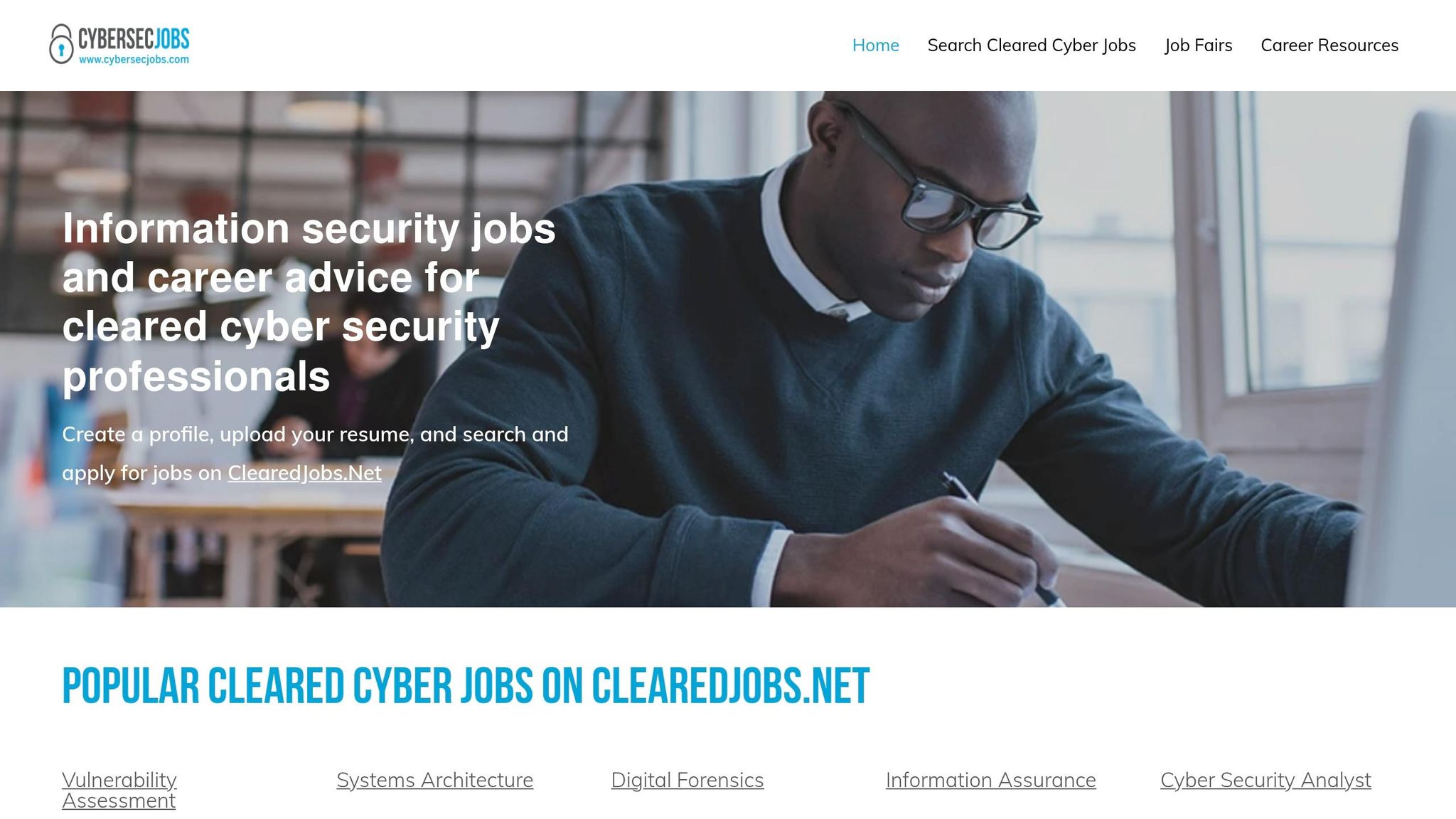
To tap into this growing demand, platforms like Cleared Cyber Security Jobs provide specialized tools for finding ICS security roles. This site is specifically designed for security-cleared professionals, offering free access to job search features tailored to clearance levels. Whether you’re looking for positions requiring Secret, Top Secret, or TS/SCI clearances, the platform allows you to narrow your search efficiently.
You can also upload your resume directly to connect with hiring managers, bypassing the need for intermediaries like staffing firms. Additionally, the platform organizes job fairs where you can meet employers face-to-face, showcasing your combination of OT experience and security credentials.
Other features include job alerts for new opportunities in sectors like power, energy, utilities, and manufacturing, as well as career resources to help you stay competitive. These resources cover certifications and professional development tailored to the cleared community, ensuring you’re well-prepared for the evolving demands of the ICS security field.
Conclusion
Building a career in ICS security as a cleared OT professional depends on developing the right technical skills, earning relevant certifications, and making the most of your security clearance. Start by gaining a solid understanding of key ICS frameworks and protocols – these are at the heart of every ICS security role.
The GICSP certification, approved by the DoD for IAT Level II roles, is a great way to showcase your ability to bridge IT and OT. It can even increase your earnings by 15%–25% [9]. While the $999 exam fee might seem steep, it’s a smart investment in your future. The certification emphasizes the safety-first triad of Availability → Integrity → Confidentiality [5].
Your security clearance gives you a competitive edge, especially in industries like defense contracting, utilities, and government-regulated manufacturing. With the ICS security market expected to hit $23.7 billion by 2027 and grow at a rate of 41%, cleared professionals are in a strong position to seize these opportunities [1]. As Emily Miller, VP of National Security and Critical Infrastructure at Mocana, aptly says:
"Credentialing yourself is number one" [1].
To stand out, take practical steps to prove your expertise. For example, set up a home lab with tools like Modbus simulators and pfSense firewalls. Update your resume to highlight measurable OT accomplishments, such as cutting mean time to detect from 6 hours to just 15 minutes [5]. With the right training and hands-on experience, you’ll be well-prepared to thrive in this fast-growing field.
FAQs
What OT experience counts most for an ICS security role?
Experience in overseeing, securing, and managing access to Industrial Control Systems (ICS) is especially important in environments like power plants, nuclear reactors, or electrical grids. Practical, hands-on knowledge of these operational settings reflects a solid background for roles focused on ICS security.
How can I practice ICS security without risking a live plant?
Creating a safe space to practice ICS security is essential, and building an OT/ICS home lab is a great way to do it. By leveraging free virtualized platforms and tools designed specifically for ICS, you can simulate key activities like network reconnaissance, protocol analysis, and system interactions – all within a controlled environment. This setup not only helps you develop hands-on skills but also lets you test defense strategies and dive into ICS technologies without putting actual industrial systems at risk.
Will my security clearance speed up hiring for ICS security jobs?
Having a security clearance can speed up the hiring process for ICS security roles. It provides a clear advantage, especially for positions that require clearance, such as those in government or critical infrastructure sectors. This is particularly important for roles where trust and access to sensitive systems are crucial.