

Delays in security clearance renewals can disrupt careers, stall income, and create frustration for professionals. Despite efforts to improve, issues like backlogs, form errors, and new vetting systems continue to slow the process. Here’s how you can mitigate these challenges:
- Understand the Causes: Backlogs, errors in SF-86 forms, and the transition to Continuous Evaluation (CE) are major contributors to delays.
- Prepare Your Application: Submit an accurate, complete SF-86 form and gather all required documents (e.g., employment history, financial records) ahead of time.
- Stay Employed: Consider interim clearances, temporary unclassified roles, or lateral moves to maintain your job and clearance eligibility.
- Use Delays Wisely: Pursue certifications (e.g., CISSP, Security+), build new skills, and network with other professionals to stay competitive.
How Do I Renew A Secret Clearance? – SecurityFirstCorp.com
Why Clearance Renewal Delays Happen
Security Clearance Renewal Delays: Key Statistics and Timeline Data
Delays in clearance renewals often stem from a mix of systemic issues, application errors, and adjustments to new security protocols. By understanding these hurdles, you can better navigate the process and potentially avoid unnecessary setbacks.
Processing Backlogs at Adjudication Agencies
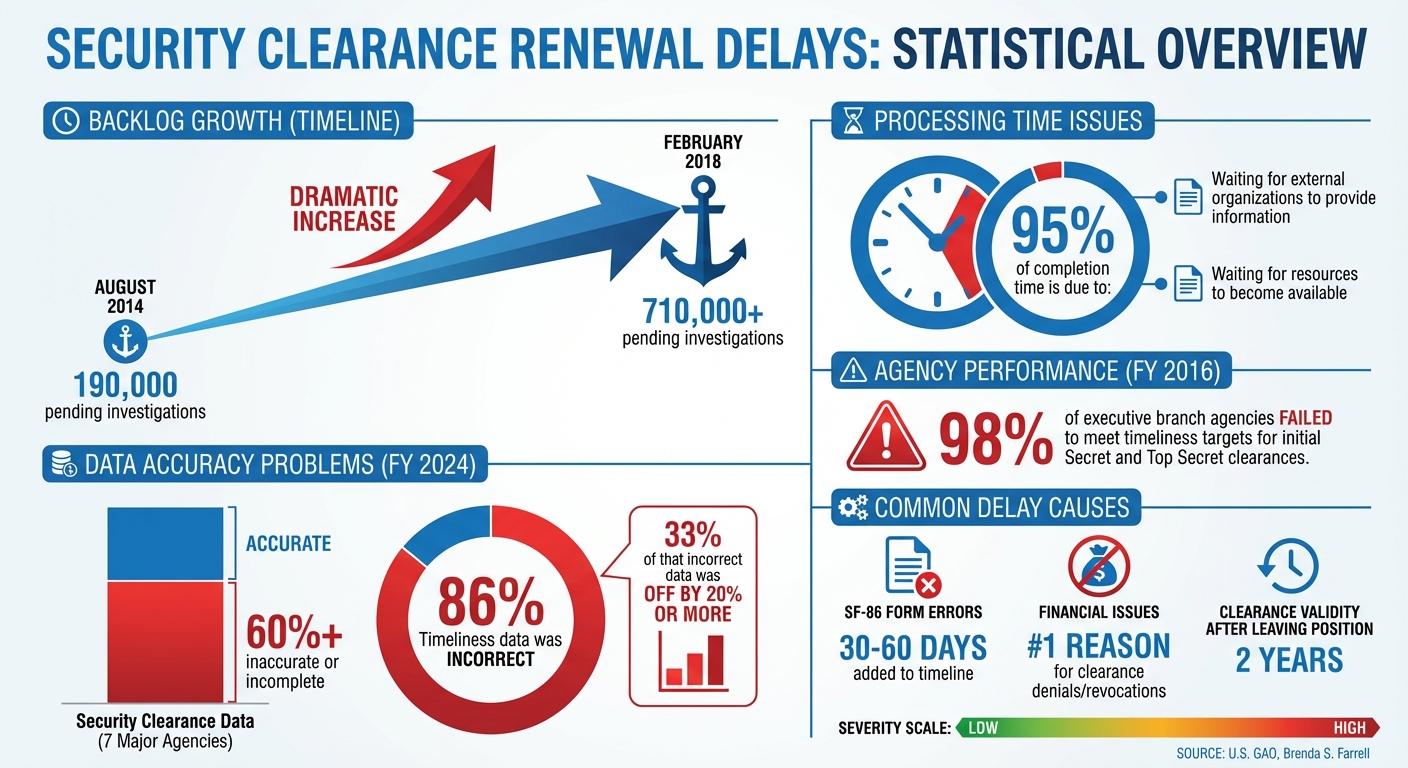
Capacity issues have long plagued the clearance system. Pending investigations ballooned from 190,000 in August 2014 to over 710,000 by February 2018, according to Brenda S. Farrell, a former director at the U.S. Government Accountability Office [2]. Although some progress has been made, resource shortages continue to slow things down.
Delays are often caused by external dependencies. For example, your renewal might be stuck for months while investigators wait for responses from past employers, schools, or other agencies. The U.S. GAO found that "about 95 percent of the time to complete the highest tier of a background investigation was due to waiting for (a) an external organization to provide information or (b) a resource to come available to work on a part of the investigation" [1]. To put it into perspective, in fiscal year 2016, 98% of executive branch agencies failed to meet timeliness targets for initial secret and top-secret clearances [2]. These statistics highlight how widespread and persistent these delays are.
Mistakes and Missing Information in SF-86 Forms
Errors in your SF-86 form can derail the process before it even begins. Simple mistakes – like leaving out key details, forgetting to include documentation, or failing to report life changes – can add 30 to 60 days to your timeline. Worse, inconsistencies in your application can raise doubts about your reliability.
The National Security Law Firm emphasizes that "omissions and inaccuracies often generate Guideline E (Personal Conduct) concerns. In federal clearance practice, lack of candor frequently becomes more serious than the underlying conduct" [3]. For instance, forgetting to list a foreign contact or misreporting a date might seem minor, but these oversights can lead to bigger problems. Adjudicators may request additional details or even schedule interviews, which could delay your renewal by months – or, in severe cases, years.
Changes to Security Vetting and Continuous Evaluation
The shift to Continuous Evaluation (CE) has fundamentally changed how clearance renewals work. Instead of predictable five- or ten-year cycles, clearance holders are now monitored in real-time, with potential issues flagged as they arise. While this system aims to enhance security, it has introduced new complications.
Dan Meyer, a partner at Tully Rinckey PLLC, explains: "Continuous Evaluation (CE) shifts the focus to people presenting risk. If you do not present a risk, you will be reviewed less and less" [4]. However, when CE identifies unreported issues – like undisclosed foreign travel or new financial debts – it can trigger a manual reinvestigation, adding months to the process. The transition to the National Background Investigation Services (NBIS) system has also introduced additional checks, further impacting processing times.
Data accuracy remains a significant challenge. In fiscal year 2024, more than 60% of security clearance data across seven major agencies was found to be inaccurate or incomplete. Additionally, 86% of timeliness data analyzed by the GAO was incorrect, with a third of that data being off by 20% or more [5]. The U.S. GAO also reported that "much of the data reported to Congress and the public from 2020–2024 has underestimated the time to complete the clearance process" [5]. These inaccuracies mean that official timelines often fail to reflect the reality of clearance delays, making it even more crucial to plan ahead and prepare for potential setbacks.
How to Prepare for a Faster Clearance Renewal
If you want to avoid delays in your clearance renewal, the key is submitting a clean, error-free application from the start. While processing backlogs are beyond your control, the quality of your submission is entirely in your hands. A well-prepared application minimizes the chances of investigators needing to follow up for clarifications or extra documentation, which can slow things down.
Gathering and Updating Required Documents
Start collecting your paperwork well in advance of your renewal deadline. You’ll need employment verifications, pay stubs, tax returns, and records of foreign travel from the past seven years. It’s also a good idea to pull your credit reports from Equifax, Experian, and TransUnion. Why? Financial issues are the most common reason for security clearance denials or revocations [7]. Knowing what’s on your credit report before you submit your renewal is essential.
Make sure you have up-to-date contact information for all references and key witnesses from your previous residences. Additionally, if your health history is relevant, include a signed medical release covering the past seven years.
Finding and Fixing Potential Issues Before Submission
Before diving into your renewal, take some time to review your previous SF-86 form. Agencies compare your new submission with past ones, and any inconsistencies – whether in dates, foreign contacts, or past conduct – can raise red flags. Double-check details like employment dates and foreign contacts to ensure they align with your earlier submissions. If you’ve addressed past financial issues, such as repaying debts or completing credit counseling, gather documentation to prove it. Also, take care of any unreported foreign travel, undisclosed contacts, or new financial obligations now, before submitting your renewal.
It’s worth noting that lying or withholding information on the SF-86 is a felony under 18 U.S.C. § 1001, punishable by up to five years in prison [6]. Investigators treat omissions as seriously as outright lies [6]. As the National Security Law Firm explains:
"The SF-86 is not reviewed to determine whether you qualify for a clearance. It is reviewed to determine whether the federal government can rely on you across time" [6].
Even minor mistakes can snowball into major issues during polygraphs or future promotions. Addressing potential problems upfront sets you up for a smoother process.
Completing Your SF-86 Form Correctly
When it’s time to fill out your SF-86, accuracy is critical. Download the fillable PDF version to complete offline before entering your information into the web-based system (e-QIP or eApp). This method can save you time and reduce frustration. Double-check zip codes to ensure your application is routed correctly, and list all nicknames or maiden names to avoid delays in database searches.
Use the "Optional Comments" field wisely. For example, if you left a job under challenging circumstances or have a past legal issue, explain the situation proactively. Reference the Adjudicative Guidelines (SEAD 4) to frame negative information in a way that highlights mitigation – such as emphasizing that the behavior was isolated, occurred long ago, or was due to factors beyond your control. Before submitting, ask your Facility Security Officer (FSO) to review your application for common errors, like incomplete Social Security numbers for spouses or missing contact details for employment verifiers. As the National Security Law Firm warns:
"Small issues or half-truths now can cause big problems later" [6].
sbb-itb-bf7aa6b
Maintaining Employment During Clearance Renewal Delays
Once you’ve ensured your application is accurate, the next step is to focus on keeping your job secure during any delays in the clearance renewal process. It’s crucial to act quickly and communicate openly with your employer before your current clearance expires. Here’s how you can navigate this tricky period.
Using Interim Clearance or Getting Employer Support
An interim security clearance can be a lifesaver during renewal delays. This temporary authorization allows you to access classified information while your background investigation is still underway. However, you can’t apply for an interim clearance on your own – your employer’s sponsor must submit the request to the Personnel Security Division.
To increase your chances of approval, work closely with your sponsor to provide a strong justification for the request. You’ll also need to sign an Interim Security Clearance Certification, which outlines the potential risks. The U.S. Department of Justice cautions:
Your interim security clearance may be withdrawn, and your employment terminated, if concealed or unfavorable information is uncovered that negatively impacts your selection.
Keep in mind that interim clearances are typically reserved for roles expected to last six months or more [8].
Discussing Renewal Timelines With Your Employer
Clear and early communication is essential when dealing with clearance renewal delays. Let your employer know about potential delays well in advance of your clearance expiring. Stay organized by maintaining personal records of your clearance and contract timelines. If there are any updates or changes, report them immediately to your security office. Being proactive not only shows professionalism but also helps your employer plan accordingly.
Exploring Temporary Roles That Don’t Require Active Clearance
If your renewal process drags on, consider asking your employer about transitioning to unclassified projects. Many organizations are willing to adjust roles to eliminate the need for classified access temporarily, helping you stay productive while your clearance is under review. Some companies may even offer flexible arrangements to retain skilled employees.
If a role adjustment isn’t possible, look into lateral moves or part-time cleared positions to keep your clearance active. As ISI Defense explains:
A security clearance is active when an employee has a job that requires access to classified information. If an employee leaves a cleared position, their clearance must be picked up by another organization within a two-year period in order for it to remain active. [9]
Career Planning for Long Clearance Delays
Extended clearance delays can be frustrating, but they also present an opportunity to strengthen your professional foundation and enhance your value in the job market. Instead of just navigating immediate employment hurdles, use this time to strategically plan your career. A well-thought-out approach during this downtime can make you stand out when cleared opportunities arise again.
Getting Certifications and Learning New Skills
Certifications aligned with DoD standards (DoDM 8140.03) are a smart investment during clearance delays. For example, CompTIA Security+ ($370) is a great starting point for building foundational skills, while CISSP ($749) is ideal if you have at least five years of experience. As (ISC)² explains:
Earning the CISSP proves you have what it takes to effectively design, implement and manage a best-in-class cybersecurity program [10].
Expanding your expertise into high-demand areas can also position you for interim or unclassified roles. Certifications like CCSP for cloud security, CEH for ethical hacking ($1,199), or GCIH for incident handling ($2,499) are particularly sought after [11]. Many sponsoring agencies or contractors offer certification reimbursement during clearance delays, so be sure to check with your security office about available professional development programs.
Connecting with Other Cleared Professionals
Networking is a powerful tool for uncovering opportunities that aren’t publicly advertised. Industry job fairs and platforms like Cleared Cyber Security Jobs can connect you with employers offering flexible roles or unlisted positions.
Professional organizations such as (ISC)² or ISACA are also valuable resources. These groups provide access to educational materials and peer networking opportunities that don’t depend on an active clearance. Engaging with these communities can help you stay informed about in-demand skills and certifications that make you more appealing to employers.
Building a Backup Plan for Future Delays
Financial stability is key when preparing for potential clearance delays. Since financial issues are a leading cause of clearance denials, maintaining a "clearance-ready" financial profile is crucial. Keep detailed records of debt payments, monitor your credit regularly, and communicate proactively with creditors. If you’re facing financial challenges, consider reaching out to reputable non-profit credit counseling services for guidance.
Additionally, security clearance eligibility typically remains valid for two years after leaving a cleared position. To avoid restarting the investigation process, aim to secure a new cleared role within that timeframe. If necessary, negotiate with your current employer to take on a lower pay-grade or non-classified role while waiting for adjudication. Lastly, keep your personal history – such as foreign travel, contacts, and addresses – up to date. This ensures your SF-86 submission is accurate and minimizes the risk of preventable delays during renewal or upgrades.
Conclusion
Delays in clearance renewal don’t have to throw your career off track. By focusing on preparation – like submitting a precise SF-86, organizing necessary documents ahead of time, and addressing any potential red flags – you can cut down on processing time and sidestep preventable issues.
Clear and early communication with your employer is just as important. Talk about renewal timelines sooner rather than later. Many companies provide options like interim clearances, temporary unclassified roles, or even professional development opportunities to help you stay engaged during delays. Starting these conversations early shows initiative and keeps you productive, which not only safeguards your current role but also sets you up for future opportunities.
If the delays drag on, use that time wisely. Earning certifications, maintaining a financially sound profile, and networking through resources like Cleared Cyber Security Jobs can keep you competitive and ready for the next step.
The key is staying proactive. Those who take charge during clearance delays not only minimize disruptions but also position themselves for long-term success.
FAQs
What steps can I take to avoid mistakes on my SF-86 form?
To fill out your SF-86 form without errors, start by gathering all the required documents. This includes your Social Security Number, fingerprints, and any relevant supporting paperwork. Make sure you’re working with the most current version of the form.
Provide complete and accurate details for every section. This means including full addresses and thorough information about your residences, employment history, and any periods of unemployment within the specified timeframes. Notify your listed references in advance, and remember not to use relatives as personal contacts. It’s also wise to review your credit report for any debts or issues that need to be disclosed and addressed.
Before you submit, carefully proofread the entire form to catch any typos or missing information. If you can, ask a trusted colleague or your Facility Security Officer to review it for accuracy. Taking these steps can help prevent delays and ensure your clearance process moves forward smoothly.
What should I do if my security clearance renewal is delayed?
If your security clearance renewal is taking longer than expected, your first step should be reaching out to your Facility Security Officer (FSO) or security manager. Confirm that your renewal application was submitted correctly and ask for a status update through the appropriate government system. Keeping your employer in the loop is also a smart move – they may need to make temporary adjustments, like reassigning tasks, to prevent any workplace disruptions.
In the meantime, there are ways to strengthen your case. Start by reviewing your SF-86 form to ensure all details are accurate. Make sure your listed references are aware they might be contacted, and take a close look at your credit report to identify and address any potential issues. If you’ve had past conduct that could raise concerns, document how much time has passed without further incidents – this can help demonstrate improvement and reduce potential red flags during adjudication.
While it’s important to stay proactive, patience is key. Renewals for Secret or Top-Secret clearances can sometimes take up to a year. Regularly check your case status, respond quickly to any requests for additional information, and keep detailed records of all communications. If the delays begin to affect your work, consider discussing temporary non-cleared assignments or alternative projects with your employer to ensure you stay productive and maintain job continuity.
What is Continuous Evaluation, and how does it affect the clearance renewal process?
Continuous Evaluation (CE) shifts away from the old model of periodic reinvestigations, introducing a system that continuously monitors a clearance holder’s background. This automated process regularly checks various databases, including those tracking financial transactions, criminal records, foreign travel, and credit reports. If any security-related concerns pop up, the system generates alerts almost instantly, enabling agencies to quickly address potential issues.
For most clearance holders, CE streamlines the renewal process. Instead of undergoing lengthy reviews, eligibility is simply confirmed – unless an alert flags a concern. When that happens, further investigation or additional details may be needed. This approach significantly reduces delays and ensures clearances stay active without the hassle of traditional periodic reviews.
Leave a Reply