

Maintaining your security clearance is essential for career stability in government and defense roles. Losing it can result in job loss or reduced opportunities. Here’s a quick breakdown of how to protect your clearance:
- Report Changes Promptly: Disclose financial issues, arrests, foreign travel, or major life changes (e.g., marriage) to your Facility Security Officer (FSO) immediately. Transparency is key.
- Manage Finances and Legal Issues: Stay on top of debts, avoid legal trouble, and resolve issues quickly. Continuous Vetting tracks these in real time.
- Track Reinvestigation Timelines: Keep records of your clearance status and ensure it doesn’t lapse, especially if switching jobs.
- Be Mindful on Social Media: Review your posts for anything that could raise concerns, and adjust privacy settings.
- Follow Clearance Rules: Stick to established protocols, report incidents, and stay compliant with guidelines.
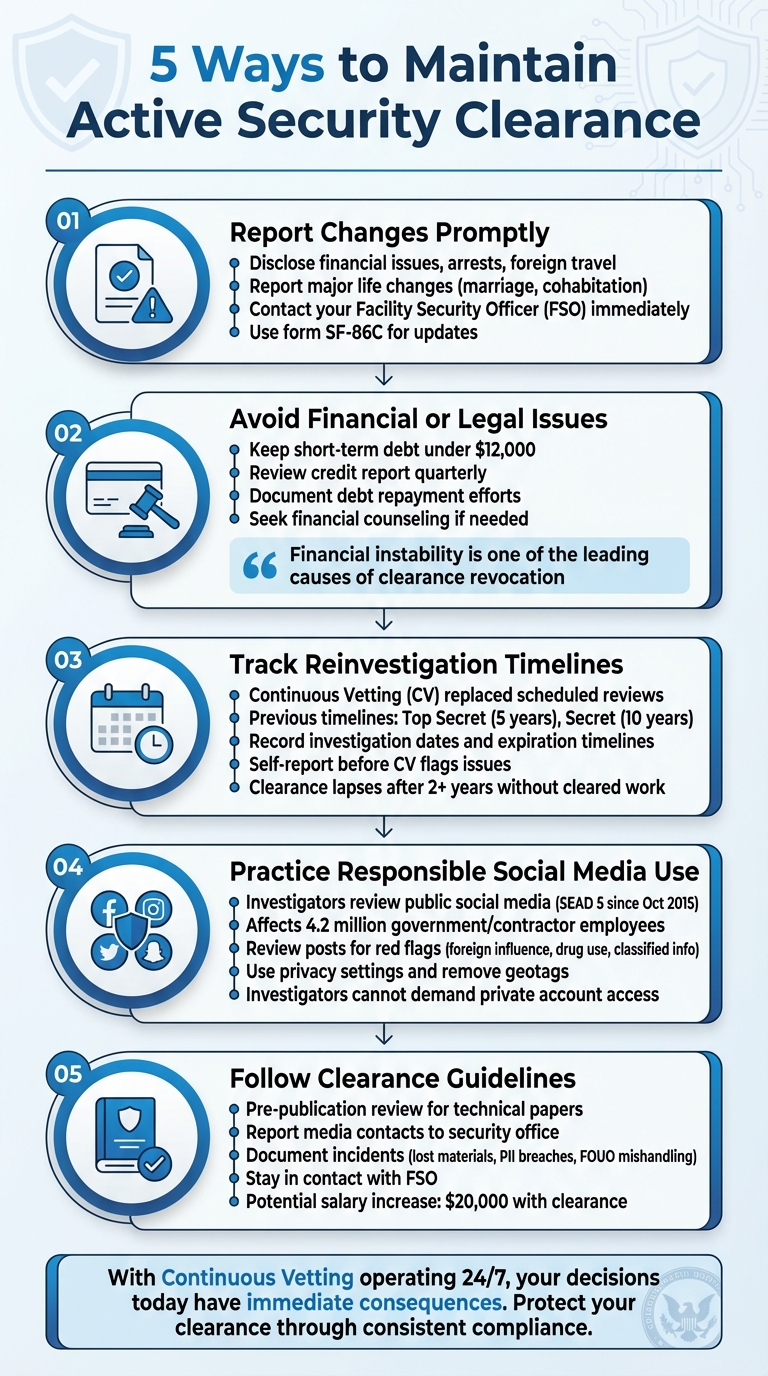
5 Essential Steps to Maintain Active Security Clearance
Top Security Clearance Mistakes to Avoid | Tips from Security Clearance Attorney Alan Edmunds
1. Adhere to Reporting Requirements
Federal regulations like SEAD 3 and SEAD 4 make self-reporting a mandatory responsibility for anyone with a security clearance. When your circumstances change, maintaining your clearance hinges on promptly and accurately disclosing those changes. Timely reporting is the backbone of responsible clearance management.
What needs to be reported? Financial troubles such as bankruptcy, wage garnishment, tax liens, foreclosure, or struggling to meet financial obligations must be disclosed. Arrests – no matter the outcome – should be reported immediately. Other reportable events include foreign travel, unusual foreign contacts, and major personal changes like marriage, cohabitation, or a name change. For individuals with SCI or SAP access, advance notice of these changes is especially critical.
Katherine Belcher from the U.S. Army Aviation and Missile Command highlights the importance of being upfront:
"Reporting in and of itself is not a reason to revoke or deny eligibility for access to classified information and may go far in receiving a favorable adjudication of the incident" [6].
Timing is everything. Proactively disclosing information shows the kind of trustworthiness that adjudicators value. On the flip side, withholding information could result in a more severe violation under Guideline E (Personal Conduct).
Your Facility Security Officer (FSO) is your go-to resource for understanding what to report and when. Many agencies use form SF-86C to update information. While minor traffic violations with fines under $150 usually don’t need to be reported [8], anything more serious should be discussed with your FSO.
Failing to self-report often leads to less favorable outcomes than voluntary disclosure [7]. With Continuous Vetting now tracking public records in real time, staying ahead of automated alerts isn’t just a good idea – it’s crucial for safeguarding your clearance.
2. Avoid Financial or Legal Issues
Relevance to Maintaining Clearance
Financial troubles are one of the main reasons people lose their security clearance. Dan Meyer, Partner at Tully Rinckey PLLC, puts it plainly: "Financial instability is one of the leading causes of clearance revocation" [5]. Why? Because financial stress can make someone more vulnerable to coercion, which raises security concerns. Similarly, legal troubles – like arrests or criminal charges – can erode the trust adjudicators have in you. Issues like delinquent debt, bankruptcy, or tax liens often trigger closer scrutiny during periodic reinvestigations or Continuous Evaluation [1].
Practicality of Implementation
Given these risks, staying on top of your financial and legal responsibilities is essential. Experts recommend keeping short-term debt under $12,000 and avoiding overdue accounts [9]. Regularly reviewing your credit report – at least every quarter – can help you catch mistakes or problems before they’re flagged by Continuous Evaluation systems [1].
If you’re dealing with financial difficulties, document your efforts to repay debts and consider seeking financial counseling. The same approach applies to legal challenges: self-reporting and seeking professional advice can demonstrate accountability. Meyer underscores the importance of accuracy: "Inaccuracy is a security liability; show yourself inaccurate and you have shown yourself to the door" [9]. Whether it’s a billing error on your credit report or a sudden legal issue, address it promptly and keep detailed records of how you resolved it. Taking these steps shows you’re serious about maintaining your clearance.
Impact on Long-Term Clearance Status
Financial or legal problems don’t automatically mean the end of your clearance – but ignoring them might. Adjudicators focus on patterns of behavior and efforts to resolve issues. Showing that you’ve taken steps – like setting up repayment plans, attending financial counseling, or complying with legal requirements – proves you’re responsible and trustworthy. Since Continuous Evaluation monitors your status in real time, unresolved problems can quickly damage your standing. Keeping your financial records clean and staying legally compliant are key to holding onto your clearance for the long haul.
3. Stay Updated on Reinvestigation Timelines
Why Tracking Timelines Matters
Keeping tabs on reinvestigation timelines is just as important as maintaining financial responsibility and consistent reporting. With federal agencies now using Continuous Vetting (CV) to monitor your background in real time, staying informed is critical. Heather Tenney, Partner at Tully Rinckey PLLC, explains: "Continuous Vetting (CV) is intended to replace scheduled reinvestigations, but individuals are still reviewed when security issues are flagged" [7]. While CV has streamlined the process, it doesn’t eliminate the need for vigilance. Previously, Top Secret clearances were reviewed every 5 years and Secret clearances every 10. Now, CV flags potential issues immediately [7][10].
How to Stay on Top of It
Even with Continuous Vetting in place, it’s a good idea to keep track of your clearance status yourself. Record your investigation dates and expiration timelines. This is especially important if you’re switching jobs or agencies, as federal agencies typically honor another agency’s clearance (reciprocity) only if the investigation occurred within the last 5 years for Top Secret or 10 years for Secret [11].
Being proactive can save you from surprises. For example, self-reporting major life changes – like financial troubles or legal issues – before CV flags them shows initiative. The Bureau of Diplomatic Security highlights this benefit: "CE maximizes the use of automated records to identify security-relevant information earlier and more frequently than the current reinvestigation cycle" [11]. By staying ahead of these checks, you take control of your narrative and demonstrate reliability.
Long-Term Benefits of Staying Proactive
Understanding how Continuous Vetting works can protect your clearance in the long run. By actively monitoring your status, you reduce the risk of unexpected flags from automated systems. Dan Meyer, Partner at Tully Rinckey PLLC, explains: "Continuous Evaluation (CE) shifts the focus to people presenting risk. If you do not present a risk, you will be reviewed less and less" [1].
This means that maintaining clean financial records, avoiding legal trouble, and promptly reporting any issues can significantly reduce the scrutiny you face. On the flip side, ignoring red flags or letting your clearance lapse for over 2 years without cleared work could force you to restart the entire clearance process [7]. Staying on top of timelines and reporting proactively helps secure your clearance and career, reinforcing the trust that adjudicators expect from cleared professionals.
sbb-itb-bf7aa6b
4. Practice Responsible Social Media Use
Relevance to Maintaining Clearance
Your online activity isn’t just about likes and shares – it can directly influence your security clearance. Since October 1, 2015, federal investigators have been authorized under Security Executive Agent Directive 5 (SEAD 5) to review publicly available social media information during background checks [3]. This means platforms like Twitter, Facebook, and Instagram are fair game for scrutiny. The Office of the Director of National Intelligence explains, "This policy allows investigators to consider an applicant’s history on Twitter, Facebook, Instagram, and other similar sites" [3].
Investigators are on the lookout for red flags, such as evidence of foreign influence, criminal behavior, drug use, or mishandling of sensitive information. Even one questionable post could raise doubts about your reliability. Dan Meyer, Partner at Tully Rinckey PLLC, emphasizes, "Maintaining a security clearance… requires regular attention to professional and personal conduct, because even small infractions can raise concerns about a security clearance holder’s ability to handle sensitive information" [4].
Practicality of Implementation
Staying mindful of your digital presence doesn’t mean you need to delete your accounts. Instead, take control of what others can see. Use tools like "View As" to check your public profile and adjust privacy settings as needed. Remove geotags and avoid sharing sensitive location details. Before submitting an SF-86 or undergoing a reinvestigation, review your past posts for anything that could be misinterpreted – whether it’s about drug use, finances, or loyalty [3]. If you frequently interact with foreign nationals, make sure to report these contacts to your Security Officer.
It’s worth noting that investigators can’t demand access to your private accounts or passwords [3]. By setting strict privacy controls, you can limit what’s visible to the public, ensuring that only the information you choose to share is accessible.
Impact on Long-Term Clearance Status
Social media reviews are now a standard part of the clearance process. With around 4.2 million government and contractor employees eligible for security clearances as of October 1, 2015 [3], agencies are increasingly relying on publicly available online data to assess trustworthiness. Actively managing your digital footprint can help protect your clearance over time. Remember, information is only retained if it’s considered "relevant" to your security status [3]. By keeping your profiles clean and professional, you reduce the chances of unnecessary scrutiny and help secure your future.
5. Follow Clearance Guidelines
Why Adhering to Guidelines Matters
Building on the principles of proactive reporting and personal accountability, sticking to clearance guidelines is a cornerstone of your role as a cleared professional. As Dan Meyer, Partner at Tully Rinckey PLLC, explains, "Maintaining a security clearance is an ongoing responsibility that requires strict adherence to established guidelines" [4]. This responsibility is rooted in Executive Order 12968, which emphasizes, "Access to classified information shall be granted only to individuals whose personal and professional history affirmatively indicates loyalty to the United States, strength of character, trustworthiness, honesty, reliability, discretion, and sound judgment" [12].
Even minor missteps can lead to investigations or even suspension of your clearance. John Moran, Deputy Chief of Staff Intelligence and Security at Army Contracting Command, highlights the importance of vigilance: "The concept of continuing evaluation is an important part of the personnel security process. Personnel are subject to periodic reinvestigation and to a reasonable degree of monitoring by supervisors, co-workers and security professionals between investigations" [12]. In other words, your actions are continuously monitored, making it critical to follow the rules consistently.
Implementing Guidelines in Daily Work
Compliance with clearance protocols isn’t just about understanding the rules – it’s about applying them every day. For instance, if you’re working on technical papers, articles, or lectures that involve classified information, these must go through pre-publication review before being shared publicly [12]. Similarly, any contact with the media should be reported to your security office, and ongoing interactions with media representatives must also be cleared [12].
You’re also expected to document and report any incidents related to clearance, such as the loss of classified materials, breaches of personally identifiable information (PII), or mishandling of "For Official Use Only" (FOUO) data, following established procedures [12]. Keeping organized records of these actions can help during periodic reviews [1]. Staying in touch with your Facility Security Officer (FSO) is equally important – they provide updates on changes to continuous evaluation requirements and reinvestigation timelines [4]. By consistently following these steps, you build and maintain the trust necessary to retain your clearance.
Long-Term Benefits of Compliance
A security clearance can significantly enhance your earning potential, with salaries increasing by as much as $20,000, and employers often investing up to $15,000 to sponsor your clearance [13]. Protecting this investment requires demonstrating sound judgment and reliability. With the move toward continuous evaluation, those who consistently follow the rules and pose no risks are subject to less frequent reviews [4]. By strictly adhering to clearance protocols, you not only reduce scrutiny but also secure your professional future. This approach reinforces earlier measures to mitigate risks and ensures both your clearance and career remain intact.
Conclusion
Keeping an active security clearance is no small task – it demands consistent effort and a commitment to five core strategies. These include meeting reporting requirements, steering clear of financial or legal troubles, staying on top of reinvestigation timelines, using social media responsibly, and strictly following clearance guidelines. Together, these habits help protect not just your clearance but also your professional future.
Even a seemingly minor mistake can put your clearance at risk. With continuous vetting now operating 24/7, any issues are flagged in real time, rather than surfacing years later during periodic reviews. This means your decisions today can have immediate consequences.
To stay ahead, take active steps to safeguard your clearance. Monitor your reinvestigation deadlines to avoid lapses in eligibility. Keep an open line of communication with your Facility Security Officer (FSO) and promptly report any major life changes – like marriage, foreign travel, or financial challenges – to show you’re dependable and transparent[1][2]. By weaving these practices into your routine, you strengthen the trust that’s been placed in you.
"Not everyone gets a trophy in clearance decision-making, and not everyone gets a second chance."
- Dan Meyer, Esq., Partner, Tully Rinckey PLLC [1]
Your security clearance is a critical asset in your career. Protecting it requires diligence and sound judgment every single day. If you’re ever in doubt, don’t hesitate to consult an expert. It’s always better to address potential issues before they escalate.
FAQs
What happens if I don’t report changes to my Facility Security Officer (FSO) right away?
Failing to notify your Facility Security Officer (FSO) about important changes in your circumstances can jeopardize your security clearance. As a clearance holder, you’re legally obligated to report significant updates like financial difficulties, legal problems, or foreign travel. Ignoring this responsibility could result in your clearance being suspended or revoked, potentially leading to job loss, damage to your professional reputation, or even legal consequences.
By reporting changes promptly, you show transparency and allow security officials to evaluate your continued eligibility for accessing classified information. Skipping this step not only endangers your clearance but could also compromise national security. Protect your career and stay compliant by reporting changes as soon as they occur.
How can my social media activity affect my security clearance?
Your activity on social media can have a direct effect on your security clearance, as it is closely monitored through the continuous vetting process. Investigators keep an eye on online behavior to spot any posts, actions, or connections that might raise red flags about your judgment or potentially compromise national security. Things like sharing sensitive information, engaging in illegal activities, or posting extremist content can seriously undermine trust in your reliability and put your clearance at risk.
With real-time monitoring now a standard practice, even minor slip-ups on social media can draw attention and prompt further investigation. To safeguard your clearance, it’s crucial to maintain responsible online habits. Avoid posting or engaging in behavior that could come across as unprofessional, unreliable, or in conflict with security protocols. Being mindful of your digital footprint is key to protecting both your clearance and your career.
What should I do to protect my security clearance if I’m experiencing financial difficulties?
If you’re dealing with financial difficulties, it’s important to take steps to safeguard your security clearance. Start by tackling your debts head-on – set up a plan to pay off overdue bills and cut back on non-essential spending. Keep detailed records of your efforts, like payment receipts or correspondence with creditors, to show you’re actively addressing the situation.
Being upfront is crucial. If you encounter major financial issues, such as bankruptcy or wage garnishments, report them to your security officer right away. This shows integrity and helps preserve trust. Regularly assess your finances and adjust your budget to live within your means – financial stability plays a key role in protecting your clearance.
Leave a Reply