

Clearance reciprocity is supposed to simplify job transitions for security-cleared professionals. Yet, inefficiencies cost the U.S. $8.37 billion annually, with the Intelligence Community alone losing $2 billion. Despite an 86% reciprocity rate, mistrust between 17 of 31 federal agencies creates delays, rescinded offers, and prolonged unemployment. Issues include outdated IT systems, redundant polygraph tests, and conflicting policies. For example, DoD transfers take 1 day, but IC transfers can drag on for 30-90 days. To avoid setbacks, professionals must maintain up-to-date clearance records, plan for delays, and understand agency-specific requirements.
Security Clearance Reciprocity
Why 17 of 31 Federal Agencies Reject Other Agencies’ Clearances
More than half of federal agencies – 55%, to be exact – refuse to accept security clearances issued by other departments, even when those clearances are equivalent. The root of this problem lies in a lack of integrated IT systems, as evidenced by the fact that 28 out of 31 agencies don’t even have complete reciprocity data.
Each agency has its own interpretation of what constitutes adequate security screening, leading to conflicting standards. For example, a contractor holding a Department of Defense (DoD) Top Secret clearance might find that clearance rejected by the Department of Energy or the Central Intelligence Agency (CIA) due to differing security protocols.
This isn’t just a bureaucratic headache – it’s a financial drain. Agencies are forced to duplicate investigations, prolong hiring timelines, and maintain larger pools of contractors to offset delays in transferring clearances. These inefficiencies cost billions of dollars and create security risks by leaving critical positions unfilled for extended periods. The following sections dive into the specific obstacles created by these systemic flaws.
FBI and Intelligence Community Policies That Slow Transfers
Agency-specific policies add layers of complexity to an already inefficient system. Take the FBI, for instance – it requires its own polygraph examination for every transfer, even if the individual already has a valid polygraph clearance. This policy alone can tack on an additional 12 to 18 months to what should be a simple process. These delays don’t just affect FBI positions; they also impact contractors supporting FBI operations.
The Intelligence Community (IC) isn’t much better. Agencies like the CIA, NSA, and other IC components often demand extra psychological evaluations, lifestyle polygraphs, or supplemental background checks – even when the individual is transferring from another IC agency with identical security standards.
Another common issue is the delay in granting access to Sensitive Compartmented Information (SCI). Even when base clearances transfer without issue, the SCI read-on process can drag out for 90 to 180 days. This is particularly frustrating for contractors moving between agencies that work on similar projects.
The Department of Energy (DOE) adds its own hurdles with the Human Reliability Program. DOE Q clearance holders face additional medical and psychological screenings that aren’t required by other agencies, even when transferring from roles with comparable or higher security responsibilities. Beyond these procedural roadblocks, outdated technology further complicates the process.
How Outdated Systems Lead to False Clearance Rejections
The technology supporting clearance reciprocity is fragmented, functioning more like isolated islands than a cohesive network. Systems like DISS (Defense Information System for Security), Scattered Castles, and CVS (Central Verification System) don’t communicate effectively, creating discrepancies in clearance data.
For example, one system might mistakenly show a clearance as expired while another lists it as current. These mismatches often result in automatic denials, requiring manual intervention that can take weeks to resolve.
Efforts to unify these platforms under NBIS (National Background Investigation Services) have been plagued by delays. The system is now eight years behind schedule and has exceeded its budget by $1 billion. Until NBIS becomes fully operational, agencies are stuck relying on outdated systems that can’t share data effectively.
The Continuous Evaluation program, designed to provide ongoing vetting of clearance holders, faces similar issues. Enrollment statuses often don’t align across agency systems. One department might see an individual as actively monitored, while another shows no record of continuous vetting. These inconsistencies lead to redundant security reviews that further delay or derail transfers.
Policy conflicts also play a role. For instance, Intelligence Community Policy Guidance 704.4 clashes with Department of Defense directives on data sharing, creating legal barriers that prevent agencies from accessing the clearance information they need. Even when the technology exists to solve these problems, conflicting policies keep agencies stuck in a cycle of inefficiency.
DoD Transfers in 1 Day vs IC Delays of 30-90 Days
For cybersecurity professionals with security clearances, speed matters when transferring clearances between roles. The difference in timelines between the Department of Defense (DoD) and the Intelligence Community (IC) is striking. The DoD has managed to process clearance transfers in just one business day, while IC transfers can drag on for 30 to 90 days. These delays can stall transitions and leave critical positions unfilled. Let’s dive into how the DoD achieved such efficiency and why the IC still struggles to keep pace.
How DoD Cut Transfer Times from 65 Days to 1 Day
The DoD has revolutionized its clearance transfer process, slashing average times from 65 days to just one day – a 95% reduction. This success stems from adopting unified reciprocity standards across all service branches, which eliminates redundant reviews and unnecessary delays. Additionally, the DoD has invested in system integration, ensuring seamless communication between various databases. By addressing mismatches and automating updates, they’ve created a process that allows cleared personnel to transition quickly without jeopardizing security.
Why IC Agencies Still Take 30-90 Days for Transfers
On the other hand, IC agencies are bogged down by outdated systems and policies, resulting in clearance transfers that can take months. One major hurdle is the delayed rollout of the National Background Investigation Services (NBIS), which has run $1 billion over budget and is eight years behind schedule. Without NBIS fully operational, many IC agencies rely on legacy systems that require manual verification of clearances.
Policies like Intelligence Community Policy Guidance 704.4 also contribute to the delays. These rules limit the sharing of clearance information between agencies, forcing each agency to independently verify a contractor’s status instead of accepting determinations from others. The combination of outdated systems and restrictive policies underscores the need for modernization and better inter-agency coordination within the IC.
Next, we’ll explore how these differences impact the broader security landscape.
SEAD 7‘s 5-Day Rule vs. 30-180 Day Reality
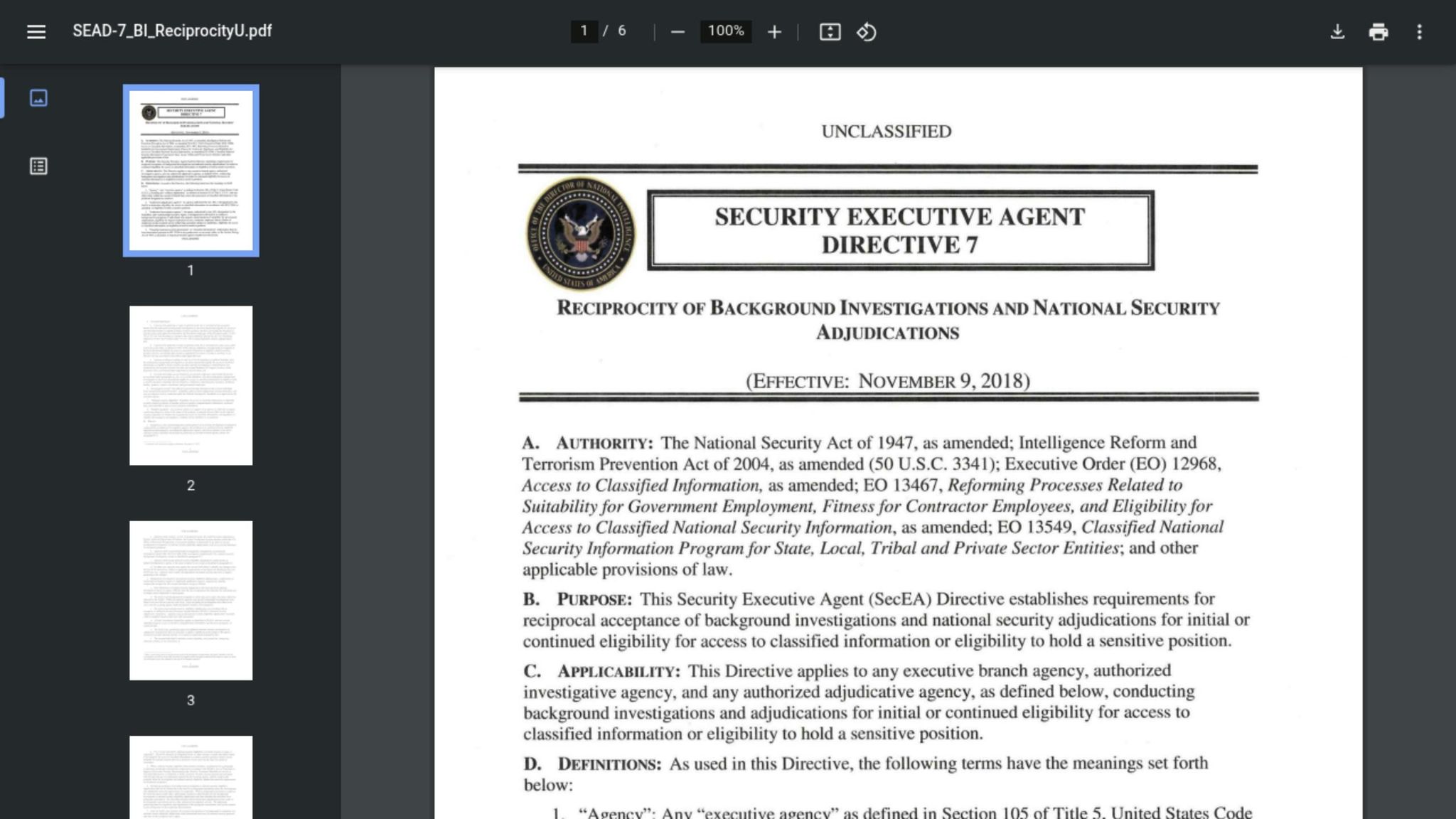
Security Executive Agent Directive 7 (SEAD 7) requires federal agencies to make reciprocity determinations within five business days. This policy aims to simplify clearance transfers and cut through the red tape that has long plagued the security clearance system. However, in practice, these transfers often stretch out to 30–180 days, depending on the agency. The delays leave critical roles vacant and contribute to a staggering $8.37 billion annual loss in national security resources. Here’s a closer look at how agencies navigate SEAD 7 exceptions to sidestep the five-day rule.
7 SEAD 7 Exceptions That Extend Processing Times
SEAD 7 outlines seven specific exceptions that allow agencies to go beyond the mandated five-day timeline. While these exceptions were meant to address rare or unusual cases, they’ve increasingly become routine workarounds for meeting deadlines.
One of the most frequently cited exceptions involves investigations older than seven years. Agencies often claim they cannot confirm the validity of these older investigations, even when the individual has maintained continuous clearance eligibility. This, combined with fragmented IT systems and missing waivers, leads to thousands of delayed transfers each year.
Other exceptions that cause additional delays include:
- Supplemental investigations
- Polygraph and medical evaluations
- Financial reviews
- Foreign influence assessments
- Technology access determinations
Each of these requirements can turn what should be a straightforward five-day process into a weeks-long ordeal.
Actual Processing Times: 30-180 Days by Agency
The reality of clearance transfer timelines varies widely across federal agencies. For instance, Intelligence Community agencies like the CIA and NSA typically take 30–90 days, while Department of Energy (DOE) transfers requiring Q clearance status can take 60–120 days due to added Human Reliability Program requirements.
On the other hand, most Department of Defense components process reciprocity within 1 to 30 days. However, specialized commands or certain contractor facilities may take 45 to 60 days for more complex cases.
Adding to the frustration, 83% of contractors report that agencies rarely provide updates during the reciprocity process. This lack of transparency leaves professionals in the dark about their cases, further highlighting the need for better communication and more efficient processes in clearance transfers.
sbb-itb-bf7aa6b
Why Polygraph Reciprocity Fails Between Agencies
Even if you’ve already passed a polygraph exam at one agency, many others won’t accept it. Instead, they require candidates to take a new test, often stretching job transitions by a frustrating 12–18 months. This rigid practice can derail career plans and create unnecessary hurdles. Agencies stick to their own internal policies, insisting on using their own examiners and procedures, even when other agencies have conducted equivalent tests.
FBI Polygraph Requirements: A Case in Point
The FBI is a prime example of how agency-specific policies complicate the process. The agency requires every new hire to pass its own polygraph exam, even if the candidate has already completed a full-scope polygraph elsewhere. This strict policy often leads to significant delays and even talent loss. Consider a cybersecurity analyst who has already cleared a full-scope polygraph at another agency. If they want to transition into an FBI contractor role, they must undergo yet another exam, despite their prior clearance. While the FBI argues this ensures adherence to its standards, the result is often redundant testing and wasted time.
The 12–18 Month Bottleneck
One of the biggest issues with repeated polygraph testing is the delay it causes. A lack of qualified examiners and scheduling backlogs means candidates often face wait times exceeding 18 months – far beyond the typical 90-day hiring window. To make matters worse, inconclusive results caused by factors like anxiety or fatigue can lead to additional rounds of testing, stretching the timeline even further.
“Polygraph wait times, follow-up tests, and extended investigations can add months or years to the overall hiring timeline” [4].
As a result, many professionals strive to maintain their counterintelligence or full-scope polygraph status as a way to stay competitive in the job market. Unfortunately, this advantage is often nullified when transferring to agencies that insist on conducting their own exams, no matter the candidate’s prior test history.
Fixing the issues with polygraph reciprocity is essential for speeding up clearance transfers and ensuring cybersecurity professionals can advance their careers without unnecessary roadblocks.
Reciprocity Myths That Destroy Job Opportunities
Many cleared professionals mistakenly believe that holding a Top Secret clearance guarantees acceptance across all federal agencies. The truth is, clearance requirements differ widely depending on the agency. Let’s tackle one of the most common myths surrounding clearance portability.
Myth: All Top Secret Clearances Work Everywhere
One of the biggest misconceptions is that a Top Secret clearance grants automatic access across all agencies. According to authoritative guidance[5], this isn’t the case. Security clearance standards vary between federal agencies – even at the Top Secret level. Beyond holding the clearance, individuals must also demonstrate a "need to know" specific classified information related to their job responsibilities before being granted access[5].
Each agency applies its own set of criteria when evaluating clearances. These include factors like allegiance to the U.S., foreign ties, financial responsibility, substance use, psychological history, criminal behavior, and IT practices[5]. Because of these differences, a clearance issued by one agency might not meet the standards of another.
Recognizing that clearances aren’t universally transferable can help professionals better navigate the unique adjudication processes of different agencies. This myth highlights the challenges inconsistent clearance policies create for career mobility. Additional myths, such as misunderstandings about automatic reciprocity and clearance expiration during job transfers, will be explored in the next section.
How to Prepare for Reciprocity Delays and Denials
Navigating reciprocity delays during job transitions can be a challenge. With 83% of contractors noting that agencies rarely provide status updates during the process, preparation is key. Taking proactive steps can help protect your career and ensure a smoother clearance transfer.
Essential Documents and Tracking Your Status
Before you start your job search, ensure that your clearance documentation is complete and up to date. Key documents to have on hand include:
- SF-86 submission dates
- Investigation completion letters
- Adjudication decisions from current and prior clearances
- Any polygraph completion certificates, including dates and administering agencies
This documentation becomes especially important for agencies like the FBI, which may require their own polygraph regardless of previous tests.
Pay close attention to investigation dates, as SEAD 7 may reject clearances with investigations older than seven years. Clearly differentiate between adjudication dates and investigation dates, particularly for Tier 5 (Top Secret) or Tier 3 (Secret) investigations, to avoid unnecessary denials.
Tracking your clearance status across different systems like DISS, Scattered Castles, and CVS is also vital. These systems often have technical inconsistencies, which could lead to false denials. To prevent this, request a DISS printout from your current Facility Security Officer (FSO) and confirm your Continuous Evaluation enrollment is active across all systems.
If your clearance was processed during the NBIS transition, verify that your records are complete. In cases where NBIS data is missing or incomplete, keep backup documentation to prove your clearance status to the receiving agency.
Appealing Reciprocity Denials
If your reciprocity request is denied, you have specific rights under SEAD 7, but timing and thorough documentation are essential. Most denials result from incomplete information rather than actual security concerns. The receiving agency’s FSO must provide written justification for the denial, citing SEAD 7 exceptions.
Act quickly if the denial is based on system errors, such as an out-of-scope status or missing investigation records. With 28 of 31 agencies (90.3%) reporting incomplete reciprocity information in their IT systems, it’s possible your clearance exists in one system but not in another.
Work with your current FSO to address documentation gaps. They can provide critical records like investigation reports, adjudication letters, and any waivers or conditions tied to your clearance. If the receiving agency’s FSO maintains the denial, escalate the issue to the agency’s Personnel Security Manager or equivalent authority. Keep detailed records of all communications and denial letters, as these will be crucial if you need to pursue a formal appeal.
Planning for Delays: Timeline and Backup Strategies
Given the potential for delays, realistic planning is essential to avoid financial strain. Although SEAD 7 mandates a five-business-day processing period, actual timelines often range from 30 to 180 days, depending on the agency. Intelligence Community (IC) agencies tend to take longer than Department of Defense (DoD) components, so consider this when planning your transition.
Start the reciprocity process 60-90 days before your intended start date. This allows time for agencies to process your request, even if they use SEAD 7 exceptions to extend the timeline. Submit all required documentation promptly, as delays on your end can reset the clock.
It’s also wise to have backup plans. If your primary job opportunity involves an IC agency transfer, consider maintaining options with DoD contractors, who can often process reciprocity much faster. This strategy provides financial stability and gives you leverage if delays jeopardize your main opportunity.
Financial preparation is critical. Reciprocity delays can leave professionals in limbo for months, contributing to the $8.37 billion annual cost of reciprocity failures in lost contractor productivity. To safeguard yourself, maintain an emergency fund covering 3-6 months of expenses specifically for such delays.
Lastly, negotiate flexible start dates with potential employers. Many cleared employers understand reciprocity challenges and may hold positions for qualified candidates who are proactive and well-prepared. That said, employer patience has its limits, so manage expectations and stay realistic about how long they might wait.
Conclusion: Protecting Your Career from Reciprocity Failures
Clearance reciprocity failures cost the economy a staggering $8.37 billion each year, disrupting careers and draining productivity. While systemic issues across federal agencies remain a challenge, understanding these hurdles and planning ahead can help you navigate the obstacles more effectively.
More than half of federal agencies reject clearances issued by others, impacting 90,000 contractor labor-years annually. These numbers represent real people – professionals who miss out on job opportunities, face financial uncertainty, or experience stalled career progress. Adding to the frustration is a lack of transparency, leaving many feeling powerless to steer their career paths. This underscores the importance of initiatives like Trusted Workforce 2.0, which aim to modernize and simplify the clearance process.
There’s hope, though, as emerging digital tools show promise for more efficient clearance transfers. For example, the DoD’s reduction of transfer times from 65 days to just one day demonstrates what’s possible when agencies prioritize efficiency. Programs like Trusted Workforce 2.0, with features like automated record checks and real-time status updates, could bring long-term improvements. Professionals should take advantage of these advancements by keeping their clearance information up to date and utilizing electronic document submission tools[1]. Additionally, ideas like a Security Clearance Ready Reserve, which would create a pool of pre-vetted individuals, could minimize redundant investigations in the future[3].
Preparation remains critical. Despite policies like SEAD 7, which mandates five-business-day determinations, actual processing times often range from 30 to 180 days depending on the agency. While continuous vetting and digital record-keeping are making headway, legacy systems and agency-specific requirements still create delays[2]. To minimize these issues, document everything, monitor your clearance status regularly, and familiarize yourself with the appeals process[1].
Misconceptions about clearance processes – such as assuming automatic reciprocity, universal acceptance of Top Secret clearances, or that clearances never expire during transfers – can lead to missteps. The suggested 60–90 day transition timeline isn’t overcautious; it’s a realistic plan for navigating a system still catching up with much-needed reforms and technological upgrades[2].
Ultimately, safeguarding your career from reciprocity failures requires treating clearance transfers as strategic moves. Success comes from thorough preparation, maintaining detailed records, building strong relationships with Facility Security Officers, and always having contingency plans. While you can’t control agency policies or outdated systems, you can control how well you prepare and approach your career transitions strategically.
FAQs
Why don’t all federal agencies accept security clearances from others, even if they’re supposed to be equivalent?
Some federal agencies are reluctant to accept security clearances from others, largely due to trust issues, policy differences, and outdated systems. A recent report revealed that 55% of agencies don’t fully trust the vetting processes of their counterparts. This lack of trust often stems from differences in standards, varying levels of risk tolerance, or procedural inconsistencies.
Another major hurdle is system incompatibility. Over 90% of agencies report that their IT systems lack complete reciprocity information, which creates bottlenecks, redundant investigations, and, in some cases, outright rejection of valid clearances. For instance, agencies like the FBI often require additional steps, such as their own polygraph tests, even when a clearance is technically valid.
These issues underscore the pressing need for improved inter-agency collaboration, system upgrades, and strict adherence to reciprocity mandates such as SEAD 7. While SEAD 7 aims to simplify clearance transfers, loopholes and delays frequently undermine its effectiveness.
How can security-cleared professionals minimize delays and avoid denials during clearance reciprocity transfers?
To keep clearance reciprocity transfers on track and avoid setbacks, double-check that all your paperwork – especially the SF-86 form – is filled out accurately and reflects your current information. It’s also a good idea to gather supporting materials, like character references or financial records, to address any potential concerns that might arise.
Stay ahead of the process by responding quickly to any agency requests for additional details. Take time to understand the specific reporting rules for the agency you’re transferring to, as requirements can vary.
If your transfer is denied, review the reasons carefully. Collect evidence to address the issues raised and consider filing an appeal through the proper channels. To minimize risks, start preparing for your transfer 60–90 days in advance and maintain open communication with your security officer throughout the process.
Why does the Department of Defense process clearance transfers faster than the Intelligence Community?
The Department of Defense (DoD) handles clearance transfers much faster than the Intelligence Community (IC), and it all comes down to differences in their processes, technology, and security protocols. The DoD has made significant strides in streamlining its procedures, leveraging tools like the Defense Information System for Security (DISS). Thanks to these improvements and automation efforts, transfer times have dropped dramatically – from an average of 65 days to as little as 1 day.
On the other hand, the IC typically takes 30 to 90 days to complete transfers. This longer timeline is due to stricter adjudication standards, additional investigative steps, and unique agency requirements, such as mandatory polygraph tests. While these extra measures enhance security, they also add considerable time to the process, making it slower compared to the DoD’s more efficient system.
Related Blog Posts
- Security Clearance Interview: What to Expect
- Why Your Polygraph Increases Salary by $40K – The Truth About Pay Premiums
- CIO-SP3 Cybersecurity Positions vs DISA Encore III – Which Vehicle Drives Your Career?
- Upgrade Secret to Top Secret Clearance – Is the Risk Worth the Reward?
Leave a Reply