

Preparing for a classified program interview is challenging because you can’t research or discuss specific mission details. Instead, the focus is on showcasing your skills, judgment, and professionalism within the constraints of confidentiality. Here’s how to stand out:
- Highlight transferable skills: Focus on areas like network security, incident response, risk management, and certifications (e.g., CISSP, Security+).
- Demonstrate discretion: Show your ability to handle sensitive information without breaching security protocols.
- Use the STAR method: Structure answers to scenario-based questions clearly – Situation, Task, Action, Result.
- Know the security clearance process: Be ready to discuss your SF-86 and adhere to strict integrity and honesty standards.
- Leverage industry frameworks: Reference standards like the NIST Cybersecurity Framework to demonstrate your expertise.
Employers are looking for candidates who can navigate high-stakes environments while respecting confidentiality. Focus on your skills, professionalism, and preparation to excel.
How to Prepare for Security Clearance Interview | Federal Background Check | Get a Federal Job
Understanding the Classified Interview Environment
Classified interviews operate under a unique set of rules, distinct from those of traditional corporate interviews. These aren’t arbitrary hurdles – they’re deliberate security protocols designed to safeguard national interests while evaluating your ability to function within the strict parameters of classified work. This framework helps explain why mission details are restricted and how you should approach the process.
Why Mission Details Are Restricted
Programs labeled Confidential, Secret, or Top Secret are designed to keep mission details secure, ensuring national interests remain protected [2].
This limitation isn’t just about security; it’s also a way to test your ability to handle uncertainty and solve problems without relying on extensive external information. Interviewers are looking for candidates who can adapt and demonstrate competence even when details are sparse.
Additionally, this environment places a premium on your commitment to staying informed. Whether it’s through certifications, professional development, or industry publications, you’re expected to keep your skills sharp and relevant [1].
Another key aspect is your ability to remain calm and composed under pressure. Classified work often involves unexpected challenges, and interviewers want to see how you manage obstacles while maintaining professionalism and quick decision-making [1].
Professional Standards for Cleared Interviews
Beyond the restrictions on information, classified interviews are built to assess your professional integrity and trustworthiness. These are not just technical evaluations – they’re comprehensive assessments of your character and reliability.
Candidates are held to exceptionally high standards, requiring unwavering loyalty, integrity, and sound judgment [3][4]. For roles involving national security, loyalty to the United States is non-negotiable [3][4]. Interviewers will evaluate whether you have conflicting allegiances or vulnerabilities that could lead to security risks, such as susceptibility to blackmail [4].
You’ll also be assessed on your adherence to strict regulations for handling and protecting sensitive information [4]. This is a critical part of determining whether you can be trusted with classified materials.
The process operates on a key principle: any doubts about your eligibility for access to classified information must be resolved in favor of national security [3]. This means your responses need to consistently reflect stability, dependability, and honesty [3][4].
Your background will be closely scrutinized, particularly through the lens of the 13 Adjudicative Criteria outlined in SEAD 4. These criteria include areas like financial responsibility, criminal history, foreign influence, alcohol use, and personal behavior [4]. However, factors like race, religion, gender, disability, or sexual orientation are explicitly excluded from consideration [3].
Expect discussions about your SF-86, where details from your personal and professional history will be verified [3][4]. Consistency and transparency are critical, as discrepancies can raise concerns about your reliability [3][4].
Ultimately, the interview is part of a larger process to determine your security clearance eligibility. It also evaluates your ability to collaborate effectively with diverse teams and adapt your communication style to suit the demands of a classified environment [1].
Highlighting Transferable Skills and Core Competencies
When working in classified roles, your transferable skills and core competencies become your most valuable assets – especially when mission details are limited. These skills not only showcase your technical expertise but also reflect the discipline and precision required for sensitive work. Let’s explore some of the key cybersecurity skills and certifications that can set you apart in these roles.
Key Cybersecurity Skills in Demand
Network security expertise is a must-have. Highlight your ability to manage firewalls, intrusion detection systems, and network monitoring tools. These skills demonstrate your capability to protect classified systems from unauthorized access and potential threats.
Incident response capabilities are equally critical. Your experience with frameworks like NIST or SANS shows that you can handle security events with a methodical and effective approach – an essential quality in high-stakes environments.
Risk management and assessment skills are vital for classified work, where decisions often carry significant consequences. Show how you’ve conducted threat evaluations, implemented mitigation strategies, and applied security controls. These examples illustrate your strategic thinking and ability to safeguard sensitive information.
Vulnerability management reflects a proactive approach to security. Discuss your hands-on experience with vulnerability scanners, patch management, and security testing. These skills demonstrate your readiness to maintain a strong security posture, even in classified systems.
Cloud security expertise is becoming increasingly relevant. Whether it’s working with frameworks or securing containerized environments, your cloud security knowledge prepares you to handle the complexities of classified cloud roles.
Presenting Your Certifications
Certifications validate your technical skills and commitment to cybersecurity. However, instead of simply listing them, focus on their practical applications and how they’ve shaped your professional expertise.
- Security+: This foundational certification highlights your grasp of core security principles and your ability to implement them effectively.
- CISSP: One of the most respected certifications in the field, CISSP demonstrates your understanding of access controls, security architecture, and risk management. Its emphasis on ethics and professional responsibility also aligns with the integrity required for classified work.
- CISM and CISA: These certifications showcase your management and auditing skills, making them ideal for leadership roles in classified environments.
- Cloud-specific certifications: Credentials like AWS Certified Security Specialty or Azure Security Engineer Associate prove your ability to secure modern infrastructure, a growing need in government agencies adopting cloud technologies.
- Vendor-specific certifications: Certifications from companies like Cisco, Palo Alto Networks, or Splunk highlight your hands-on expertise with widely used security tools in government settings.
When discussing certifications, provide examples of how they’ve enhanced your work. For instance, explain how CISSP knowledge helped you design a secure architecture or how Security+ enabled you to meet Department of Defense (DoD) security requirements.
Demonstrating Professional Traits
While technical skills and certifications are essential, your professional traits often reveal your readiness to thrive in classified environments.
- Problem-solving abilities: Share examples where you resolved complex security issues with limited information. This mirrors the challenges often faced in classified work.
- Adaptability: Highlight your ability to adjust to new technologies, evolving procedures, or unexpected challenges – qualities that are crucial in dynamic classified programs.
- Attention to detail: Emphasize your experience with precise documentation, configuration management, or thorough security reviews. These examples underscore your commitment to accuracy and thoroughness.
- Collaboration skills: Classified roles often require teamwork across diverse groups. Provide examples of how you’ve worked effectively with both technical teams and management to achieve shared goals.
- Continuous learning: Show your dedication to staying current with emerging threats and technologies. This is especially important in classified work, where maintaining expertise is critical even when you can’t discuss specifics.
- Communication skills: Demonstrate your ability to explain technical concepts to non-technical audiences, brief senior officials, or document processes clearly for future use.
Finally, your commitment to security protocols is a cornerstone of classified work. Share examples of how you’ve consistently adhered to security procedures, even when it required extra effort. This reinforces your reliability and trustworthiness in handling sensitive information.
Handling Vague or Restricted Questions
Interviews for classified programs often include scenario-based questions aimed at gauging how you approach problem-solving in uncertain situations. Since specific mission details might not be shared, these questions test your ability to think critically and tackle complex challenges. They provide a structured way to evaluate your thought process and adaptability when faced with hypothetical scenarios.
Answering Hypothetical or Scenario-Based Questions
One effective way to tackle these types of questions is by using the STAR method (Situation, Task, Action, Result) [5]. This approach helps you structure your answer by breaking it down into four clear parts: the context of the situation, the task you needed to complete, the actions you took, and the results you achieved.
When responding, emphasize your analytical thinking and decision-making process. This not only showcases your ability to handle tough scenarios but also reflects your preparedness for working in high-stakes, controlled environments.
sbb-itb-bf7aa6b
Using Industry Knowledge and Cleared Community Resources
When specific mission details are off-limits, leaning on industry standards and community best practices can be an effective way to prepare. This approach shows employers that you have a solid grasp of the cybersecurity field and can confidently apply established frameworks in classified environments.
Industry Frameworks as a Foundation
The NIST Cybersecurity Framework is a key resource for preparing for interviews tied to classified programs. It provides a roadmap for managing cybersecurity risks through five core functions: Identify, Protect, Detect, Respond, and Recover [6]. In interviews, you can highlight your technical expertise by explaining how you’ve used these principles in the past. For example:
- Identifying critical assets and vulnerabilities
- Implementing robust protective measures
- Establishing reliable detection systems
- Developing actionable incident response plans
- Preparing recovery strategies for post-incident scenarios
Even when mission details are classified, framing your experience within these functions demonstrates a methodical and professional approach to tackling security challenges. Additionally, cleared professionals align their practices with strict community standards that emphasize ethical responsibility.
Cleared Community Standards
Working in classified environments requires adherence to unique ethical and professional guidelines. These include principles like compartmentalization and the "need-to-know" standard, which ensure sensitive information is accessed only by those directly involved. Showing familiarity with these standards signals your readiness to handle the elevated responsibilities that classified roles demand.
Leveraging Cleared Cyber Security Jobs Resources
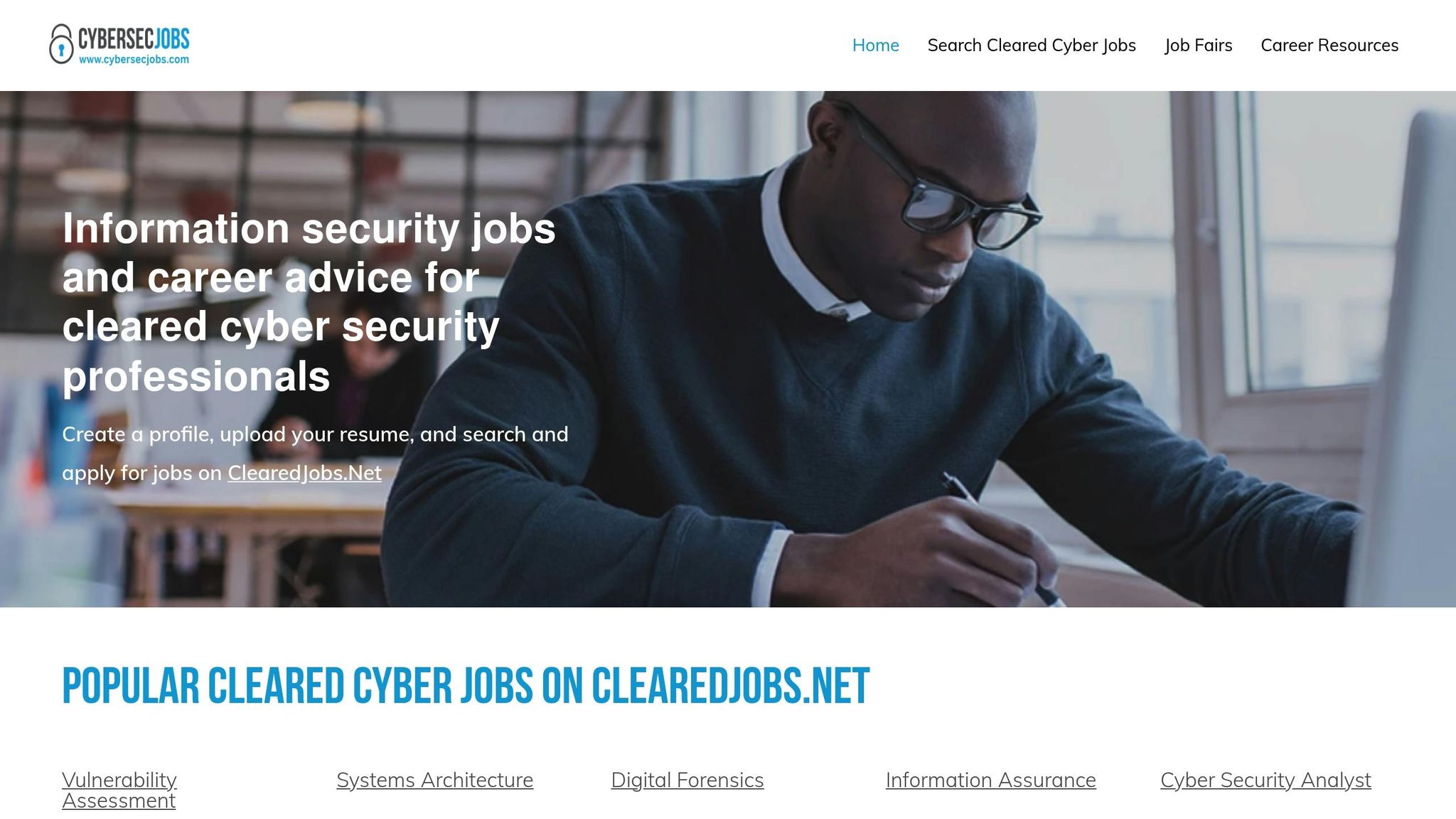
Beyond frameworks and ethical guidelines, platforms like Cleared Cyber Security Jobs offer practical tools to help you stand out. Their resources include:
- Resume enhancement tips: Highlight your security clearances and certifications (e.g., CISSP, CISM, CompTIA Security+) effectively.
- Interview coaching: Tailored advice for navigating interviews without access to mission-specific details.
- Job alerts and recruiter communication: Stay informed about opportunities designed for cleared professionals and maintain timely, professional interactions with recruiters.
Using these tools, you can craft a polished resume, keep your profile updated in the cleared candidate database, and ensure your qualifications are front and center. These steps not only optimize your visibility to employers but also prepare you for the unique challenges of classified program interviews [7].
Pre-Interview Preparation Steps
When preparing for an interview in a classified work environment, focus on the elements you can control. Organize your materials and present yourself as a reliable professional who understands the unique demands of these roles.
Pre-Interview Checklist
Start by reviewing your SF-86 (or its equivalent). Refresh your memory on details like employment history, addresses, incidents, foreign travel, and contacts. Be ready to discuss these items thoroughly, and bring a copy of your SF-86 for reference during clearance-related discussions [8][10].
Prepare essential documents, including a photo ID, financial records, legal dispositions, and lists of foreign contacts or travel. Keeping these materials organized and easily accessible reflects readiness and professionalism [10].
Practice answering potential interview questions, particularly in areas that may raise concerns, such as financial issues, legal incidents (e.g., DUIs), foreign relations, or employment gaps. A mock interview with a knowledgeable peer can help refine your responses. Keep in mind that investigators often come to the table with prior information from records and references, so being truthful is critical [9][10].
Above all, commit to honesty and consistency. Answer questions fully and truthfully, avoiding any attempt to conceal or downplay information. If you realize there’s an error or omission on your SF-86, address it proactively during the interview. Transparency and professionalism are essential throughout the security clearance process [8][10].
Once you’ve organized your documentation and prepared your responses, tailor your approach to meet the expectations of cleared employers.
Tailoring Your Approach for Cleared Employers
Your security clearance is a major asset and can set you apart during the hiring process. To make the most of it, highlight your clearance strategically on your resume. Include it in the header along with your name and contact information [11].
Clearly indicate whether your clearance is current or inactive, and specify the dates it was active. Mention the clearance level – such as Top Secret, Secret, or Confidential – and, if applicable, emphasize the one that’s most relevant to the job. Always provide accurate information, as misrepresenting your clearance can lead to serious repercussions [11].
In interviews, focus on showcasing your understanding of compartmentalization and the "need-to-know" principles. Avoid discussing specific departments, locations, job titles, or supervisors tied to classified work [11].
Adapt your approach to align with the specific job and employer. Research the role’s requirements and ensure your qualifications match the clearance level needed. When describing your experience, provide enough detail to highlight your accomplishments and the value of your work, but steer clear of mentioning classified information. Let your clearance underscore qualities like trustworthiness, attention to detail, and your ability to handle sensitive tasks [11][12].
While your clearance is important, remember it’s only one part of your overall profile. Balance it with your technical skills, certifications, and professional achievements. Use resources like Cleared Cyber Security Jobs to keep your profile updated, ensuring that your qualifications remain prominent for potential employers in the cleared community.
Conclusion: Approaching Classified Program Interviews with Confidence
Interviewing for classified programs without access to specific mission details can feel challenging, but success lies in preparation, professionalism, and showcasing your transferable skills. Even without detailed mission knowledge, a well-prepared and focused approach allows you to tackle these interviews with confidence.
Preparation is key. Start by researching the organization’s broader goals, aligning your skills with the job requirements, and practicing how to articulate your experiences using methods like the STAR framework. This not only helps you feel more confident but also equips you to answer questions effectively. Remember, your non-verbal cues – like maintaining eye contact and presenting yourself with confidence – can leave a lasting impression.
In classified environments, professionalism is non-negotiable. Demonstrating that you can discuss your experience without crossing any security boundaries shows you’re ready for sensitive work. Your security clearance is more than just a credential; it’s evidence of your trustworthiness and ability to handle classified responsibilities. When combined with your technical expertise, certifications, and career milestones, it positions you as a strong candidate, even if specific classified details can’t be discussed. Balancing your technical skills with a strong sense of integrity is what truly sets you apart.
Being part of the cleared community also opens doors to resources tailored for security-cleared professionals. Platforms like Cleared Cyber Security Jobs provide exclusive job postings, industry insights, and networking opportunities that can help you advance your career.
When you step into a classified program interview, trust in your preparation, maintain a professional demeanor, and let your clearance and achievements speak for themselves. Interviewers are aware of the limitations surrounding classified details – they’re looking for candidates who can communicate effectively while respecting those boundaries. With preparation and confidence, you’ll be ready to showcase your value.
FAQs
How can I prepare for a classified program interview when I don’t have access to mission details?
Preparing for a classified program interview when you don’t have details about the mission can feel challenging, but it’s all about focusing on what you bring to the table: your skills, certifications, and relevant experience. Make sure to emphasize your ability to thrive in high-security, sensitive environments, and highlight traits like problem-solving, adaptability, and dependability.
When preparing, think about how your background aligns with the role. Use specific examples to showcase your expertise and professionalism. Be ready to discuss your technical knowledge, past achievements, and how you’ve upheld strict security protocols in previous roles. It’s also a great idea to prepare thoughtful questions about the team and responsibilities – this shows you’re engaged and genuinely interested, even without knowing all the mission details.
In the interview, let your confidence shine through your body language. Stay composed, approachable, and focused on demonstrating how you’re ready to contribute effectively, even with limited information about the mission itself.
What skills and certifications are most important for classified program roles?
For roles within classified programs, transferable skills like effective communication, problem-solving, critical thinking, and flexibility are highly prized. These abilities enable professionals to tackle the unique challenges of working in restricted and intricate environments with assurance.
When it comes to certifications, credentials like CISSP, Security+, CISA, and CISM are especially valued. These certifications highlight expertise in areas such as security management, auditing, and technical controls – key competencies for making meaningful contributions to classified cybersecurity initiatives in the U.S.
How can I effectively approach scenario-based questions during a classified program interview to showcase my problem-solving skills?
When tackling scenario-based questions during a classified program interview, it’s important to stay composed and methodical. Walk the interviewer through your thought process, step by step. Share how you break down the problem, evaluate potential risks, and craft logical solutions.
A structured framework like the STAR method – Situation, Task, Action, Result – can be a game-changer here. It allows you to clearly outline your approach to problem-solving, highlighting your ability to think critically and navigate complex situations, even when specific mission details are limited. Use this opportunity to emphasize your professional skills and relevant experiences that align closely with the role.
Leave a Reply