

Cleared network security jobs are in high demand, offering lucrative salaries and career growth for professionals with security clearances. Here’s what you need to know:
- Job Demand: By 2026, 514,000 cybersecurity jobs are projected, with 26% remaining unfilled. Security clearances significantly boost employability.
- Salary Boosts: Security clearances can increase pay by 20–40%. Average salaries for cleared positions start at $129,443, with additional earnings of $45,000–$65,000 annually for Full Scope Polygraph clearances.
- Career Levels: Roles range from entry-level SOC Analysts ($65,000–$100,000) to senior-level CISOs ($200,000–$400,000+).
- Certifications: Must-have certifications include CompTIA Security+ (entry-level), CISSP (mid-to-senior level), and CCNA for networking roles.
- Clearance Levels: Secret, Top Secret, and TS/SCI clearances are essential. Higher clearances mean higher pay but require thorough background checks.
- Skills in Demand: Expertise in cloud security, Zero Trust Architecture, AI/ML security, and programming languages like Python and SQL is highly valued.
Key takeaway: A career in cleared network security offers high salaries, job security, and growth potential. Focus on certifications, gaining experience, and leveraging your security clearance to maximize opportunities.
How to get a Security Clearance for I.T. Jobs 🇺🇸 GovTech 2024
sbb-itb-bf7aa6b
Cleared Network Security Job Types
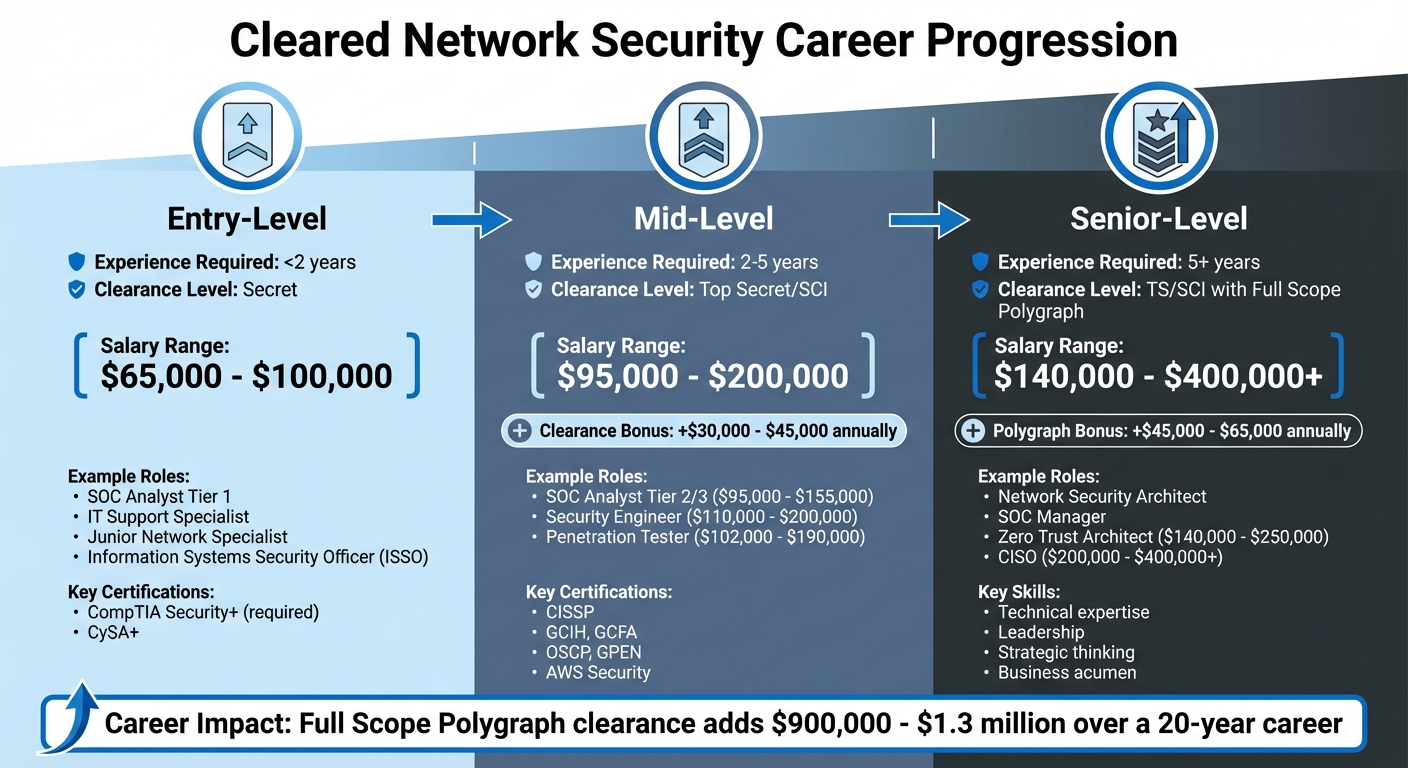
Cleared Network Security Career Levels: Roles, Salaries, and Certifications Comparison
Cleared network security careers are divided into three tiers, each with distinct technical requirements and salary expectations. As you move from entry-level roles to senior positions, your expertise – and the value of your security clearance – grows significantly.
Entry-Level Positions
Entry-level cleared roles focus on monitoring and escalating security incidents. A common starting point is the SOC Analyst Tier 1, where responsibilities include tracking security alerts, investigating straightforward issues, and escalating more complex threats to senior staff. Other entry-level roles include IT Support Specialist, Junior Network Specialist, and Information Systems Security Officer (ISSO), which involves applying Risk Management Framework (RMF) controls.
These positions typically require less than two years of experience and a Secret clearance. Many contractors are willing to sponsor promising candidates for their clearance. Salaries for cleared SOC Analysts range from $65,000 to $100,000 annually [1]. A CompTIA Security+ certification is the standard requirement, especially for Department of Defense (DoD) 8140 positions starting February 15, 2026.
Veterans with cyber-related military experience, such as MOS 35N or 1B4X1, often skip entry-level roles entirely. Thanks to their technical training and existing clearances, they can transition directly into mid-level positions [1].
As experience grows, professionals can take on roles that focus on proactive security measures.
Mid-Level Positions
Mid-level positions, requiring 2 to 5 years of experience, shift the focus from reactive monitoring to proactive security measures. For example, SOC Analyst Tier 2/3 roles involve threat hunting, investigating advanced incidents, and optimizing security tools. Security Engineers handle tasks like deploying security infrastructure, automating systems, and creating custom configurations. Meanwhile, Penetration Testers simulate attacks to uncover vulnerabilities before adversaries can exploit them.
Salaries for mid-level positions range from $95,000 to $200,000, with a Top Secret/SCI clearance adding an extra $30,000 to $45,000 annually [1]. Specializations like Zero Trust Architecture and Cloud Security often command even higher pay.
| Role Level | Position Example | Salary Range (Cleared) | Key Certifications |
|---|---|---|---|
| Entry-Level | SOC Analyst Tier 1 | $65,000 – $100,000 | Security+, CySA+ |
| Mid-Level | SOC Analyst Tier 2/3 | $95,000 – $155,000 | GCIH, GCFA |
| Mid-Level | Security Engineer | $110,000 – $200,000 | CISSP, AWS Security |
| Mid-Level | Penetration Tester | $102,000 – $190,000 | OSCP, GPEN |
As professionals advance, the focus shifts toward leadership and strategic oversight in senior roles.
Senior-Level Positions
Senior-level cleared roles require a blend of technical expertise, leadership skills, and strategic thinking. Network Security Architects design secure environments and draft enterprise-wide security policies. SOC Managers lead security teams, mentor junior staff, and communicate risks to executive leadership. At the top, Chief Information Security Officers (CISOs) oversee security strategies for entire agencies or major contractor programs.
These roles demand not only technical mastery but also business acumen and strong communication abilities. Cleared CISOs can earn between $200,000 and $400,000+, while Zero Trust Architects make $140,000 to $250,000 [1]. A Full Scope Polygraph clearance adds an additional $45,000 to $65,000 annually, which can amount to $900,000 to $1.3 million over a 20-year career [1].
While most senior positions require working within a SCIF (Sensitive Compartmented Information Facility), some governance and compliance roles offer hybrid work arrangements. The highest earners in this tier combine advanced clearances, expertise in emerging areas like AI/ML security, and the ability to communicate complex risks to business leaders [1].
Required Certifications for Cleared Network Security Professionals
As discussed earlier, meeting both clearance and technical qualifications is essential for professionals in this field. Certifications play a critical role in ensuring candidates meet these standards. In fact, specific certifications are mandatory under DoD directives 8570 and 8140 for certain Labor Category (LCAT) positions. Without the required certification, candidates simply aren’t eligible for these roles [2].
As one industry expert aptly puts it:
"No cert = you literally can’t sit in the seat, regardless of your skills." – CyberSecJobs Editorial [2]
Employers rely on certifications to align candidates with specific LCATs, which also influence the billing rates contractors can charge the government [2]. Having the right certification not only speeds up onboarding but also reduces training costs [5]. With around 26% of cybersecurity positions projected to remain unfilled by 2026, cleared candidates with certifications are in high demand and have a competitive edge [1].
CompTIA Security+
CompTIA Security+ is often considered the go-to certification for entry-level cleared positions. It’s a key requirement for meeting DoD 8140 standards [1][2]. The exam costs $404 and must be renewed every three years to remain valid for federal contracts [1][2][5]. Holding this certification can boost your annual salary by an estimated $5,000 to $10,000 [1][2]. For those new to cleared roles, Security+ is one of the most versatile certifications, meeting requirements for both IAT Level II and IAM Level I positions [4].
CISSP (Certified Information Systems Security Professional)
CISSP is widely regarded as the certification with the highest return on investment for cleared professionals [2]. It’s designed for those with management-level expertise and is a must-have for senior LCAT positions across most major defense contracts [2]. This certification qualifies professionals for roles such as IAT Level III, IAM Level II/III, and IASAE – positions that often require Top Secret or TS/SCI clearances [5]. The exam costs $749, but the potential salary increase of $15,000 to $25,000 makes it a worthwhile investment [1][2]. CISSP is often a requirement for management and high-level architecture roles [4][5]. To earn this certification, candidates need five years of paid work experience across two or more CISSP domains, though a relevant degree can reduce this requirement to four years [2].
Cisco Certified Network Associate (CCNA)
The CCNA certification is ideal for professionals looking to build foundational networking skills, particularly for hands-on technical roles involving Cisco-based infrastructure [3]. It qualifies candidates for IAT Level I and II positions, such as helpdesk or systems support roles [5]. For cleared professionals who manage routers, switches, and network security appliances, CCNA is especially valuable. This certification also pairs well with Security+, offering a combination of security and networking expertise that many roles demand [3][5].
These certifications are essential stepping stones for professionals aiming to advance into specialized or leadership roles within cleared network security positions.
Skills Employers Look for in Cleared Network Security Professionals
Employers prioritize both technical expertise and effective communication when hiring professionals to safeguard sensitive networks and collaborate with teams.
On the technical side, a strong command of network security controls is essential. This includes managing firewalls, IDS/IPS systems, and VPNs to prevent unauthorized access. Another critical skill is threat analysis, which involves researching adversaries and examining indicators of compromise. With incident response roles increasing by 100.89% in 2023 [7], expertise in areas like forensics, crisis management, and containment has become indispensable.
As cyber threats grow more advanced, securing cloud infrastructures has taken center stage. Professionals need to be skilled in securing cloud environments, managing access controls, and implementing encryption across platforms like AWS GovCloud and Microsoft Azure. Additionally, designing and deploying Zero Trust architectures is now a high-priority requirement. Familiarity with programming languages such as Python, SQL, C, and C++ is also crucial for detecting malicious activities and automating responses.
Expertise in AI and machine learning (ML) is another sought-after skill, as these technologies reshape the cybersecurity landscape. Employers value individuals who can effectively use AI tools, validate their outputs, and protect AI/ML systems from potential threats. As one industry expert aptly notes:
"AI is not a job thief – it’s a job transformer." – Wallarm
However, technical abilities alone don’t guarantee success. The ability to communicate risks clearly, conduct security training, and document findings sets top candidates apart. Professionals who combine technical know-how with strong interpersonal skills gain a competitive edge. These combined skills not only play a critical role in safeguarding national security but also open doors to leadership opportunities in government and defense sectors.
Security Clearance Levels and Requirements
Security clearances are a cornerstone of network security, determining the roles you can access and the sensitive information you may handle. The U.S. government categorizes clearances into three primary levels based on the potential harm unauthorized disclosure could cause to national security: Secret, Top Secret, and Top Secret with SCI (Sensitive Compartmented Information). Secret clearances protect information that could cause "serious damage", Top Secret clearances cover data that could lead to "exceptionally grave damage", and TS/SCI clearances allow compartmentalized access to highly sensitive information [6].
Most professionals start at the Secret level, which accounts for about 60% of all active security clearances [6]. The investigation process varies by level. Secret clearances take 1–6 months, with a Tier 3 investigation reviewing the past 7–10 years of your history. Top Secret clearances require 4–12 months and involve a more thorough Tier 5 investigation covering the last decade [6][12]. As of early 2026, efforts to reduce the investigation backlog have cut it by 65%, bringing it down to around 100,000 cases and speeding up processing times [9].
Clearances also come with financial benefits. Secret clearance holders often earn 5–10% more than their peers, while Top Secret clearance holders see a 10–15% premium. TS/SCI professionals command even higher premiums, ranging from 15–25% [6]. However, access to classified information isn’t automatic. Each mission or program requires a specific "need-to-know" determination [8][14].
Here’s a closer look at each clearance level, from requirements to salary impacts.
Secret Clearance
Secret clearance is the entry point for many roles in defense contracting and government IT, including systems analysts, IT administrators, and network support technicians. It protects information that could cause serious harm if disclosed [6]. The Tier 3 investigation examines your past 7–10 years, including employment history, residences, and personal conduct. Current federal targets aim to process these clearances in about 40 days [9][12].
Applicants must fill out the SF‑86 form, a detailed questionnaire covering addresses, foreign contacts, financial history, and any criminal records. Financial issues are the most common reason for clearance denials, so reviewing your credit report and resolving any problems beforehand is key [8][10]. Importantly, you can’t apply for a clearance on your own – you need sponsorship from a federal agency or a cleared contractor after receiving a conditional job offer [12].
As of 2026, the Trusted Workforce 2.0 initiative has replaced periodic reinvestigations with Continuous Vetting (CV). This system uses automated checks to monitor clearance holders. Over 3.8 million individuals are now enrolled, and they must self-report significant events like arrests, large debts, or new foreign contacts [9][10].
For those advancing to higher levels, additional scrutiny applies.
Top Secret Clearance
Top Secret clearance is required for higher-level positions like cybersecurity engineers, Information Systems Security Managers (ISSM), and vulnerability researchers [6]. The Tier 5 investigation is more rigorous, involving in-person interviews with neighbors, coworkers, and references to verify trustworthiness and character over the past 10 years [6][12]. Processing times average around 75 days but can stretch to 4–12 months for complex cases [6][9].
The cost of a Top Secret investigation is approximately $5,596, compared to $433 for Secret clearances. These fees are covered by government funds, not the individual or employer [8]. Adjudicators evaluate applicants using 13 guidelines, including allegiance to the U.S., financial responsibility, and personal conduct [11][12].
"The dominant theme for security clearances process in 2026 is implementation amidst unpredictability."
– Kevin James from Cybersecurity For Me [10]
Cybersecurity professionals should be mindful of their online presence, as adjudicators increasingly review activities like GitHub contributions or gaming community participation for signs of judgment and security awareness. Under the 2026 National Defense Authorization Act, departing Department of Defense personnel retain classified access eligibility for up to five years, up from the previous 24-month limit, making transitions between cleared roles smoother [9].
For roles demanding the highest level of compartmentalized access, TS/SCI clearance is the next step.
Top Secret/SCI Clearance
Sensitive Compartmented Information (SCI) isn’t a separate clearance level but an additional authorization attached to a Top Secret clearance [6][13]. It’s essential for Intelligence Community roles and work conducted in Sensitive Compartmented Information Facilities (SCIFs). Positions like cyber threat intelligence analysts, SIGINT analysts, and SCIF operations specialists require this level of access [6].
Getting SCI access involves holding a Top Secret clearance, undergoing indoctrination for specific compartments, and often completing a counterintelligence or full-scope polygraph exam. Processing times for SCI access can range from 6–18 months for new applicants [6][12]. Access to one compartment, such as SIGINT or HUMINT, doesn’t automatically grant access to others – each requires a separate need-to-know determination [13].
Working in SCIFs comes with strict rules. Personal electronic devices are banned, and discussing compartmented information outside secure facilities is prohibited. When listing your clearance on a resume, it’s wise to include your clearance level and polygraph status but avoid mentioning specific SCI compartments for security reasons [13]. TS/SCI holders with polygraph clearance enjoy a salary premium of 15–25% above market rates [6].
How to Get Hired for Cleared Network Security Jobs
Landing a cleared network security job isn’t just about having technical expertise or stacking up certifications. It’s about presenting yourself effectively in a highly specialized job market with strict security requirements. From crafting a resume that gets past automated filters to acing interviews and navigating exclusive job platforms, here’s how you can position yourself for success.
Writing Resumes for Cleared Positions
Start by listing your clearance level prominently at the top of your resume, alongside your name and contact details. Be specific with phrases like “Active Top Secret Clearance with SCI eligibility” or “Previously held Secret clearance; reinvestigation eligible.” This keeps potential employers informed without revealing sensitive information.
Follow OPSEC (Operational Security) guidelines carefully – leave out classified project names, sensitive numbers, or investigation details. Instead, use the STAR method (Situation, Task, Action, Result) to frame your accomplishments in a measurable and impactful way. As Ashley Jones, Editor at ClearedJobs.Net, puts it:
"Your security-cleared resume is not a biography or a mere list of qualifications. It’s an ad designed to help you land that coveted cleared job interview and move to the next stage of the hiring process."
Create a section dedicated to your technical skills, listing tools like firewalls, SIEM solutions, intrusion detection systems, and vulnerability assessment platforms. Highlight certifications like CompTIA Security+ and CISSP, and mention any certifications you’re currently pursuing, along with expected completion dates. Keep your resume concise – one or two pages max – and focus on recent, relevant experience. Avoid flashy designs or elements like graphics and columns, as these can confuse Applicant Tracking Systems (ATS). Tailor your resume to match the language in job descriptions. For example, if a listing mentions "penetration testing", use that exact term. Lastly, avoid sharing specific clearance levels on public platforms like LinkedIn to maintain security.
Preparing for Network Security Interviews
Interviews for cleared roles often dive deeper than standard technical questions. Be ready to discuss hands-on experiences, such as lab work, Capture the Flag (CTF) competitions, or personal projects that showcase your practical skills. Highlight your knowledge of emerging areas like cloud security, zero trust architecture, and AI/ML security, as these are increasingly sought after.
Use the STAR method to explain how you’ve solved problems or mitigated risks in past roles. Behavioral questions will likely explore how you handle sensitive information or maintain security protocols under pressure. Always stick to OPSEC – when discussing past projects, focus on the technical challenges and skills involved without revealing classified details. With a strong resume and well-prepared interview responses, you’ll be ready to tackle this competitive job market.
Using Cleared Cyber Security Jobs to Find Opportunities

Platforms like Cleared Cyber Security Jobs are tailored to the unique demands of this field. Start by completing your profile and using Boolean search logic to refine your job hunt. For example, enclose phrases like “network security” in quotes and use “OR” to broaden your search criteria. Set up automated Job Agents to save time and ensure you don’t miss new postings. If you hold a Top Secret clearance, include Secret-level positions in your search to expand your options. Searching by zip code and mileage radius can also reveal jobs listed under military base names instead of cities.
Take advantage of the platform’s cleared job fairs – whether in-person or virtual – to connect directly with employers. To protect your privacy, you can block specific companies from viewing your profile or choose to remain anonymous while showcasing your skills.
With over 514,000 cybersecurity job postings as of 2026 (a 12% increase from the previous year), and 26% of these roles still unfilled, the demand for cleared professionals is high. As one hiring manager advises:
"Stop collecting certifications. Start applying. I see too many people with 6 certs and no job applications. You need ONE good cert and 100 job applications, not six certs and 10 applications."
Network Security Career Path for Cleared Professionals
Starting a career in cleared network security often begins with foundational IT roles like help desk support, junior systems administration, or entry-level network engineering. These positions help you build the technical expertise needed to transition into specialized security roles. Typically, the career path progresses from Junior Network Security Engineer to Network Security Engineer, then Senior Engineer, followed by Network Security Manager, and eventually roles like Director of Network Security or CISO.
By the time you reach the five-year mark, your value in the field increases significantly. At this stage, you’re more than just another skilled engineer – you’ve gained institutional knowledge, program-specific "read-ins", and built relationships within the SCIF (Sensitive Compartmented Information Facility). These assets make you indispensable, as they’re nearly impossible for outside hires to replicate. This combination of clearance and expertise often leads to higher salaries and greater responsibilities.
Specializing in areas like Zero Trust Architecture, Cloud Security, or AI Security can further accelerate your career and boost your earning potential. For example, senior-level Zero Trust roles, driven by federal mandates, command salaries ranging from $185,000 to $250,000. Emerging AI Security roles add an additional $20,000 to $40,000 above standard positions. Additionally, holding a TS/SCI with a Full Scope Polygraph can increase your annual earnings by $45,000 to $65,000 compared to non-cleared roles.
Certifications aligned with DoD 8140 mandates are essential for career growth. Starting with CompTIA Security+ ensures entry-level compliance, while earning a CISSP around your fifth year maximizes your return on investment. If management is your goal, a CISM certification can add an extra $12,000 to $20,000 annually. Contract recompetes also offer opportunities for salary growth, as new prime contractors often pay 15–20% more to retain incumbent staff with active clearances rather than endure the lengthy clearance process for new hires.
Location can also influence your earnings. While Washington, DC offers the highest raw salaries (a TS/SCI averages $149,398 as of October 2025), cities like San Antonio and Huntsville provide better cost-adjusted salaries. For instance, a $118,000 salary in these areas can have the same purchasing power as over $170,000 in DC. Federal positions also offer competitive compensation – consider that a GS-14 salary of $163,104, when factoring in full benefits, can rival a $185,000 contractor salary due to pensions and matching contributions.
This structured career progression provides a solid foundation for the job search and interview strategies covered in the next section.
Conclusion
This guide has highlighted the essential skills, certifications, and strategies needed to thrive in the competitive world of cleared network security. The field offers career opportunities that go beyond what’s typically available in the commercial sector. With over 514,000 cybersecurity job postings projected for 2026 and around 26% of those positions expected to remain unfilled [1], the demand for security-cleared professionals is immense. Holding a security clearance can significantly boost your earnings, adding between $10,000 and $65,000 annually depending on the clearance level – translating to an increase of $900,000 to $1.3 million over a 20-year career.
These figures emphasize the importance of making smart career moves. Instead of chasing multiple certifications without direction, focus on obtaining one key certification that meets job requirements, like CompTIA Security+ (costing $404). As you gain experience, you can move on to advanced credentials such as CISSP, priced at $749. Specializing in areas like Zero Trust Architecture or AI/ML Security can also help maximize your earning potential.
To maintain your clearance, secure a new role within 24 months to avoid costly reinvestigation fees, which can range from $10,000 to $30,000. When negotiating job offers, aim for a 15–20% salary increase; employers often favor candidates who are ready to work without the delays of a clearance process.
Leverage platforms like Cleared Cyber Security Jobs to connect with employers actively looking for cleared professionals. These platforms also provide tools like salary data and career resources to streamline your job search. With federal cybersecurity spending projected to surpass $27 billion in 2026, now is the time to take advantage of these opportunities and build a rewarding career in cleared network security.
FAQs
Can I get a cleared network security job without already having a clearance?
Yes, it’s possible to apply for certain roles without a security clearance, but it depends on the job and the employer. Some companies, including government contractors, are willing to sponsor candidates for clearances, enabling you to apply even if you don’t have one. However, many positions require you to already hold a clearance due to the sensitive nature of the work involved. Another option is starting in roles that don’t require a clearance and pursuing one later to broaden your career opportunities.
Which certification should I get first for DoD 8140 cleared roles?
For roles covered under DoD 8140, the Security+ certification serves as an excellent entry point. As one of the approved baseline certifications under this directive, it’s widely respected within the industry. Earning this certification helps you meet initial qualifications while laying the groundwork for growth in cleared network security positions.
How do I list my clearance on a resume without breaking OPSEC?
When adding your security clearance to a resume, it’s important to balance showcasing your qualifications with protecting sensitive information. Clearly state your clearance level (e.g., Confidential, Secret, or Top Secret), but do not include sensitive details like clearance numbers or investigation dates.
A good practice is to position your clearance level prominently near the top of your resume, alongside your name and contact information. This makes it easy for recruiters to see your eligibility while ensuring operational security (OPSEC) is maintained.