

Your experience as a 0651 Cyber Network Operator in the Marine Corps positions you perfectly for high-paying civilian cybersecurity roles. With hands-on skills, knowledge of classified systems (like SIPR and JWICS), and an active security clearance, you’re already ahead of most civilian candidates. Here’s how to make the leap:
- Active Security Clearance: A Secret or TS/SCI clearance can boost your salary by $15,000–$30,000 annually and save employers thousands in processing costs.
- In-Demand Skills: Your expertise in network monitoring, encryption, and federal compliance frameworks aligns with roles like SOC Analyst, Systems Administrator, and Vulnerability Analyst.
- Certifications: Earning credentials like CompTIA Security+, CISSP, or AWS Solutions Architect can further increase your marketability.
- Salary Potential: Cleared cybersecurity professionals often earn $120,000–$160,000 annually, with senior roles exceeding $200,000.
- Programs to Leverage: Use resources like SkillBridge, VET TEC, and Onward to Opportunity to gain certifications and hands-on experience before separation.
This guide provides strategies to translate your military experience into civilian terms, craft a strong resume, and secure a lucrative career in the cleared cybersecurity field. Start now to maximize the value of your clearance and expertise.
What 0651 Cyber Network Operators Do and Why It Matters
Primary Duties of a 0651 Operator
As a 0651 Cyber Network Operator, your role was at the heart of the Marine Corps’ network infrastructure, ensuring that critical operations stayed online. You handled the installation, configuration, and maintenance of data network systems, whether they were stand-alone setups or client-server configurations. Your responsibilities also included managing MS Exchange, Defense Message Systems, and encryption devices on classified networks. On top of that, you operated helpdesks, monitored services around the clock, troubleshot system issues, upgraded hardware, and integrated multiple systems – all while working under intense mission-driven conditions [6].
Unlike training environments that rely on simulations, your experience defending live networks gave you a level of expertise that can’t be replicated in a classroom. Managing SIPR and NIPR networks, executing communications plans, and maintaining constant uptime sharpened your ability to perform under pressure – skills that are directly applicable to civilian cybersecurity roles [3].
These hands-on responsibilities provided the foundation for tackling high-pressure, real-world cybersecurity challenges in the civilian sector.
Skills That Transfer to Civilian Cybersecurity
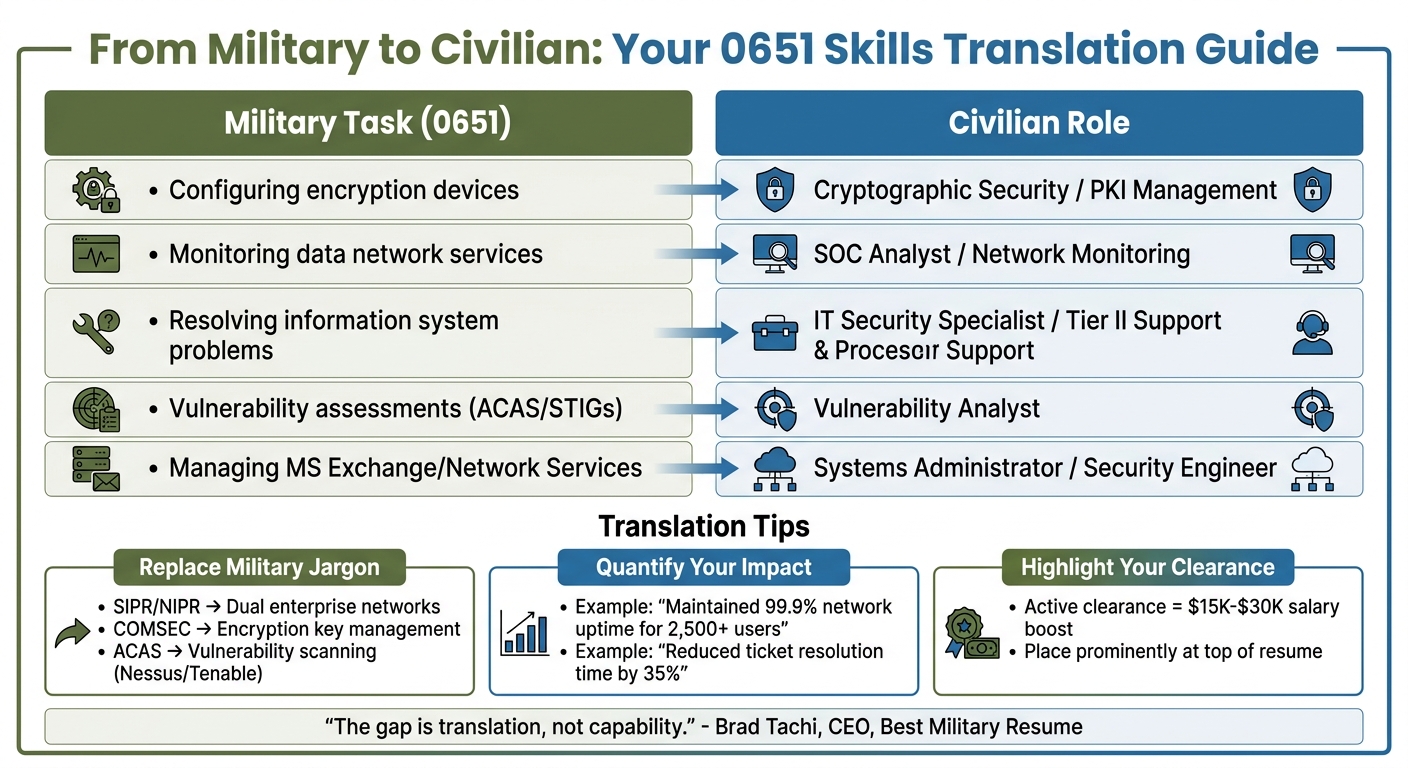
The technical skills you developed as a 0651 operator align perfectly with the demands of civilian cybersecurity roles. Your expertise in network monitoring, for example, makes you a strong candidate for positions like SOC Analyst, where responding to security alerts and investigating incidents is key. Similarly, your experience conducting vulnerability assessments using ACAS and performing STIG checks sets you up for roles as a Vulnerability Analyst. Managing MS Exchange and network services translates to opportunities as a Systems Administrator or Security Engineer [4].
| Military Task | Civilian Role |
|---|---|
| Configuring encryption devices | Cryptographic Security / PKI Management |
| Monitoring data network services | SOC Analyst / Network Monitoring |
| Resolving information system problems | IT Security Specialist / Tier II Support |
| Vulnerability assessments (ACAS/STIGs) | Vulnerability Analyst |
| Managing MS Exchange/Network Services | Systems Administrator / Security Engineer |
Your knowledge of federal compliance frameworks like NIST 800-53 and the Risk Management Framework (RMF) is highly sought after, particularly by defense contractors and government agencies [4]. Additionally, the watch-standing discipline you developed – marked by continuous vigilance, structured escalation processes, and unwavering attention to detail during long monitoring shifts – directly mirrors the expectations of civilian SOC environments. These aren’t skills you can pick up from a textbook; they come from hands-on, operational experience, making you a valuable asset in the cleared job market [4].
sbb-itb-bf7aa6b
How Military Cyber Experience Translates to Civilian Careers
Matching Your Military Experience to Civilian Jobs
0651 Cyber Network Operator Skills to Civilian Cybersecurity Roles Transition Guide
Civilian Jobs That Match 0651 Skills
If you have 0651 experience, you’re well-qualified for civilian roles like Network Administrator and Systems Engineer [7]. For those who served as senior operators or Cyber Network Chiefs, positions such as IT Operations Manager or Senior Systems Administrator are a great fit [7]. The key is translating your skills into language that resonates with civilian employers.
Military-specific terms like "NCOIC for S-6" or "BDE G-6 Shop" won’t make sense to automated resume systems. Instead, focus on clear, actionable descriptions: Action + Technical Detail + Business Impact [7]. For example, instead of military jargon, say: "Managed IT operations for a 3,000-user dual enterprise network." This phrasing highlights your responsibilities and scope in a way that civilian hiring managers can immediately understand.
Swap technical terms for their civilian equivalents. For instance:
- Replace "SIPR/NIPR" with "dual enterprise networks (classified/unclassified)."
- Use "cryptographic security" or "encryption key management" instead of "COMSEC" [7][4].
When discussing tools like ACAS, use terms like "vulnerability scanning with Tenable Nessus" rather than relying on acronyms. Also, highlight any commercial tools you’ve worked with – such as Splunk, Wireshark, Cisco routers and switches, or Active Directory – since these are the exact keywords recruiters are looking for [7][3].
"The gap is translation, not capability." – Brad Tachi, CEO, Best Military Resume [7]
Quantify your accomplishments wherever possible. For instance, instead of saying you "maintained networks", try: "Maintained 99.9% network uptime for 2,500+ users" or "Reduced ticket resolution time by 35% through process improvements" [7]. These numbers clearly show the value you bring to an organization.
Lastly, make sure to highlight your security clearance – this can be a major advantage in the job market.
How to Emphasize Your Security Clearance
Highlighting your security clearance is just as important as translating your technical achievements. An active clearance gives you a competitive edge, especially for roles in defense and government contracting, where employers value candidates who can start immediately without the need for sponsorship.
Make your clearance level easy to spot by placing it prominently at the top of your resume, either in the header or your professional summary [7]. Avoid hiding it in a "Certifications" section near the bottom, as recruiters typically skim resumes in under 10 seconds. If your clearance is inactive but still within the 24-month reactivation window, be sure to note this clearly – employers will understand it can be quickly reactivated [4].
Certifications That Support Your Transition
Key Certifications for Cleared Professionals
If you’re looking to step into civilian cybersecurity roles, certifications are a crucial part of the journey. Here’s a breakdown of some key ones to consider:
- CompTIA Security+: This is often the first step for those entering IT roles in federal or defense sectors. It meets DoD 8140/8570 IAT Level II requirements, making it almost mandatory for many positions. The exam costs around $404 and can be funded through Marine Corps COOL while you’re still on active duty [2][9].
- CompTIA CySA+: Perfect for aspiring Security Operations Center (SOC) analysts, this certification emphasizes threat detection and incident response. It typically costs between $392 and $400 [2].
- CISSP (Certified Information Systems Security Professional): This is the go-to certification for senior and management-level cybersecurity roles. CISSP-certified professionals often earn median salaries exceeding $120,000, with many senior positions offering between $130,000 and $160,000 [10]. The exam costs about $749, and your military service may count toward the required five years of experience [3].
- Cisco CCNA: Ideal for those eyeing network administration roles, this certification lays the groundwork for more advanced networking credentials [9].
- CEH (Certified Ethical Hacker) and OSCP (Offensive Security Certified Professional): If offensive security interests you, these are excellent options. CEH, priced between $950 and $1,199, is a multiple-choice exam suitable for entry-level roles, while OSCP, starting at $1,599 for the course and exam bundle, is a highly regarded hands-on exam that tests practical skills [2].
- Cloud Certifications: As more organizations move to the cloud, credentials like AWS Solutions Architect and Azure Security Engineer are increasingly valuable. The AWS exam costs around $300 and demonstrates your expertise in cloud infrastructure [9].
"One of our Army Signal NCOs went from E-6 to a $115K SOC analyst role in eight months. Security+ got him in the door. CySA+ got him the offer over other candidates. The clearance sealed it." – Brad Tachi, Navy Veteran & BMR Founder [2]
Focusing on earning one high-impact certification can provide a strong foundation for your transition into civilian cybersecurity roles.
How to Prepare for Certification Exams
To maximize your success, start planning your certification journey 12 to 18 months before your separation date [9]. Here’s a general guide for study timelines:
- Security+: 4–8 weeks
- CySA+ and CEH: 6–10 weeks
- CISSP: 8–16 weeks [2]
Take advantage of programs like VET TEC, which covers tuition for cybersecurity bootcamps and provides housing stipends without affecting your GI Bill benefits [9]. Another great option is Onward to Opportunity (O2O), a program through Syracuse University that offers free training and exam vouchers for certifications like CompTIA, Cisco, and AWS [9]. During your last 180 days of service, consider applying for DoD SkillBridge, which allows you to attend boot camps at no cost while still receiving your military pay [9].
For additional preparation, explore free resources like Professor Messer’s video courses for CompTIA exams and hands-on labs from platforms like TryHackMe and CyberDefenders [2]. The VA also reimburses up to $2,000 annually for certification exam fees under the GI Bill, and CompTIA provides military discounts on exam vouchers [9].
Once you’ve earned your certifications, the next step is crafting a resume that showcases your enhanced skills and qualifications.
Creating Your Resume and Job Search Plan
Writing a Resume for Civilian Employers
When transitioning from the military to a civilian career, it’s crucial to translate your military roles into terms that resonate with civilian employers. For example, instead of listing "0651 Cyber Network Operator", use "Network Administrator." Similarly, "0689 Cyber Network Chief" can be rephrased as "IT Operations Manager." This approach ensures that hiring managers, who typically spend only about six seconds scanning a resume, can quickly grasp your qualifications.
Highlight your active security clearance prominently at the top of your resume. Whether it’s a Secret or TS/SCI clearance, this detail not only makes you more attractive to employers but can also boost your salary by $15,000 to $30,000. Employers value this because it saves them the time and cost of sponsoring a new clearance.
Focus on quantifying your achievements. For instance, instead of saying "managed network operations", you could write "maintained 99.7% uptime for a 2,500-user network" or "reduced security vulnerabilities by 22% by implementing automated scanning protocols." Use the CAR method (Challenge, Action, Result) to structure your bullet points. This format clearly demonstrates the value you’ve brought to previous roles. Additionally, replace military-specific jargon with civilian-friendly terms. For example:
- "COMSEC" becomes "encryption key management"
- "NCOIC" becomes "Operations Supervisor"
- "ACAS" becomes "vulnerability scanning (Nessus/Tenable)"
"Military cyber professionals have something that most civilian cybersecurity candidates don’t: real-world operational experience defending networks against actual threats, not just simulated ones." – Best Military Resume
Tailor your resume to match the language used in job postings. For example, if a job description mentions "SIEM administration", make sure that exact phrase appears in your resume to improve its chances of passing through Applicant Tracking Systems (ATS). Limit your resume to one or two pages, use a "Month Year" format for employment dates (e.g., March 2018 to June 2022), and include a technical skills section listing tools like Splunk, Wireshark, Nessus, Cisco routers, and NIST frameworks.
Once your resume is polished, you can focus on targeting job opportunities that align with your clearance and skills.
Finding Jobs on Cleared Cyber Security Jobs
Cleared Cyber Security Jobs is a specialized platform for professionals with active security clearances. Upload your resume and set up job alerts to connect with direct-hire employers. You can filter job searches by clearance level, location, and specific technical skills, such as "SOC analyst" or "vulnerability management."
Start your job search at least six months before your separation date. This timeline helps you secure a cleared position before your clearance expires. By combining an optimized resume with targeted job alerts, you’ll increase your visibility to employers actively seeking cleared professionals. Additionally, take advantage of the platform’s career resources. These include guides on resume writing, interview preparation, and certification planning tailored to the cleared community. Participating in job fairs hosted by the platform can also help you connect directly with hiring managers from defense contractors and federal agencies.
Finding Opportunities in the Cleared Job Market
Networking as a Cleared Professional
In the cleared job market, networking plays a crucial role. Many opportunities come through professional relationships and referrals rather than traditional job boards. If you’re transitioning out of the military, start building your network 12–18 months before separation.
LinkedIn is a must-use platform for cleared professionals. To make your profile stand out, use civilian job titles like "Network Security Administrator" or "SOC Analyst" instead of military job codes. Highlight your clearance level in your headline and summary sections. Recruiters at defense contractors often rely on Boolean searches with keywords like "TS/SCI", "Polygraph", or "Secret" to find candidates.
"Your clearance is a golden ticket, but only if you put it where employers can find it. A clearance buried on page two of your resume or missing from your online profile is a clearance that is not working for you." – Brad Tachi, Navy Veteran & BMR Founder [12]
Joining professional organizations such as ISSA (Information Systems Security Association) or ISC2 can also expand your network. Attend local chapter meetings where you can meet hiring managers and veteran mentors already working in the cleared sector. Industry events like Black Hat or RSA are excellent places for informal conversations that often lead to job opportunities [11].
Another effective strategy is reaching out to veterans who are now in civilian cybersecurity roles. Setting up 20-minute informational interviews can give you valuable insights into company culture, salary benchmarks, and the certifications that matter most. These conversations can sometimes lead to referrals for open positions.
By combining these connections with formal transition programs, you can build a solid foundation for your career shift.
SkillBridge and Internship Programs
The Department of Defense SkillBridge program is a game-changer for transitioning service members. During your last 180 days of active duty, you can gain civilian work experience while still receiving military pay and benefits. This creates a low-risk trial period for both you and the employer before your official separation.
Many major defense contractors offer SkillBridge internships tailored for transitioning service members. Companies like CrowdStrike and Palo Alto Networks actively participate, providing hands-on experience with advanced cybersecurity tools [1]. Since these programs are competitive, apply 6 to 12 months before your separation date to increase your chances of securing a spot.
A significant benefit of SkillBridge is that many participants receive full-time job offers before their military service ends. This eliminates employment gaps and ensures your clearance transfers seamlessly into your new role. To get started, contact your TAP office for guidance on the application process.
Veteran-focused organizations like Hire Heroes USA, American Corporate Partners, and FourBlock can also help. These groups connect you with corporate mentors who offer career advice and introductions to hiring managers [14]. Additionally, VetSec provides a supportive community for veterans in technology, along with access to low-cost or free cybersecurity training programs [13].
When combined with proactive networking, SkillBridge programs set you up for a smooth transition into the cleared cybersecurity workforce.
Salary Expectations for Cleared Cybersecurity Jobs
Pay Ranges for Common Cybersecurity Roles
Your 0651 background offers a strong foundation for higher salaries in the cleared cybersecurity field. Understanding your earning potential is key to effective negotiation. Cleared positions generally pay 20% to 40% more than their commercial counterparts, with your security clearance acting as a career-long advantage [15][8].
If you have over four years of operational experience, steer clear of entry-level SOC Analyst roles (typically $65,000–$80,000) and focus on mid-level positions that start at $90,000 and can exceed $140,000 [3]. Possessing a TS/SCI clearance with Full Scope Polygraph can add $45,000 to $65,000 annually compared to non-cleared roles – potentially translating to $900,000 to $1.3 million in additional lifetime earnings over a 20-year career [15][8].
| Role | Entry (0–2 years) | Mid (3–7 years) | Senior (8+ years) |
|---|---|---|---|
| SOC Analyst (Tier 1) | $65,000–$100,000 | $78,000–$100,000 | N/A |
| Security Engineer | $85,000–$105,000 | $110,000–$150,000 | $150,000–$200,000 |
| Incident Responder | $75,000–$95,000 | $100,000–$135,000 | $135,000–$175,000 |
| Penetration Tester | $67,000–$102,000 | $102,000–$143,000 | $143,000–$190,000 |
| Cloud Security Architect | $100,000–$125,000 | $130,000–$175,000 | $175,000–$240,000 |
These numbers highlight how much a security clearance can boost your earning potential. Roles focusing on AI Security Engineering or Zero Trust Architecture can bring an additional $20,000–$40,000 premium compared to standard cleared positions [15].
When considering salary benchmarks, research the Labor Category (LCAT) billing rate for your role. Employers typically allocate 40%–55% of the government billing rate to your salary. If you’re transitioning between defense contractors, aim for a 15–20% pay increase, as your ability to start immediately (without waiting for clearance processing) makes you a valuable hire [15].
Lastly, try to secure a cleared position within 24 months of separation; the value of your clearance is at its peak upon separation and diminishes over time [16].
Conclusion
Your experience as a 0651 directly aligns with high-paying, cleared cybersecurity roles where employers value your operational background and active clearance. With the cybersecurity industry expected to grow by 33% through 2033 – adding roughly 17,300 new jobs each year – you’re in a prime position to tap into some of the most lucrative opportunities in the field [4]. This growth highlights the importance of certifications, a well-crafted resume, and strategic use of your clearance.
To maximize these opportunities, focus on three key areas:
- Certifications: Earn industry-recognized credentials like CompTIA Security+, which satisfies the DOD 8140 baseline requirements.
- Resume Translation: Clearly convey your military experience in terms that resonate with civilian employers.
- SkillBridge: Utilize programs like SkillBridge 6–12 months before separating to gain civilian work experience while still receiving military pay [4][17][3].
"If you have a CompTIA Security+, a TS/SCI clearance, and two years of hands-on network experience from your military service, you’re already more qualified than half the applicants with a bachelor’s degree." – Brad Tachi, CEO, Best Military Resume [4]
Timing is critical. Your active clearance is a valuable, time-sensitive asset, with its peak value occurring within 24 months of separation. Employers prize active TS/SCI clearances, as they eliminate 6–18 months of processing time and save thousands in sponsorship costs [4][16][3][5].
The cleared cybersecurity sector is highly competitive, but your skills and credentials give you a distinct advantage. Top defense contractors like Booz Allen Hamilton, Leidos, and Raytheon actively seek 0651 operators who are ready to hit the ground running without clearance delays [3][5]. Your combination of hands-on experience, active clearance, and certifications positions you as a highly sought-after candidate.
Take action now to secure your place in the cleared cybersecurity market and capitalize on the opportunities waiting for you.
FAQs
How do I explain SIPR/JWICS work on a civilian resume?
When presenting military experience on a resume, it’s crucial to use language that resonates with civilian employers. This means breaking down military-specific terms into descriptions that highlight your technical expertise and real-world achievements.
For instance, instead of listing a title like "SIPR/NIPR administrator", describe what you accomplished in the role: "Managed secure classified networks supporting critical military operations." Emphasize measurable results, such as "ensured network security with 99.9% uptime across classified and unclassified systems."
Additionally, if you hold a security clearance like Top Secret/SCI, make sure to include it prominently in your resume header or summary. This detail can set you apart for roles requiring clearance and demonstrate your readiness for sensitive positions. Focus on showcasing your skills in a way that connects with civilian job requirements while highlighting your proven track record in high-stakes environments.
What’s the fastest certification path for 0651s?
The fastest route to certification for 0651 Cyber Network Operators is through the CompTIA Security+ certification. This credential is widely respected and showcases essential cybersecurity skills. With dedicated study, it’s possible to earn this certification within a few months. For veterans with military cyber experience, the process often moves even faster, enabling them to secure entry-level roles in cybersecurity more efficiently.
How do I keep my clearance active after separation?
To maintain your security clearance after leaving the military, you need to find a cleared employer willing to sponsor it within 24 months. If you don’t secure sponsorship during this period, your clearance will expire, and you’ll have to undergo a new investigation – a process that can take anywhere from 6 to 18 months. Once you separate, your clearance becomes inactive but stays on file for 24 months. Acting quickly is key to avoiding the hassle of starting over.