

Cleared Security Engineers protect classified systems for national security. These roles require U.S. citizenship, a security clearance, technical skills, and certifications like CISSP or Security+. Here’s what you need to know:
- Clearance Levels: Secret, Top Secret, or TS/SCI with processing times from 10 days to over a year.
- Certifications: Start with Security+; move to advanced ones like CISSP or CEH.
- Skills: Knowledge of NIST 800-53, RMF, cloud security (AWS GovCloud, Azure Government), and SIEM tools.
- Salary: $100,000–$220,000 depending on clearance and experience.
- Career Path: From Junior Engineer to senior roles like ISSM or Vulnerability Researcher.
Prepare by ensuring your clearance eligibility, gaining relevant certifications, and networking within the cleared cybersecurity community. This guide provides everything you need to start or advance your career in this high-demand field.
Can the Security+ Land You an IT Job? Why the Sec+ Is Important in GovTech (DoD 8570/8140)
sbb-itb-bf7aa6b
Required Qualifications and Certifications
Security Clearance Processing Times and Levels 2026
U.S. Citizenship and Security Clearance Requirements
If you’re aiming for a cleared Security Engineer position, U.S. citizenship is non-negotiable. According to Executive Order 12968, only U.S. citizens can access classified information. Green card holders and other non-citizens are excluded unless they qualify for a Limited Access Authorization (LAA). Even then, LAA approvals are rare and granted only when a specific skill is urgently needed, and no cleared U.S. citizen is available.
To begin the clearance process, you’ll need sponsorship from a federal agency or a cleared government contractor, typically after receiving a conditional job offer. The level of clearance you obtain determines the kind of information you can access. For example:
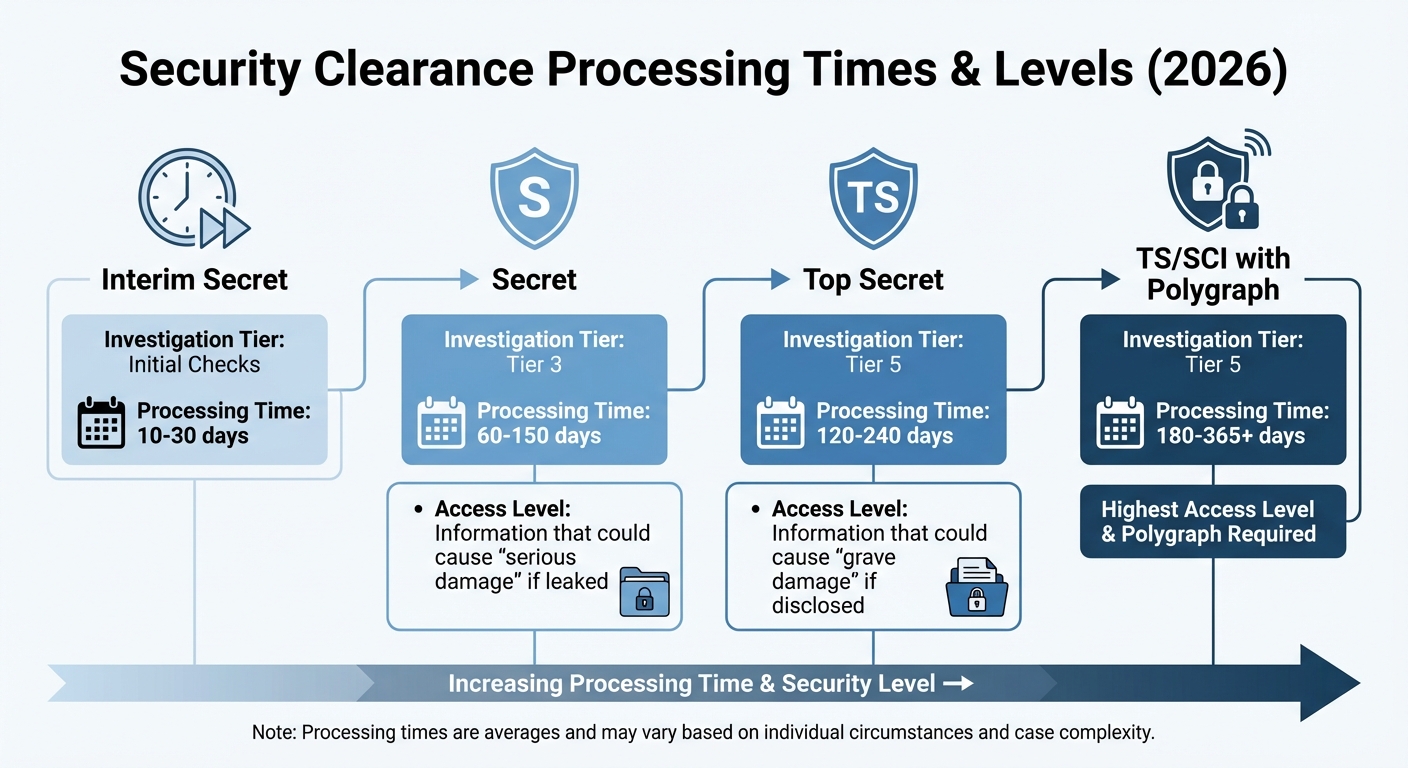
- Secret (Tier 3): Grants access to information that could cause "serious damage" if leaked.
- Top Secret (Tier 5): Allows access to information that could result in "grave damage" if disclosed.
Here’s a breakdown of current clearance processing times:
| Clearance Level | Investigation Tier | 2026 Avg. Processing Time |
|---|---|---|
| Interim Secret | Initial Checks | 10 – 30 days |
| Secret | Tier 3 | 60 – 150 days |
| Top Secret | Tier 5 | 120 – 240 days |
| TS/SCI with Polygraph | Tier 5 | 180 – 365+ days |
Before applying, it’s smart to review your credit report and resolve any delinquencies. Additionally, document all foreign contacts and travel for the past decade in a single, organized record. With the advent of Continuous Vetting, your history is monitored in real time. This includes criminal records, financial irregularities, and international travel. Accuracy is key – falsifying information on the SF-86 form (submitted via eApp) can lead to clearance denial. Be transparent and include any mitigating factors to avoid complications[3].
Once you’ve addressed clearance requirements, it’s time to focus on the certifications that showcase your technical expertise.
Key Certifications for Security Engineers
The DoD 8140 Workforce Qualification Program serves as a guide for certifications required in various cybersecurity roles within the Department of Defense and its contractors. For many positions, these certifications are not optional – they’re mandatory[4].
- Entry-Level Certification: Security+ is widely recognized as the starting point for cybersecurity professionals.
- Advanced Certifications: For higher-level roles, certifications like CISSP (Certified Information Systems Security Professional), CEH (Certified Ethical Hacker), or CISM (Certified Information Security Manager) are often required.
- The CISSP, often considered the industry standard, requires at least five years of full-time experience in two or more cybersecurity domains. A four-year degree can substitute for one year of experience[6].
Certifications are often viewed as "Capability Indicators", demonstrating your proficiency level – whether beginner, intermediate, or expert. Before pursuing a specific certification, consult the DoD Cybersecurity Qualification Matrix to confirm that it aligns with your career goals. For further guidance, tools like the Cyber Career Pathways Tool can help you identify certifications relevant to Security Engineer roles[4].
Certifications are only part of the equation. Your education and hands-on experience play a crucial role in building your qualifications.
Education and Experience Requirements
For most Security Engineer positions, employers expect candidates to have at least a bachelor’s degree in fields like computer science, information security, or cybersecurity[5]. While an associate degree paired with significant experience can sometimes suffice, it may limit your earning potential. Many government agencies actively recruit students through cybersecurity internships, often targeting those in the final two years of their degree programs[5].
Experience requirements vary by role:
- Mid-Level Roles: Typically require 1 to 5 years of professional experience.
- Senior and Executive Roles: Often demand 10 or more years in positions like security architect or information security analyst[5].
Before starting the eApp process, gather all necessary documentation. This includes 10 years of residential, employment, and education history, as well as details about foreign contacts and relationships. Items like old leases, passport stamps, and detailed records of foreign associations will help streamline the process[3].
Finally, remember that while some states have legalized marijuana, it remains illegal at the federal level. Any recent or current use is a red flag for security clearance eligibility[3].
Skills and Job Responsibilities
Technical Skills for Cleared Environments
As a Cleared Security Engineer, you’ll need a firm grasp of federal compliance frameworks. A key one is NIST Special Publication 800-53, which details 20 security control families critical for securing federal information systems [7]. Familiarity with the Risk Management Framework (RMF) is also essential for protecting government systems [8].
Your responsibilities go beyond just understanding frameworks – you’ll also document detailed security protocols. Expect to create System Security Plans (SSP), Plan of Action and Milestones (POA&M), Security Concepts of Operations (CONOP), and Security Requirements Traceability Matrices (SRTM) [8]. This means technical writing skills are just as important as configuring firewalls or deploying intrusion detection systems.
Cloud security knowledge is another must-have. Since FedRAMP enforces FISMA standards for cloud systems, you’ll need to secure cloud environments while meeting compliance requirements [7][8]. For identity and access management, expertise in Public Key Infrastructure (PKI), identity systems, and cryptographic testing is vital [8]. Additionally, proficiency with SIEM tools like Splunk is critical for monitoring and responding to incidents [2].
"FISMA mandates that federal agencies follow NIST’s cybersecurity standards and guidelines when creating and maintaining their security programs." – 6clicks [7]
These skills form the backbone of your role, enabling you to protect federal systems effectively.
Daily Tasks and Responsibilities
Your technical expertise will guide your daily responsibilities. You’ll spend time monitoring security logs, analyzing network traffic, and reviewing threat intelligence feeds to identify unusual activity or potential breaches [10]. Regular vulnerability scans are part of the job, as is working with system administrators to address any weaknesses [10].
Incident response is a significant part of your role. When a security event occurs, you’ll lead efforts to contain the threat and conduct digital forensic investigations to uncover its origin [10]. You’ll also manage patching cycles, ensuring operating systems and firmware stay updated by tracking vendor advisories [10]. In cleared environments, you’ll collaborate with Information System Security Officers (ISSOs) to ensure all updates meet federal standards [8].
"There is no typical day. You have to be fluid, adaptable and willing to change gears based on customer needs." – Charles Feller, Solution Engineer, Varonis [9]
The job demands a calm demeanor, even during high-pressure situations. You’ll need to explain complex technical issues in simple terms for non-technical stakeholders [9]. Whether your clearance is Secret or Top Secret/SCI, the role requires a problem-solving mindset and the ability to work within strict regulatory frameworks [9].
Career Advancement and Salary Information
Career Path from Entry-Level to Senior Roles
Starting out in cybersecurity often involves roles like Cybersecurity Analyst or Junior Security Engineer, where you’ll be tasked with protecting classified networks like SIPRNet. These positions offer valuable, hands-on experience with federal security protocols and compliance frameworks.
As you gain expertise, mid-level positions such as Information Systems Security Officer (ISSO) or Cloud Security Engineer become accessible. These roles, often in environments like AWS GovCloud, demand a deeper understanding of security controls across multiple systems. At the senior level, you might move into positions like Information Systems Security Manager (ISSM), Vulnerability Researcher, or Cyber Threat Intelligence Analyst, where the focus shifts to strategic oversight and leadership in security operations.
The Trusted Workforce 2.0 initiative also plays a key role in career progression. This framework promotes seamless reciprocity between federal agencies, allowing professionals to transition without restarting the clearance process. As Kevin James puts it, the goal is "clear once, trusted everywhere"[3], broadening opportunities for career advancement across agencies.
With each step up the ladder, salary expectations naturally increase.
Salary Ranges by Clearance Level and Experience
In cybersecurity, salaries vary based on clearance level, experience, and location. For example, in the Washington D.C. metro area, salaries for infrastructure and security-related engineering roles range from $100,000 to $220,000[11]. Experienced engineers typically see median salaries between $140,000 and $160,000[11].
Clearance level is a major factor in earning potential. Professionals with Top Secret/SCI clearances earn more than those with Secret clearances due to the additional vetting required and the smaller pool of qualified candidates. Entry-level roles tend to start at the lower end of the scale, while those with 5–10 years of experience and specialized certifications can command salaries at the higher end.
Several elements influence where you fall within these salary ranges.
What Affects Your Salary
Location plays a big role in salary differences. High-cost areas like Washington D.C. or Colorado tend to offer higher pay. Expertise in niche technologies, such as Splunk or AWS/Azure, also increases earning potential[11]. A contributor on a cybersecurity forum, clearedrob, explains:
"If I will be working on a niche technology (ex: splunk), or a critical system, or on a small team (they might be desperate), then I ask for premium"[11].
Other factors include the nature of the role. On-site SCIF (Sensitive Compartmented Information Facility) positions generally pay more than remote ones[11]. Advanced degrees and certifications can also push you into higher salary brackets, especially when paired with active clearances[11]. While large defense contractors often have strict pay bands, senior positions in high-cost regions typically top out between $170,000 and $190,000[11].
How to Apply for Cleared Security Engineer Jobs
After assessing your qualifications and skills, the next step to landing a cleared Security Engineer job is crafting a compelling resume and preparing thoroughly for the interview process.
Writing Your Resume
Think of your resume as your ticket to an interview. Highlight your clearance level prominently – either in your contact details or professional summary. Include a dedicated technical skills section listing tools and frameworks relevant to the job, such as SIEM platforms, NIST, or ISO 27001.
Avoid sharing classified project details. While it’s crucial to mention your clearance level, do not include classified project names, office specifics, budgets, or colleagues’ names. Keep sensitive information limited to cleared job boards.
Focus on measurable achievements by using the STAR method (Situation, Task, Action, Result). Instead of vague statements like "responsible for network security", provide specific examples, such as "reduced system vulnerabilities by 35% through proactive monitoring." Numbers speak volumes, whether it’s uptime percentages or the number of users supported. As Bill Branstetter from 9th Way Insignia advises:
"Keep subjective self-descriptions out of your summary section. I’m looking at you, Results-Oriented Team Players."
Keep your resume concise – one to two pages is ideal – and consider leaving out graduation years to avoid potential age bias. Make sure to showcase key certifications like CISSP, CEH, or Security+. If you’re working toward a required certification, include it with an expected completion date.
Once your resume is polished, shift gears to prepare for interviews.
Preparing for Interviews
Cleared Security Engineer interviews often combine technical challenges with behavioral questions that assess trustworthiness and reliability. For the technical portion, expect to discuss systems architecture, coding tasks, and your hands-on experience with the tools listed in the job description.
Use the STAR method to present your accomplishments. Walk through examples where you identified vulnerabilities, implemented security measures, or improved system performance. Back your stories with concrete data – percentages, timeframes, or other measurable results make your experience more impactful.
When discussing your clearance, be direct about your current level and any prior investigations. Employers value cleared candidates not just for passing rigorous background checks but also for their understanding of secure environments. If you’re transitioning from the military, clearly state your availability and any relocation plans.
Customize your preparation for each employer. Research the company’s contracts, technologies, and security priorities. Align your experience with the job’s specific requirements, whether it’s penetration testing, AWS GovCloud security, or compliance with federal frameworks. Reading your resume aloud before the interview can help you catch errors and ensure your responses sound polished and professional.
Networking in the Cleared Cybersecurity Community
As you climb the ladder from entry-level to senior roles, building a strong professional network becomes a must. Why? Because in the world of cleared cybersecurity, landing a role like a Security Engineer often hinges on trusted connections rather than simply applying online [13]. This community thrives on relationships grounded in trust and shared experiences, making networking your ticket to uncovering opportunities that never make it to public job boards.
Networking isn’t just about asking for favors – it’s about giving back, too. Share job leads or offer technical advice to your peers, even when you’re not actively job hunting. This kind of mutual exchange builds lasting relationships. If you have military experience, don’t overlook those connections – they carry significant weight in the cleared defense world [13]. Another smart move? Prepare a quick elevator pitch that highlights your skills and career goals for those brief but impactful conversations at meetups or conferences. And when you want to dig deeper, request short informational interviews (15–20 minutes) to gain insights without pressuring someone for a job [24,25]. These strategies not only grow your network but also set the stage for using targeted job platforms effectively.
Using Cleared Cyber Security Jobs
Platforms like Cleared Cyber Security Jobs are a goldmine for finding roles tailored to specific clearance levels, locations, and technical requirements. By uploading your resume, you make yourself visible to employers actively searching for candidates with clearances.
Job fairs are another powerful tool, especially for cleared professionals. G.B., a Technical Project Manager at CACI, shares their experience:
"I recently transitioned out of the military and started attending Cleared Job Fairs to get comfortable speaking to potential employers, to network, and to learn about the market… For veterans especially, attending Cleared Job Fairs can be critical to a successful career transition" [15].
Whether virtual or in-person, these events let you connect with multiple recruiters in one place. To make the most of them, research the participating companies ahead of time and tailor your pitch for those quick but meaningful conversations [15].
While online tools are helpful, in-person events and professional associations can take your networking to the next level.
Connecting with Other Cleared Professionals
Industry conferences like RSA, Black Hat, DEF CON, and BSides are treasure troves of networking opportunities [12]. Sometimes, the most valuable connections happen during informal chats between sessions.
Professional groups such as SANS, ISACA, CompTIA, and (ISC)² also offer structured networking through local chapters and online forums. Volunteering at cybersecurity events is another great strategy – it not only gives you free access to sessions but also naturally connects you with organizers and industry leaders [12]. Online spaces like Reddit’s r/netsec, Stack Overflow, and GitHub are excellent for showcasing your expertise and building relationships.
After meeting new contacts, follow up with a personalized thank-you email within 24–48 hours. Keep your network in the loop about your career progress [24,25]. When attending events, don’t forget about operational security: use a VPN, disable Bluetooth, and steer clear of public USB charging stations [16]. To keep those connections alive, occasionally share relevant industry news or updates with your network [12].
Conclusion
The demand for Cleared Security Engineers is growing fast, with cybersecurity jobs expected to increase by 29% between 2024 and 2034 [14]. This surge highlights the need for professionals who can safeguard classified systems, work with sensitive threat intelligence, and operate within government-exclusive environments [3]. A security clearance is your ticket to these high-stakes roles.
Today’s updated clearance processes make it easier and faster to enter the field. For example, an Interim Secret clearance can be issued in just 10 to 30 days, allowing you to start working while your full investigation is underway [3]. Additionally, the industry’s push for "clear once, trusted everywhere" reciprocity simplifies transitions between federal agencies and contractors [3].
To prepare, gather your 10-year history of residences and employment, review your finances to resolve any credit issues, and ensure full transparency when completing your SF‑86/eApp. Keep in mind, you’ll need a conditional job offer from a federal agency or defense contractor to sponsor your clearance application [1][3].
The financial rewards in this field are impressive. Security Engineers earn an average of $155,000 nationwide, with senior roles reaching up to $200,000 [17]. These salaries reflect the critical responsibilities involved. Whether you’re transitioning from the military or coming from an IT background, combining your technical expertise with a dedication to national security can open doors to challenging and rewarding opportunities.
Ready to take the next step? Look for cleared Security Engineer roles that align with your skills and clearance level.
FAQs
Can I get a clearance without a job offer?
No, you generally can’t get a security clearance without a job offer or sponsorship from an authorized employer. The process requires a government agency or contractor to sponsor you for a role that involves access to classified information. While you can take steps like gathering necessary documents or completing background forms, the actual clearance is typically issued only after you’re hired for a position that justifies the need for it.
What issues most often delay or deny a clearance?
The most frequent reasons for delays or denials of a security clearance often revolve around financial instability, personal conduct, foreign influence, and criminal history. Issues like significant debt, questionable behavior, or connections to foreign entities can lead to doubts about an individual’s trustworthiness and reliability.
Other contributing factors might include substance abuse or a history of poor decision-making. To prevent setbacks or a denial during the process, it’s critical to approach these concerns with transparency, honesty, and a proactive effort to address any red flags.
How do I prove impact on my resume without sharing classified details?
When showcasing your achievements, focus on measurable outcomes like streamlining workflows or cutting expenses, while keeping classified details private. Highlight your technical expertise, relevant certifications, and key responsibilities. Use phrases like "managed secure systems" or "implemented security protocols" to illustrate your capability in handling sensitive information responsibly. This approach allows you to demonstrate your contributions effectively while respecting confidentiality and adhering to OPSEC standards.