

The CISSP certification is one of the most sought-after credentials for cybersecurity professionals with security clearances. Here’s why it matters and how it can elevate your career in government and defense roles:
- Key Benefits: Recognized by the U.S. Department of Defense (DoD) under Directive 8140, CISSP certification qualifies professionals for advanced cybersecurity roles, boosting salaries by 9%–35%. Average earnings for CISSP-certified individuals reach $125,000 annually.
- Demand: Over 82,000 job openings require CISSP certification, making it a critical asset for cleared professionals aiming to work with agencies like NSA, DIA, and NGA.
- Exam Overview: The CISSP exam costs $749, includes 100–150 adaptive questions, and requires a score of 700/1,000 to pass. It covers eight domains, including Security and Risk Management, Identity and Access Management, and Software Development Security.
- Eligibility: Requires five years of experience in at least two CISSP domains. A one-year waiver is available for specific degrees or certifications like Security+ or CCNA.
- Maintenance: Certification holders must earn 120 Continuing Professional Education (CPE) credits every three years and pay an annual maintenance fee of $125.
Why It Matters: CISSP certification aligns with federal frameworks like NIST SP 800-53 and the Risk Management Framework, ensuring professionals meet government standards while advancing to senior roles such as ISSO, ISSM, or even CISO.
Whether you’re starting as an Associate of ISC2 or meeting full certification requirements, CISSP is a career-defining credential for cleared cybersecurity professionals.
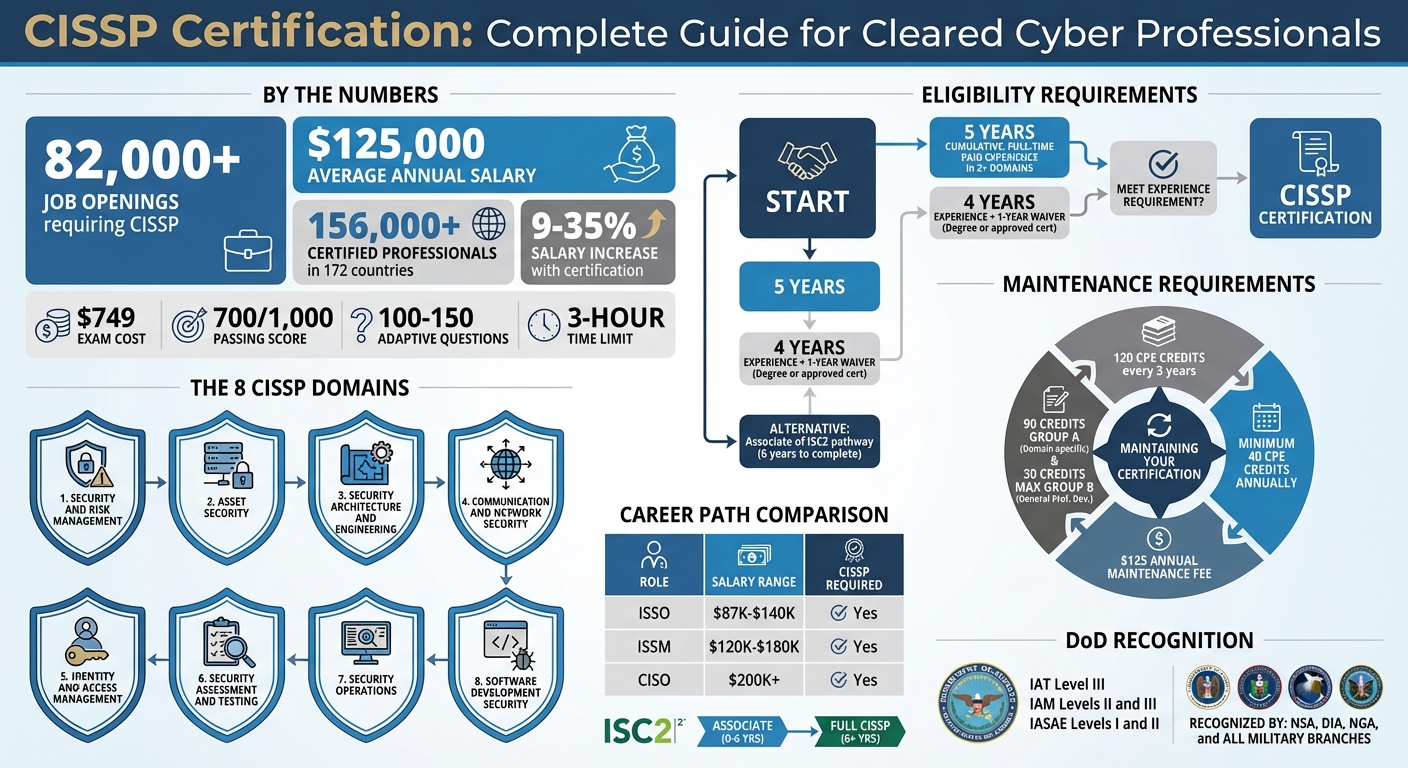
CISSP Certification Requirements and Career Benefits for Cleared Cybersecurity Professionals
What You Need to Know About CISSP Certification
CISSP Definition and Recognition
The Certified Information Systems Security Professional (CISSP), managed by ISC2, is a credential that proves your ability to design, implement, and oversee a comprehensive cybersecurity program [2][8]. Often referred to as the gold standard in cybersecurity certifications, it stands out for its rigorous requirements and global reputation. It was also the first certification to align with the ANSI/ISO/IEC Standard 17024, setting it apart from entry-level options by requiring both technical and managerial expertise [7][11].
As of July 2022, more than 156,000 professionals in 172 countries held the CISSP certification. It’s also officially recognized by the U.S. Department of Defense for both Information Assurance Technical (IAT) and Managerial (IAM) roles under DoDD 8570 and DoDM 8140.03 [8][11]. Beyond passing the exam, candidates must complete an endorsement process, where an active ISC2 member verifies their professional experience [9].
Let’s break down the eight domains that the CISSP exam covers.
The 8 CISSP Domains
The CISSP exam evaluates candidates across eight domains, each reflecting key areas of cybersecurity expertise. Here’s a quick overview:
- Security and Risk Management: Covers governance, compliance, and frameworks like NIST and FedRAMP.
- Asset Security: Focuses on data classification and handling sensitive or classified information.
- Security Architecture and Engineering: Includes security models like Bell-LaPadula and designing secure systems, such as SCIFs.
- Communication and Network Security: Addresses secure network architectures, air-gapped networks, and encrypted communication.
- Identity and Access Management: Explores authentication methods like MFA and Mandatory Access Control.
- Security Assessment and Testing: Aligns with continuous monitoring and maintaining Authority to Operate (ATO).
- Security Operations: Encompasses incident response and disaster recovery for SOCs.
- Software Development Security: Focuses on secure coding and DevSecOps practices.
The exam itself uses Computerized Adaptive Testing (CAT), presenting between 100 and 150 questions within a 3-hour time limit. To pass, you’ll need a score of 700 out of 1,000 points. The exam fee is $749 [7][2][10].
Understanding these domains is critical for preparing for the exam, but meeting the eligibility requirements is just as important.
CISSP Requirements and Eligibility
To qualify for the CISSP, you need five years of cumulative, full-time, paid work experience in at least two of the eight CISSP domains [6][10]. Full-time work is defined as a minimum of 35 hours per week over four weeks per month. Part-time work can count too – 1,040 hours of part-time work equals six months of full-time experience [6].
If you hold a four-year college degree or an approved credential like Security+, CCNA, or CISM, you can waive one year of the experience requirement. However, only one waiver is allowed [6][9]. Starting April 1, 2026, ISC2 will update its waiver list, removing certifications like CISA, CEH, and several GIAC credentials [6].
If you don’t meet the experience requirement, you can still take the exam and earn the Associate of ISC2 designation. This gives you six years to gain the necessary work experience while qualifying for many DoD 8570/8140 roles [6][10]. After passing the exam, you’ll have nine months to complete the endorsement process with an active ISC2 member. Failing to do so will require you to retake the exam [9][10].
"The experience requirement is what separates CISSP from entry-level certifications. ISC2 requires five years of cumulative, paid, full-time work experience in at least two of the eight CISSP domains." – Elias Ward, Deep Coding Specialist [10]
When documenting your experience, focus on duties that align with the eight domains rather than job titles. Roles like System Administrator or Network Manager often include qualifying security tasks, even if “Security” isn’t in the title [9][10]. For classified work, describe your responsibilities at the highest unclassified level possible when submitting your endorsement [9].
To maintain your CISSP certification, you’ll need to earn 120 Continuing Professional Education (CPE) credits every three years, with a minimum of 40 credits per year. Additionally, there’s an annual maintenance fee of $125 [2][10].
How to pass the CISSP 2025 (Complete Roadmap)
Why CISSP Matters for Cleared Cybersecurity Professionals
For cybersecurity professionals working in the government and defense sectors, the CISSP certification is more than just a credential. It’s a key that unlocks career growth and helps meet critical compliance requirements.
Salary and Career Growth for Cleared Professionals
Earning a CISSP certification can significantly boost your career in the cleared cybersecurity space. On average, CISSP-certified professionals earn salaries that are 9%–35% higher, with typical earnings around $125,000 annually. For those in cleared roles, the certification often brings an additional $15,000–$35,000 per year on top of standard pay[2][13].
This certification isn’t just about higher pay; it also opens doors to senior-level positions that are typically out of reach for non-certified individuals. For instance:
- Information Systems Security Officer (ISSO): Salaries range from $87,000 to $140,000.
- Information Systems Security Manager (ISSM): Salaries range from $120,000 to $180,000.
- Chief Information Security Officer (CISO): Earnings can exceed $200,000 annually[3].
With approximately 82,494 active job openings requiring CISSP certification and a total of 91,765 certified professionals, the demand is clear. These benefits not only enhance individual careers but also align with the stringent requirements of the Department of Defense (DoD).
Meeting DoD 8570 Requirements
For cleared professionals, CISSP is often a mandatory credential for specific roles under DoD Manual 8140 and the older Directive 8570[3]. It qualifies individuals for advanced categories, including:
The certification is widely recognized across all branches of the military – Army, Navy, Air Force, and Marine Corps – as well as key defense agencies like the NSA, DIA, and NGA. This broad acceptance allows professionals to move between agencies and contractors without needing to re-certify. For defense contractors, CISSP is frequently a requirement to secure and staff government contracts[3].
Additionally, the CISSP curriculum aligns with federal guidelines such as FISMA, FedRAMP, and NIST SP 800-53 security controls, ensuring that certified professionals are well-equipped to meet government standards. New hires typically have 180 days from their start date to attain the certification, or they risk losing their position[13].
CISSP-Certified vs. Non-Certified Professionals
The career trajectory for CISSP-certified professionals is notably different from those without the certification. While CISSP-certified individuals often advance into strategic roles like CISO or ISSM, their non-certified counterparts tend to remain in more technical or operational positions. The certification serves as a marker of advanced expertise, particularly under the DoD 8140 framework.
| Feature | CISSP-Certified | Non-Certified |
|---|---|---|
| DoD 8140 Eligibility | Qualifies for advanced roles | Limited to entry-level or non-DoD roles |
| Job Opportunities | Access to 82,494+ active openings[2] | Fewer opportunities |
| Salary Potential | 9%–35% higher earnings[2] | Standard market rates |
| Primary Responsibilities | Security architecture, policy creation, and program oversight | Technical and operational tasks |
| Career Path | Strategic leadership roles (e.g., CISO, ISSM) | Focused on technical roles |
For cleared professionals, CISSP is more than just a certification – it’s a game-changer. It can even substitute for a college degree in many cases, making it an attractive option for those without a formal education. Plus, its vendor-neutral approach ensures flexibility, allowing professionals to work across various technology platforms without being tied to a specific ecosystem.
sbb-itb-bf7aa6b
How to Get and Keep Your CISSP Certification
Earning your CISSP certification requires passing a challenging exam and meeting specific experience requirements. The process involves three main steps: preparing for and passing the exam, using the Associate pathway if you don’t yet meet the experience criteria, and maintaining your certification through ongoing professional development.
Preparing for the CISSP Exam
The CISSP exam uses Computerized Adaptive Testing (CAT), meaning the difficulty adjusts based on your answers. You’ll face 100 to 150 questions within 3 hours, and you’ll need to score 700 out of 1,000 points to pass[7]. The exam fee is $749[10].
To prepare, focus on understanding and applying security principles in practical scenarios. The exam covers eight domains, with Security and Risk Management being the largest section. Many professionals find their daily work experience provides a solid base for the exam.
Most candidates dedicate 3 to 6 months to studying, setting aside 10–15 hours per week. Training resources like CBT Nuggets, which costs $59.00 per month (or $49.91 per month if billed annually)[15], are popular. Many employers are willing to cover these costs as part of professional development.
If you don’t yet have the required five years of experience, you can still pursue the certification through the Associate pathway.
Getting CISSP with Less Than 5 Years of Experience
You’re not required to have five years of experience before taking the CISSP exam. Passing the exam without meeting the experience criteria earns you the Associate of ISC2 designation while you work toward the necessary experience[14][6].
"The Associate of ISC2 badge demonstrates to employers that you have what it takes to add value to their cybersecurity team now as you progress on your journey to certification." – ISC2[14]
Associates have up to six years to fulfill the work experience requirement. You can reduce this to four years by claiming a one-year waiver for a qualifying degree or certification, such as a bachelor’s or master’s degree in a related field, or certifications like CompTIA Security+, CCNA, or CASP+[6][15]. However, only one waiver can be applied – you can’t combine a degree and certification for additional reductions[6][7].
While holding the Associate designation, you’ll pay a $50 Annual Maintenance Fee (AMF) and earn 15 CPE credits annually[14][17]. Once you gain the required experience, you’ll need to submit an endorsement application before your six-year term ends. An ISC2 member in good standing must verify your experience, or ISC2 can act as your endorser if needed[16]. Transitioning to full CISSP status requires an $85 fee[14].
Once certified, maintaining your CISSP becomes essential for long-term career success.
Maintaining Your CISSP: CPE Requirements
After achieving your CISSP certification, staying current is vital for your career in cybersecurity. To maintain your certification, you must earn 120 CPE credits every three years, with a minimum of 40 CPE credits annually[18][19]. The Annual Maintenance Fee (AMF) for fully certified members increases to $135[18][19].
CPE credits are divided into two categories:
- Group A: Activities directly related to the eight CISSP domains.
- Group B: General professional development, such as leadership or management training.
At least 90 of the 120 credits must come from Group A activities, with a maximum of 30 credits from Group B[18][19].
Cleared professionals can earn CPE credits through various activities. For example:
- Attending ISC2 chapter meetings earns 1 credit per hour.
- Reading NIST Special Publications or CISA threat reports counts as self-study.
- Major work projects, like implementing a new security framework, can provide up to 40 CPEs annually[19].
- Speaking engagements, published articles, and professional contributions also qualify.
ISC2-hosted webinars and events like the Security Congress often automatically upload credits to your portal, simplifying tracking[17]. To stay on track, aim for about 3.5 credits per month to meet the annual requirement[19]. Keep detailed records of all CPE activities for at least five years in case of an audit[19]. Missing these requirements could result in certification suspension, and if not resolved, you’d need to retake the exam[19].
Earning and maintaining your CISSP certification not only keeps you compliant but also reinforces your expertise in the competitive cybersecurity field.
Using CISSP to Find Cleared Cybersecurity Jobs
Your CISSP certification can be a game-changer in the cleared cybersecurity job market. Highlight it effectively on your resume and leverage it to land roles that align with your expertise and clearance level.
Adding CISSP to Your Resume
Make sure your CISSP certification stands out by listing it right next to your name in the header of your resume. Include it again in a dedicated "Certifications" section, along with the certification date and your ISC² member number. In your professional summary, explain how your CISSP aligns with the job requirements you’re targeting. When describing your work experience, tie your day-to-day responsibilities to specific CISSP domains. This approach not only highlights your technical skills but also shows how your certification is applied in real-world scenarios.
A well-crafted resume is your first step toward landing the right job.
Finding CISSP Jobs on Cleared Cyber Security Jobs

Once your resume is polished, use specialized job search tools to find opportunities tailored to your CISSP and clearance level. Platforms like Cleared Cyber Security Jobs allow you to narrow your search. For example, the Boolean Search function lets you combine keywords like "CISSP AND TS/SCI" to pinpoint jobs requiring both the certification and a specific clearance level. The Skills Cloud feature also makes your CISSP credential stand out when recruiters view your profile.
To stay ahead, set up Job Alerts and use IntelliSearch, which matches your resume with high-demand CISSP positions instantly. Engaging in Pulse/Groups can also help you network with other professionals and connect with recruiters who specialize in cleared cybersecurity roles.
Interviewing as a CISSP-Certified Cleared Professional
Your CISSP certification isn’t just a resume booster – it’s a strong talking point during interviews. Use it to demonstrate how your knowledge informs your decision-making in security. Share examples from your professional experience, independent projects, or even home lab setups to show your initiative and problem-solving skills. Additionally, mention any efforts to stay current, like attending ISC² chapter meetings or pursuing extra courses, to highlight your dedication to growth.
As Chuxing Chen, Ph.D., CISSP, PMP, says, "Remember, CISSP is only a ‘door-knocker’, NOT a pass." [5]
While the CISSP opens doors, your hands-on experience and practical skills are what ultimately seal the deal during interviews.
Conclusion
The CISSP certification plays a key role in advancing careers within government and defense cybersecurity. With over 82,000 CISSP-specific job openings tied to DoD roles [2] and its alignment with 44% of DoD 8140 work roles [1], it’s clear why it’s considered the most sought-after credential in the cleared space. Whether you’re eyeing roles like ISSO, earning between $87,000 and $140,000, or senior ISSM positions with salaries ranging from $120,000 to $180,000, the CISSP opens doors that are often closed to non-certified professionals [3]. It serves as a cornerstone for the advanced opportunities discussed earlier.
"Government cybersecurity careers run on standardized credentials, and CISSP sits near the top of that hierarchy." – CertifiedCISSP.com [3]
Beyond job opportunities, the CISSP delivers a salary boost of over 20% and aligns with federal standards like NIST and the Risk Management Framework [3][4]. It’s recognized across all military branches and defense agencies, ensuring flexibility and mobility within the field [3].
Even if you’re starting as an Associate of (ISC)², this pathway provides a clear milestone while allowing you up to six years to meet the certification requirements – all while holding a recognized designation [2][6]. Whether you’re just beginning your career or advancing as a seasoned professional, the CISSP remains a powerful tool for growth. Once certified, maintaining your credential by earning 120 Continuing Professional Education (CPE) credits every three years ensures you stay competitive in a field expected to grow 29% between 2024 and 2034 [2].
When paired with clearance, the CISSP positions you at the intersection of regulatory knowledge and technical expertise. Leverage it wisely, and it will continue to unlock opportunities throughout your cybersecurity career.
FAQs
What are the key advantages of earning a CISSP certification for security-cleared professionals?
Earning a CISSP certification can be a game-changer for security-cleared professionals. This credential opens the door to a broader range of job opportunities, especially since many sought-after roles in the cleared cybersecurity field either require or strongly prefer it. Beyond that, it positions professionals as strong candidates for leadership and strategic roles, making it a powerful tool for climbing the career ladder.
The financial benefits are worth noting too. In the U.S., CISSP-certified professionals earn an average of $131,000 annually, with certain positions, like Security Architect, offering salaries as high as $148,000. Beyond boosting your resume, this certification showcases your expertise and dedication to the field, giving you a distinct advantage in interviews and career growth.
How does the CISSP certification meet DoD and federal cybersecurity standards?
The CISSP certification holds a strong reputation within the Department of Defense (DoD) and federal agencies, thanks to its alignment with the DoD 8140 framework (previously known as DoD 8570). This certification qualifies professionals for nearly half of the cyber workforce roles defined under this framework.
As a recognized standard for cybersecurity expertise, CISSP is approved for a range of positions across DoD and federal sectors. Its broad coverage of security domains ensures it meets the stringent requirements for cleared cybersecurity roles, making it an essential credential for those looking to advance their careers in this field.
How can I maintain my CISSP certification after earning it?
To keep your CISSP certification active, you’ll need to meet the Continuing Professional Education (CPE) requirements and follow ISC2’s guidelines. This includes earning 120 CPE credits within a three-year cycle. These credits can be earned through activities like attending cybersecurity conferences, completing relevant training courses, or engaging in professional development. Of these, at least 90 credits must directly relate to the eight CISSP domains to ensure your expertise remains current.
You’ll also need to pay an annual maintenance fee and adhere to the ISC2 Code of Ethics. These requirements reflect your dedication to staying informed and advancing in the dynamic world of cybersecurity.
Related Blog Posts
- Top 10 Cyber Security Jobs for Cleared Professionals
- CIO-SP3 Cybersecurity Positions vs DISA Encore III – Which Vehicle Drives Your Career?
- CISSP Cleared Cybersecurity vs CASP+ – The Certification ROI Debate for TS/SCI Holders
- Cleared Cybersecurity Career Assessment – Your Success Scorecard and Action Plan
Leave a Reply