

Becoming a Security Operations Center (SOC) Manager is a career milestone in cybersecurity, blending technical expertise with leadership. Here’s what you need to know:
- Role Overview: SOC Managers oversee 24/7 threat monitoring, incident response, and compliance with federal regulations like DoD Directive 8140/8570.01-M. They translate technical threats into business insights and lead cross-team coordination during incidents.
- Career Path: Typically requires 8–10 years of experience, starting as a Tier 1 Analyst and advancing through Tier 3 roles. Leadership, mentoring, and technical skills are essential.
- Salary: Cleared SOC Managers earn $150,000–$180,000 on average, with security clearances adding a 15–25% premium.
- Certifications: CISSP, CISM, and DoD-compliant certifications like GCIH or CySA+ are often mandatory.
- Clearances: Secret, Top Secret (TS), or TS/SCI clearances are required, with higher levels offering increased earning potential.
- Key Skills: Proficiency in SIEM, SOAR, EDR tools, crisis communication, and compliance management.
This role demands a balance between technical knowledge and leadership, making it both challenging and rewarding for those ready to take the next step.
SOC L1 vs L2 vs L3 vs Manager: The ONLY Breakdown of Roles, Skills, and Pay You Need
sbb-itb-bf7aa6b
What Does a SOC Manager Do?
A SOC Manager oversees the entire security operations, serving as the key decision-maker during incidents, from detection to recovery [2]. This role blends technical expertise with leadership, requiring a deep understanding of security threats and the ability to explain their impact to non-technical stakeholders.
SOC Managers lead teams of security analysts across different tiers while ensuring round-the-clock threat monitoring. With enterprise SOCs processing over 10,000 alerts daily – and 45% of those going uninvestigated [5] – streamlining alert triage becomes essential.
They also transform raw security data into actionable insights for executives, often using customized dashboards and compliance reports [2][3]. During active incidents, clear communication is critical for coordinating responses across IT, legal, and public relations teams. In cleared environments, these responsibilities become even more complex due to additional regulatory requirements.
Core Responsibilities in Cleared Environments
In cleared environments, SOC Managers handle extra responsibilities that go beyond standard corporate operations. They ensure incident response plans align with NIST SP 800-61r2 standards and comply with NIST SP 800-53 security controls [2][3]. This ensures that every phase, from detection to post-incident review, meets federal auditing standards.
Daily tasks include monitoring security tools, tracking performance metrics like Mean Time to Detect (MTTD), Mean Time to Acknowledge (MTTA), and Mean Time to Respond (MTTR), and conducting post-incident reviews to maintain efficiency [2][5]. Managers also use the MITRE ATT&CK framework to help analysts map attacker tactics and understand threat progression [2].
Another major responsibility is managing the team. SOC Managers hire, train, and mentor staff while addressing challenges like burnout – an issue highlighted by the fact that 52% of SOC analysts have considered leaving their jobs due to constant stress and alert fatigue [2]. Providing clear career progression paths, from Tier 1 to Tier 3, helps retain talent and strengthen the team [2][6].
How Cleared SOC Management Differs
While many responsibilities are shared across SOCs, managing a cleared SOC involves unique compliance and reporting requirements. Managers must ensure cyber incidents are reported in official government systems of record, adhering to protocols set by agencies like the Department of Homeland Security (DHS) or the Department of Defense (DoD).
Cleared roles also require compliance with DoD Directive 8140/8570.01-M, which dictates specific certifications for team members working on government systems [2][3]. These requirements influence hiring strategies and career development in ways that differ from commercial SOCs.
Additionally, managing security clearance adds another layer of complexity. SOC Managers need to maintain their own clearances, understand clearance levels, and ensure their team stays compliant with clearance standards. Mastering these requirements is crucial for anyone aiming to lead a cleared SOC successfully.
Required Skills and Certifications
If you’re aiming for a SOC Manager role, you’ll need to sharpen both your technical expertise and leadership skills while earning certifications that meet federal standards. This position demands a deep understanding of various technologies, effective crisis management, and the ability to lead teams in high-pressure situations. As Safwan Azeem aptly puts it:
Holding CISSP doesn’t guarantee promotion – but not holding any cert often guarantees you’ll be overlooked [1].
Technical and Leadership Skills
Your technical skills will be the backbone of your qualifications. Proficiency in SIEM platforms like Splunk or QRadar, SOAR solutions, and EDR/XDR tools such as CrowdStrike or SentinelOne is essential [1]. With over 64% of cybersecurity roles now requiring expertise in AI, machine learning, or automation, mastering these technologies is no longer optional [5]. You’ll need to validate AI-generated insights and manage workflows that balance human oversight with automation.
Leadership, however, is what sets managers apart. Strong crisis communication, conflict resolution, and mentoring skills are critical – especially since burnout affects 52% of SOC analysts, with many contemplating leaving their roles [2]. You’ll also need to translate complex technical data into business risk metrics that executives and CISOs can act on, often through customized dashboards [2]. Additional responsibilities include managing budgets, developing security policies, and setting metrics like MTTD (Mean Time to Detect) and MTTR (Mean Time to Respond) [2].
Before stepping into a management role, focus on demonstrating leadership within your current position. Lead incident retrospectives, mentor junior team members, and refine operational workflows [1]. Volunteering for "Incident Commander" roles during breaches is another excellent way to hone decision-making and maintain composure under pressure [7].
While technical knowledge and leadership abilities lay the foundation, certifications validate your expertise and are often non-negotiable for these roles.
Certifications for Cleared Professionals
For SOC Managers in cleared environments, certifications aligned with DoD Directive 8140/8570.01-M are a must [3]. The CISSP certification is widely regarded as a baseline for management roles, covering security and risk management comprehensively [2]. CISM, on the other hand, focuses on governance and incident handling, making it ideal for compliance-heavy environments [8]. CompTIA SecurityX (formerly CASP+) demonstrates advanced technical skills in architecture and integration and is recognized by the DoD under ISO 17204 [3].
For those specializing in incident response, GCIH offers targeted training in detection and response techniques [2]. CompTIA CySA+ is another excellent choice, validating skills in behavioral analytics and continuous monitoring [3]. Most SOC Managers hold at least two certifications, which not only meet technical and managerial requirements but also contribute to the 15–25% salary premium associated with security clearances.
The path to becoming a SOC Manager typically spans 5–10 years, progressing through roles from Tier 1 Triage to Tier 3 Threat Hunting [2] [5]. To accelerate your learning, explore hands-on labs like Hack The Box and CyberDefenders, or build home labs to practice. Cyber ranges such as BlueYard or Secplayground are also great for simulating real-world attack scenarios [8] [9].
Career Progression to SOC Manager
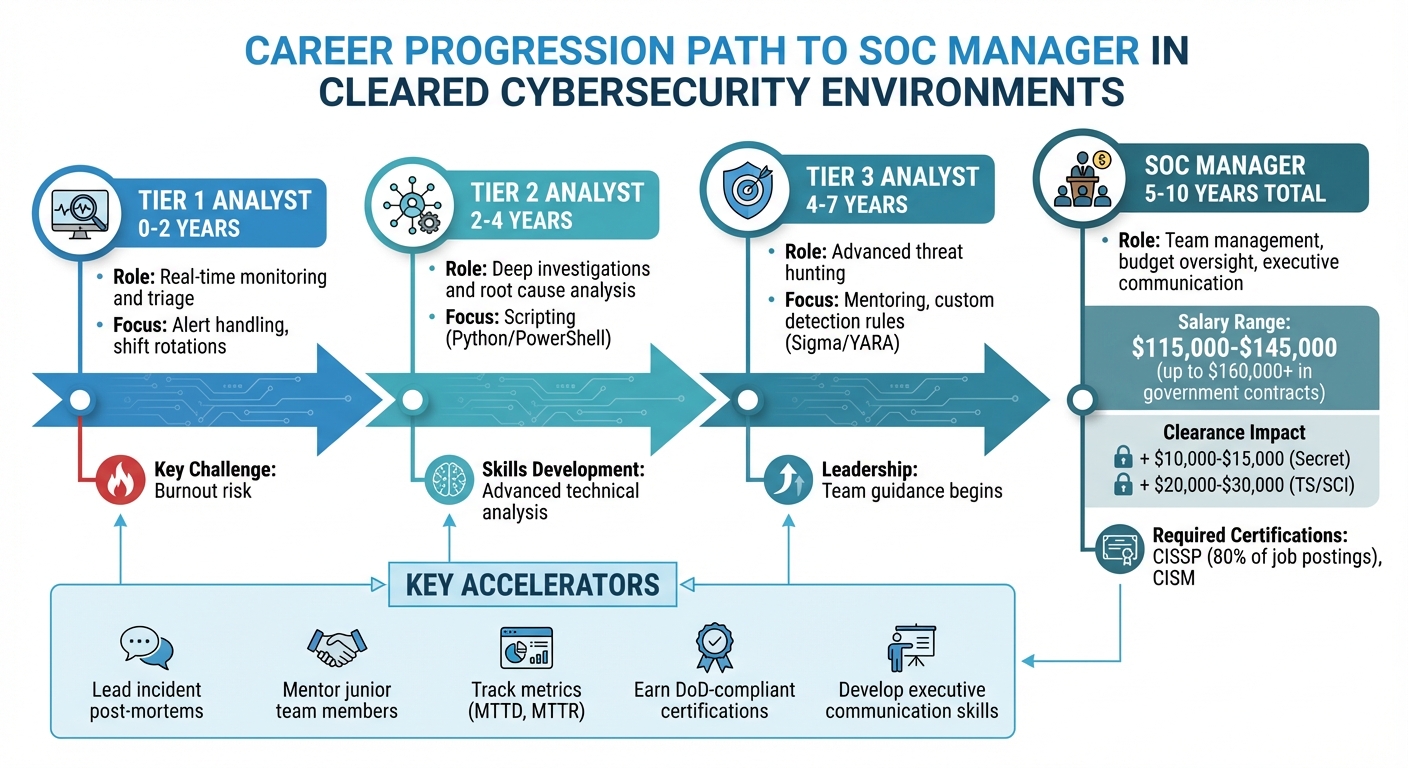
SOC Manager Career Path Timeline: From Tier 1 Analyst to Leadership
Typical Career Timeline
The journey to becoming a SOC Manager typically starts with gaining hands-on experience in various analyst roles. It begins with 0–2 years as a Tier 1 Analyst, focusing on real-time monitoring and triage. This role often involves rotating shifts, which can lead to burnout [10]. Afterward, analysts move into Tier 2 Analyst roles (2–4 years), where they handle deeper investigations and root cause analysis. Here, skills like scripting in Python or PowerShell can set you apart. By the time analysts reach the Tier 3 Analyst level (4–7 years), their work involves advanced threat hunting, mentoring, and creating custom detection rules using tools like Sigma or YARA [10].
The transition to SOC Manager usually occurs after 5–10 years of progressive experience [2][3]. This role shifts focus from hands-on technical tasks to managing teams, budgets, and communicating with executives. In environments requiring security clearances, your clearance level can significantly impact your earnings. For instance, a Secret clearance might add $10,000–$15,000 to your salary, while a TS/SCI clearance could add $20,000–$30,000 [10]. SOC Manager salaries typically range from $115,000 to $145,000, but senior roles in government contracts can exceed $160,000 [1]. These steps build the foundation for the leadership responsibilities discussed in the next section.
How to Accelerate Your Career Growth
Climbing the SOC career ladder faster requires proactive steps and targeted skill-building. Start by taking on leadership tasks, even before being formally promoted. For example, volunteer to lead incident post-mortems, oversee shift handovers, or mentor junior team members [1]. Keep a record of your achievements, like reducing Mean Time to Respond (MTTR) or creating a new incident severity rubric, to showcase your value during promotion reviews [1][11].
Certifications also play a critical role in advancing your career. Begin with Security+ for entry-level compliance, then move to CySA+ for analytical skills, and finally aim for CISSP or CISM as you target management roles. Notably, 80% of SOC Manager job postings require CISSP, making it a must-have credential [10]. Alongside certifications, build expertise in tools like SIEM, EDR/XDR, and SOAR to solidify your technical foundation [1][2].
Developing executive communication skills is equally important. Learn how to translate technical incident data into business-focused language that highlights risks and solutions. Participating in cross-functional projects with legal, compliance, or IT teams can help you hone relationship-management skills critical for leadership [1]. Demonstrating your ability to move from simply "watching alerts" to identifying patterns and presenting strategic insights to directors signals that you’re ready for the next level of responsibility [1][11].
Security Clearance Requirements
Clearance Levels Explained
SOC Manager positions demand strict security clearances, categorized into three main levels: Secret, Top Secret (TS), and Top Secret/Sensitive Compartmented Information (TS/SCI). These levels determine access to increasingly sensitive information. A Secret clearance applies to data where unauthorized disclosure could severely harm national security. Top Secret clearance covers information that could cause "grave damage" if exposed. The TS/SCI level grants access to intelligence compartments and often involves oversight of Special Access Programs (SAP).
The investigation process differs by clearance level. For a Secret clearance (Tier 3), the process includes record verification, employment checks, and education reviews, taking approximately 60–150 days. Top Secret clearance (Tier 5) requires a Single Scope Background Investigation (SSBI), including in-person interviews, and typically takes 120–240 days. Investigations for TS/SCI clearance often include a polygraph and can last 180–365+ days [14]. By early 2026, the investigation backlog had dropped to about 100,000 cases, marking a significant improvement [13].
Higher clearances come with greater responsibilities and earning potential. Those holding security clearances are among the top 10% of wage earners in the U.S. [12]. As a SOC Manager with TS/SCI clearance, you’ll oversee intelligence-focused data and manage staff access to classified compartments – responsibilities that go beyond what lower clearance levels entail. These rigorous requirements highlight the importance of security clearances in enabling SOC Managers to lead critical cybersecurity operations effectively.
Maintaining Your Clearance
Securing a clearance is just the beginning; keeping it active is equally important. The introduction of Trusted Workforce 2.0 fundamentally changed the process. This system replaced periodic reviews with Continuous Vetting (CV), which uses automated, near real-time monitoring of criminal records, credit issues, and public databases. As of early 2026, more than 3.8 million cleared individuals were enrolled in this federal program [13].
"An incident on a Saturday could generate an alert to your security office by Monday. This makes immediate self-reporting of any adverse event… a critical component of sustaining trust." – Kevin James, Cybersecurity Professional [14]
To maintain your clearance, you must self-report foreign travel, interactions with foreign nationals, and significant financial events like bankruptcy or major debt. Financial issues remain the top reason for clearance revocation, so monitoring your credit history and debt-to-income ratio is crucial. Adjudicators also review your digital footprint, including GitHub activity, gaming forums, and social media, for signs of poor judgment. Proactive self-reporting is viewed more favorably than waiting for automated systems to flag issues.
If you leave a sponsoring position, your clearance typically becomes inactive after 24 months. However, the 2026 National Defense Authorization Act extended eligibility for departing Department of Defense personnel to five years, making it easier to transition into contractor SOC Manager roles [13].
Moving from Technical Work to Management
Building Management Skills
Making the leap from technical roles to management is an important step in a cleared SOC career. This transition builds on your technical expertise while preparing you for broader responsibilities. The journey often begins by showing leadership informally – take the lead on tasks like shift handovers, post-incident reviews, or improving internal Standard Operating Procedures (SOPs) before being officially promoted [1]. This proactive approach demonstrates your readiness for management and earns trust from both your team and leadership.
One of the best ways to develop management skills is through mentorship. Start by guiding interns or junior analysts [1]. These experiences help you build communication skills and prove your ability to lead teams through challenges. Consider volunteering to run daily standups or retrospectives to practice facilitation [1].
Equally important is "managing up", or building trust with executives. Regularly update your manager on Key Performance Indicators (KPIs), challenges, and strategic ideas [1][15]. For instance, maintaining a tuning log to track noisy detection rules and their resolutions highlights your focus on operational efficiency [11]. Similarly, creating a severity rubric with clear examples of P1 to P4 incidents showcases your discipline and ability to prioritize during triage [11].
Expanding your perspective beyond the SOC is also essential. Engage in activities like compliance reviews, tabletop exercises, or company-wide meetings to see how security fits into larger business goals [1][15]. Practice translating technical jargon into language that resonates with non-technical stakeholders and executives [15][2]. As Safwan Azeem puts it:
Soft skills determine promotability, not just performance [1].
While building leadership skills is critical, staying connected to your technical roots is just as important.
Balancing Technical and Management Duties
Even after moving into management, maintaining technical credibility is key. While you’re no longer expected to code like your engineers, you should remain fluent in tools like SIEM, SOAR, and EDR platforms to earn your team’s trust [1]. Staying proficient ensures your decisions are grounded in operational realities rather than assumptions [1].
Your focus will shift from handling individual incidents to providing strategic oversight. Instead of triaging every alert, you’ll review incident timelines, assign complex cases, and verify that analysts follow proper protocols [1]. You’ll also take the lead on evaluating new technologies and managing vendor relationships to keep the security stack up-to-date [2]. During high-severity incidents, step into the role of "incident commander" to coordinate responses across teams like IT, legal, and public relations, showcasing both leadership and hands-on expertise [2].
Daily responsibilities will look very different in management. Analysts focus on detection, triage, and response, while managers prioritize strategy, people management, and the overall security posture [1]. Metrics of success also evolve – from speed and pattern recognition to KPIs, budget oversight, and risk reduction [1][2]. This shift not only broadens your career scope but often comes with substantial financial rewards, making the balance between technical expertise and leadership all the more worthwhile.
Wrapping Up
Becoming a cleared SOC Manager is about more than just technical skills – it’s a mix of certifications, practical experience, and leadership growth. The path usually starts with roles like SOC Analyst, where you gain the foundational knowledge and experience needed for advancement. Along the way, earning certifications, especially those recognized by the Department of Defense (DoD), can demonstrate your readiness for leadership while meeting federal requirements [1][3].
But technical skills and certifications alone won’t get you there. Taking initiative is key. Step up during shift handovers, help junior analysts grow, and find ways to improve standard operating procedures – even before you officially move into a leadership role [1]. Track metrics like Mean Time to Detect (MTTD) and Mean Time to Respond (MTTR) to highlight your contributions and show you’re prepared for the strategic responsibilities of managing a SOC. These efforts build trust and establish your readiness for overseeing teams, managing risks, and communicating effectively at a higher level [4].
The rewards for this career leap are both professional and financial. SOC Managers typically see a 30%–60% salary jump, with average earnings ranging from $110,000 to $160,000, and in some cases, exceeding $180,000 in high-demand industries [4]. However, the role isn’t just about the paycheck. It’s a transition from focusing on tactical detection to driving strategic leadership. Your success will be measured by how well your team performs, how effectively risks are mitigated, and the overall security strength of your organization [1].
As Safwan Azeem, ACSMC, puts it:
Security leadership doesn’t wait for permission. It moves forward when you do.
FAQs
Can I become a SOC Manager without a CISSP?
Yes, you can become a SOC Manager without holding a CISSP certification. However, certifications such as CISSP or GCIH are highly recommended. They not only bolster your qualifications but also showcase your expertise in cybersecurity. These credentials often give candidates an edge when pursuing leadership positions in the field.
How do I get a Secret or TS/SCI clearance for a SOC role?
To work in a SOC role requiring a Secret or TS/SCI clearance, you’ll need to go through the U.S. government security clearance process. This involves submitting an application, completing specific forms, and passing thorough background checks. These checks cover areas like your employment history, criminal record, financial standing, and any connections with foreign nationals.
For positions dealing with classified information, employers typically sponsor the clearance application. Keep in mind, the process can take several months, and maintaining the clearance demands strict adherence to security protocols.
What should I do now to move from Tier 3 to SOC Manager?
To move from a Tier 3 role to a SOC Manager position, you’ll need to build expertise in cybersecurity operations while also honing leadership and incident management skills. Here are some key ways to make that leap:
- Sharpen leadership abilities: Take charge of team projects, coordinate activities, and work closely with stakeholders to develop a collaborative approach.
- Pursue relevant certifications: Credentials like CISSP or CISM not only validate your expertise but also demonstrate your readiness for managerial responsibilities.
- Broaden your scope of work: Take on tasks such as drafting Standard Operating Procedures (SOPs), overseeing incident response efforts, and preparing reports for senior management.
By focusing on these areas, you’ll be better equipped to step into a SOC Manager role.