

Metasploit is an essential tool for penetration testers working in high-security environments. It allows testers to confirm exploitability, simulate advanced threats, and meet strict compliance requirements such as CMMC, FedRAMP, and NIST SP 800-115. This guide focuses on using Metasploit effectively in cleared environments, covering installation, configuration, legal considerations, and advanced techniques.
Key Takeaways:
- Why Metasploit Matters: Goes beyond vulnerability scanning by validating real risks. Features like Meterpreter enable stealthy, in-memory operations critical for sensitive networks.
- Compliance: Aligns with federal frameworks by providing CVE-referenced metadata and audit trails.
- Advanced Features: Supports APT simulations, post-exploitation techniques, and custom exploit development.
- Best Practices: Includes secure configuration, session tracking, and adherence to strict legal boundaries.
This guide equips cleared professionals with the tools and techniques to conduct secure, compliant, and effective penetration tests.
Penetration Testing with Metasploit: A Comprehensive Tutorial | PT2
sbb-itb-bf7aa6b
Setting Up Metasploit for Secure Penetration Testing
Metasploit Configuration Settings for Cleared Penetration Testing Environments
How to Install Metasploit
Installing Metasploit in a secure environment starts with using the official Omnibus installers or nightly builds from Rapid7. These packages include all necessary dependencies like Ruby and PostgreSQL, ensuring compatibility across Linux, Windows, and macOS systems [3].
Before proceeding, verify the installer’s integrity using the provided SHA-1 hashes. This step ensures the file hasn’t been tampered with during download, which is especially important for tools that interact with sensitive systems. Note that administrative or root privileges are required to complete the installation and integrate tools like Nmap and John the Ripper [3].
Once installed, initialize the local PostgreSQL database by running msfdb init. For environments requiring strict data separation, use the workspace command to create isolated database environments for each project. This approach helps maintain compliance by preventing data overlap between contracts or authorization periods [6].
Be aware that firewalls and antivirus programs may flag Metasploit during installation or use. Coordinate with your security team to whitelist the Metasploit directory (e.g., C:metasploit-framework on Windows) and secure any necessary exceptions.
After installation, move on to configuring Metasploit with settings tailored for secure environments.
Configuring Metasploit for Cleared Environments
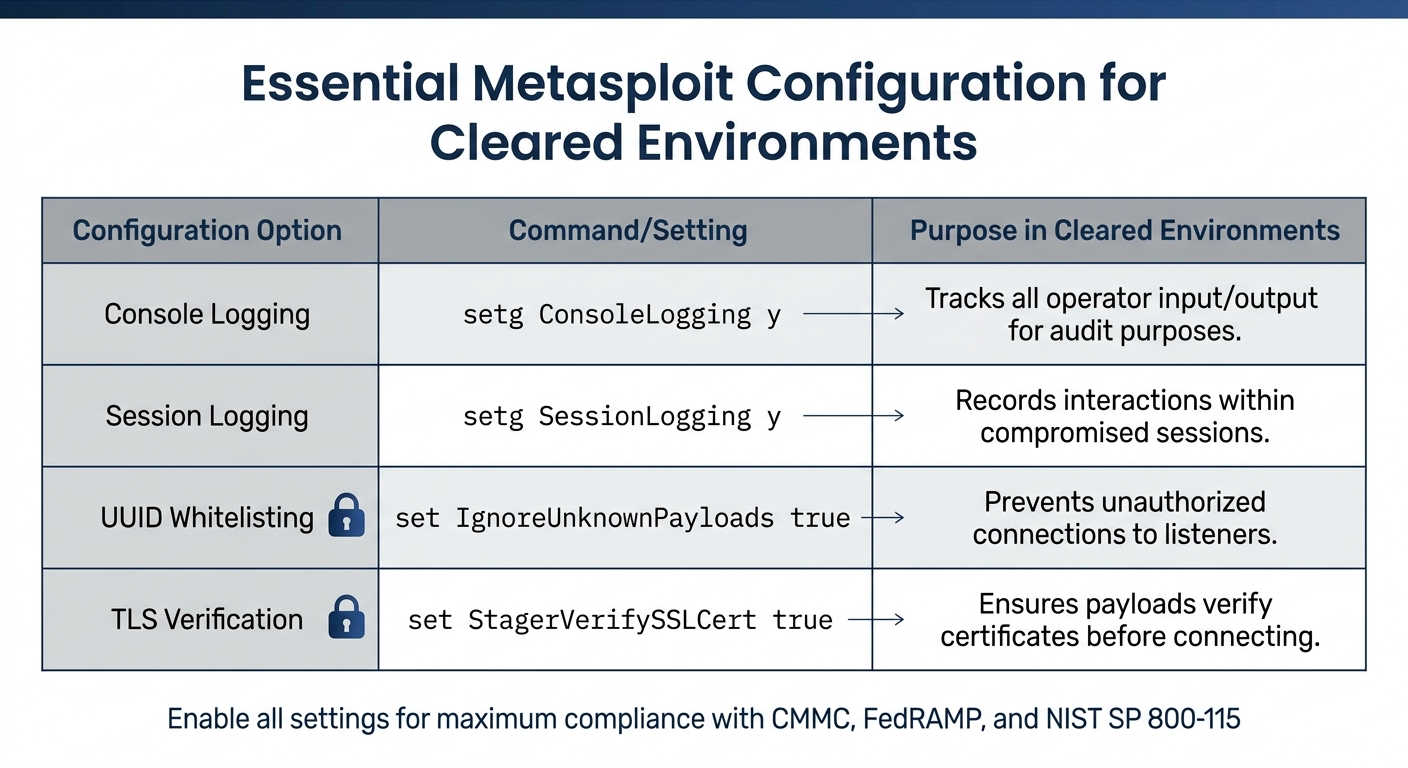
To meet operational security standards in cleared environments, adjust Metasploit’s configuration. Start by enabling Paranoid Mode, which enhances security through features like payload UUID tracking, whitelisting, and TLS pinning [4]. Set PayloadUUIDTracking=true and IgnoreUnknownPayloads=true to ensure only authorized payloads can connect.
For secure communication, generate a custom SSL/TLS certificate using 4096-bit RSA encryption. Assign this certificate to your listeners with HandlerSSLCert, and enable certificate verification by setting StagerVerifySSLCert=true. These steps reduce the risk of man-in-the-middle attacks.
Here’s a quick overview of key configuration options:
| Configuration Option | Command/Setting | Purpose in Cleared Environments |
|---|---|---|
| Console Logging | setg ConsoleLogging y |
Tracks all operator input/output for audit purposes |
| Session Logging | setg SessionLogging y |
Records interactions within compromised sessions |
| UUID Whitelisting | set IgnoreUnknownPayloads true |
Prevents unauthorized connections to listeners |
| TLS Verification | set StagerVerifySSLCert true |
Ensures payloads verify certificates before connecting |
Enable global logging (setg ConsoleLogging y and setg SessionLogging y) to create a detailed record of all actions. Adjust the LogLevel setting between 1 and 5, with level 3 offering a good balance between detail and storage needs.
To limit exposure, configure session expiration to automatically close inactive Meterpreter sessions [5]. Use resource scripts (like .rc files) to automate these configurations, ensuring consistency across different projects [6].
Legal and Ethical Requirements
Once Metasploit is securely installed and configured, it’s critical to operate within legal and ethical boundaries. This ensures compliance with the standards discussed earlier.
"The Computer Fraud and Abuse Act does not distinguish between intentional and accidental unauthorized access – the authorization document is the sole legal protection." – Penetration Testing Authority [2]
Every penetration test must be conducted under explicit, written authorization. The Computer Fraud and Abuse Act (18 U.S.C. § 1030) criminalizes any unauthorized access, whether intentional or accidental. To stay compliant, your Rules of Engagement document should clearly define the scope of testing, including systems, timeframes, and approved techniques.
In environments requiring high security, authorization must go beyond basic permission. Contracts should explicitly allow exploitation activities, not just vulnerability scanning. According to NIST SP 800-115, there’s a clear difference between identifying vulnerabilities (enumeration) and actively demonstrating exploitability (exploitation).
Before running any module, review its metadata with the info command to ensure it aligns with the authorized scope. Certain exploits may crash services or cause irreversible changes, so understanding these risks is crucial. Since Metasploit can pivot across networks, misconfigurations could lead to unintended access outside the approved scope. To prevent this, configure your testing infrastructure carefully and document every action. This thorough documentation supports compliance with frameworks like CMMC and HIPAA [2].
Key Metasploit Modules for Cleared Penetration Testing
Metasploit’s modules are divided into three main categories – auxiliary, exploit, and payload – each playing a specific role in a structured, compliance-focused penetration test.
Auxiliary Modules for Reconnaissance
Auxiliary modules are versatile tools that allow you to gather intelligence without risking the instability that can come with exploit attempts [13]. They’re perfect for mapping networks and identifying potential targets.
For network mapping, auxiliary/scanner/portscan/tcp helps identify open ports, while auxiliary/scanner/discovery/udp_sweep can locate active UDP services like SNMP and DNS [11]. You’ll need to set the RHOSTS parameter for target ranges and adjust THREADS to balance speed and detection risks.
In Active Directory environments, auxiliary/gather/ldap_query is a great choice for enumerating users, computers, and domain misconfigurations [10]. You can use the action setting to focus on specific information: set it to ENUM_ACCOUNTS for user lists, ENUM_GPO for Group Policy Objects, or ENUM_USER_ASREP_ROASTABLE to find accounts vulnerable to AS-REP roasting attacks. To stay compliant with security protocols, configure LDAP::Auth to use Kerberos or NTLM.
For SMB reconnaissance, modules like auxiliary/scanner/smb/smb_version can identify OS and SMB versions, while auxiliary/scanner/smb/smb_enumusers uses RPC to enumerate system users [11]. These tools are essential for understanding Windows environments before attempting exploitation.
In environments where active scans might cause disruptions or trigger alerts, passive discovery is a safer option. The Passive Network Discovery MetaModule monitors broadcast traffic to uncover useful information [12]. You can apply Berkeley Packet Filters (BPF) to limit the capture to specific protocols like SMB, SSH, or HTTP, which reduces noise and file sizes.
Exploit Modules for Vulnerability Testing
Once you’ve gathered reconnaissance data, exploit modules allow you to test for vulnerabilities.
For Windows systems missing the MS17-010 patch, exploit/windows/smb/ms17_010_psexec is a top choice. This module combines multiple exploits – EternalChampion, EternalSynergy, and EternalRomance – and is often more stable than the standard EternalBlue module because it avoids using kernel shellcode to stage Meterpreter. Before running this exploit, use auxiliary/scanner/smb/smb_ms17_010 to confirm that a Named Pipe is accessible for anonymous logins, which is common in pre-Vista and some domain environments.
When choosing a target, consider operational security. The Native Upload target writes an executable to SYSTEM32 for high reliability but is easily detected by antivirus software. The Powershell target, on the other hand, embeds the payload in a command, avoiding disk artifacts and staying memory-resident. This makes it a better option in environments with active endpoint detection.
For Unix systems, exploit/unix/misc/distcc_exec targets the distcc daemon, which is often found on build servers, to execute arbitrary code.
If you have valid credentials, exploit/windows/smb/psexec is a quick way to expand network access. This module highlights the risks of credential reuse and weak password policies, common issues in cleared environments.
After confirming a vulnerability, payload modules help you test controlled access.
Payload Modules for Access Testing
Payloads are the code delivered to a system after successful exploitation. They perform tasks like opening shells, creating users, or dumping credentials [7] [8]. Choosing the right payload is crucial for compliant testing.
Payloads are categorized into singles, stagers, and stages:
- Singles are self-contained, like
windows/shell_reverse_tcp[14]. - Stagers are small initial payloads that download larger ones [14].
- Stages are secondary components, such as Meterpreter, which provides additional functionality [14].
Staged payloads are smaller and ideal for initial exploitation where buffer space is limited. Stageless payloads, being larger and self-contained, are more stable in environments with high security monitoring [8].
Meterpreter is one of the most powerful payloads available, offering encrypted communications and advanced post-exploitation features like privilege escalation, keylogging, and pivoting [8]. Cybersecurity expert Mitchell Langley emphasizes its capabilities:
"The Meterpreter shell stands out as one of the most powerful tools within Metasploit, offering encrypted communications and a wealth of post-exploitation features." [8]
In environments with active endpoint protection, encoders like shikata_ga_nai can help obfuscate payloads to evade static signature detection [14] [8]. However, modern antivirus solutions often focus on behavior rather than signatures, so encoding alone isn’t enough for advanced evasion.
Ensure your listeners are properly configured by setting LHOST (listen address) and LPORT (listen port). If you’re working over a VPN, specify the tun0 interface [7]. After testing, document all exploited vulnerabilities and commands, remove any uploaded files, and terminate sessions to maintain system integrity [8]. These steps are essential for ensuring both technical effectiveness and compliance in cleared environments.
Advanced Skills: Exploit Development and Post-Exploitation
Creating Custom Exploits
Developing custom exploits requires precision and a strong commitment to ethical and legal standards. It’s essential that any exploitation is conducted only on systems where explicit written permission has been granted – this is typically outlined in a signed Rules of Engagement (RoE) document. Performing exploitation without authorization violates the Computer Fraud and Abuse Act (CFAA), a federal crime that carries severe penalties. These guidelines not only ensure legal compliance but also uphold professional integrity [15].
The Metasploit framework simplifies many foundational tasks, like payload generation, encoding, and NOP generation, so you can focus on the specifics of your exploit. A good starting point is the sample module located in documentation/samples/modules/exploits/. Custom exploits are written in Ruby and structured as a MetasploitModule, which inherits from Msf::Exploit::Remote.
Before deploying a payload, use the check command to verify the target’s vulnerability without triggering any actions. For buffer overflow exploits, avoid relying on system DLLs like kernel32.dll when selecting a JMP ESP address. As Wei "sinn3r" Chen, an Exploit Engineer at Rapid7, explains:
"Using the jmp esp address from kernel32.dll is a bad habit… most system DLLs change way too often due to patch levels" [16].
Instead, target addresses within the application’s core DLLs for better consistency and reliability.
Metasploit ranks modules on a seven-level scale. In environments where testing is cleared, prioritize modules rated as Excellent (600) or Great (500) for more reliable results [15]. Additionally, document any potential side effects in the module’s Notes field using constants such as ARTIFACTS_ON_DISK, IOC_IN_LOGS, or CRASH_SAFE. This practice promotes transparency and aligns with compliance standards.
Post-Exploitation Techniques for Cleared Environments
Once you’ve developed a stable exploit, the next step is to secure and maintain access. In cleared environments, post-exploitation activities require strict adherence to operational security protocols. Meterpreter, a tool that runs entirely in memory, helps minimize forensic footprints, while its encrypted channels (TLS/AES) ensure secure communication.
After gaining access, migrate your session to a stable process like explorer.exe to avoid losing your connection. To reduce the risk of detection, use the idletime command to check for user inactivity before performing any noisy actions.
For privilege escalation, the getsystem command can exploit named pipe impersonation or token duplication to elevate access. Additionally, the kiwi extension – a wrapper for Mimikatz – allows you to extract NTLM hashes and Kerberos tickets directly from memory. For lateral movement, leverage the autoroute command to add subnets to the routing table and use socks_proxy to route external tools through the compromised host via proxychains.
Cleanup and reporting are critical steps in maintaining compliance and operational integrity. Use register_file_for_cleanup() in custom modules to ensure temporary files are removed, or run the clearev command to wipe event logs after your activities. To securely store gathered data, use the store_loot() function to save information into the Metasploit database instead of leaving unencrypted files on the target system. These measures not only safeguard your operations but also ensure a complete and secure testing process.
Compliance and Best Practices for Cleared Penetration Testers
Legal and Regulatory Requirements
The Computer Fraud and Abuse Act (18 U.S.C. § 1030) serves as the primary legal guide for penetration testing activities. It’s crucial to have explicit authorization outlined in a Rules of Engagement (RoE) document. This document should include written permission detailing the targets, scope, testing timelines, and stop-on-impact protocols [1][2].
For federal agencies, FISMA (Federal Information Security Management Act) mandates system controls based on NIST SP 800-53, which outlines baseline requirements for managing federal information systems [17]. Penetration testing findings should align with NIST SP 800-53 control families. Similarly, federal contractors working with the Department of Defense must adhere to CMMC (Cybersecurity Maturity Model Certification) by documenting findings in relation to specific control families [2].
Another critical standard is NIST SP 800-115, which provides a structured methodology for conducting penetration tests [1][2]. For cloud service providers working with federal agencies, compliance with FedRAMP is essential. This framework requires findings to reference documented CVEs, a feature supported by Metasploit’s metadata [2]. It’s vital to review a module’s "target list" and description to avoid disruptions, especially in sensitive environments [9].
| FISMA Control | Requirement Name | Metasploit Testing Focus |
|---|---|---|
| AC-7 | Unsuccessful Logon Attempts | Verifying enforcement of login attempt limits (e.g., >3 failed attempts in 60 seconds) |
| CM-7 | Least Functionality | Identifying systems running multiple major services (e.g., HTTP and DNS) |
| IA-2 / IA-5 | Identification & Authentication | Detecting use of default usernames or blank passwords |
| RA-5 | Vulnerability Monitoring | Testing the effectiveness of regular scans by attempting exploitation |
| SI-2 | Flaw Remediation | Checking if known vulnerabilities are patched with the latest updates |
These legal and regulatory frameworks establish the foundation for the operational measures discussed in the next section.
Operational Security (OpSec) Best Practices
Effective OpSec begins with pre-exploitation research. Always review module descriptions and use the check command to confirm vulnerabilities without triggering any unintended side effects [9].
Environment mirroring is another key practice to prevent downtime in sensitive systems. Recreate the target environment and test exploits there before applying them to production systems [9]. If using VPNs – common in cleared environments – ensure that LHOST is configured correctly (e.g., tun0) to maintain stable connections [7]. You can also use show evasion and show advanced commands to adjust modules for stealth, helping bypass security controls [9].
Data segregation is critical for organizing and protecting sensitive information. Use workspaces to separate data for different projects or network segments, which makes reporting easier and reduces the risk of accidental data mixing [8]. Integrating Metasploit with a PostgreSQL database ensures secure, automated storage of scan results, credentials, and collected data ("loot") [8]. To evade antivirus detection, encoders like shikata_ga_nai can obfuscate payloads effectively [8].
For compliance and security, encrypt your assessment data, limit team access, and enforce strict retention policies (usually 90 days or less) [1]. Automate routine tasks using .rc files to minimize manual errors during critical operations [8].
Documenting and Reporting Findings
Clear and accurate documentation is essential for meeting compliance requirements and communicating effectively with stakeholders. Start every test by creating a new workspace (workspace -a [Name]) to prevent mixing findings from different projects. Leverage database functions like db_nmap and store_loot() to streamline the documentation process.
Metasploit offers standardized reporting tools to help categorize and organize data. For instance:
- Use
store_loot()for storing files and forensic evidence. - Use
report_auth_info()to log reusable credentials or hashes. - Use
report_vuln()to document successful exploitations. - Use
report_note()for general observations using OID-style types [18].
For federal compliance, Metasploit Pro includes a "FISMA Compliance Report", which provides a pass/fail summary for specific NIST SP 800-53 requirements. This can be added as an appendix for formal audits [17].
Before running any module, use the info command to document potential side effects, such as service crashes, and verify that the target environment matches the module’s specifications. Reports should include a detailed breakdown of the testing methodology, key statistics, and technical findings, supported by evidence like stored loot. This helps stakeholders prioritize remediation efforts effectively. Maintain an audit trail by logging all report events in reports.log.
For compliance-focused assessments (e.g., FedRAMP, HIPAA), findings should be linked to specific CVEs. Metasploit modules include CVE references in their metadata to facilitate this requirement [2]. Reviewing the original GitHub pull request for a Metasploit module can also provide valuable insights into how the module was tested and what vulnerabilities it addresses.
Practical Examples: Metasploit in Cleared Roles
Building on earlier discussions about module configurations and compliance practices, let’s explore how Metasploit can be applied in real-world cleared environments.
Simulating Advanced Persistent Threats (APTs)
To mimic an Advanced Persistent Threat (APT), you can follow the typical attack lifecycle – from initial breach to persistence. Metasploit’s modular design makes it possible to chain exploits, payloads, and post-exploitation tools in a seamless sequence.
For instance, start with initial access by exploiting vulnerabilities like EternalBlue (CVE-2017-0144) [8]. Once inside, establish command and control using Meterpreter [19]. From there, use routing and tunneling techniques to navigate segmented networks [8][21]. The incognito extension in Meterpreter lets you impersonate user tokens, enabling lateral movement without needing to crack passwords or extract plaintext credentials [22]. For privilege escalation, the local_exploit_suggester can identify missing patches or configuration flaws [8][21].
Here’s a quick breakdown of how Metasploit modules align with various APT phases:
| APT Phase | Metasploit Module/Command | Purpose |
|---|---|---|
| Initial Access | msfvenom |
Generate custom payloads [8][21] |
| Privilege Escalation | getsystem / kiwi |
Gain SYSTEM rights or extract credentials from memory [21] |
| Lateral Movement | psexec / wmi |
Execute code on remote systems using captured hashes or tokens [21] |
| Persistence | run persistence |
Create backdoors via startup folders or services [21] |
| Exfiltration | download / screenshot |
Collect sensitive data and transfer it [19][21] |
| Cleanup | clearev |
Erase Windows event logs to hide traces [21] |
To streamline these steps, you can use .rc resource files to automate multi-stage attacks. For example, scripting a search for Domain Admin tokens across multiple systems becomes efficient with resource files [8][22]. In Kubernetes environments, the auxiliary/cloud/kubernetes/enum_kubernetes module is particularly useful for navigating compromised containers and extracting sensitive data like service tokens [20].
These techniques are particularly relevant when testing environments with strict compliance requirements, as they combine precision with controlled testing.
Testing Environments with Complex Compliance Requirements
When working in regulated environments, testing must adhere strictly to pre-approved guidelines and avoid intrusive methods. Start by securing written authorization that defines the Rules of Engagement (RoE), including testing windows and data handling protocols [23][1]. Metasploit workspaces can help you organize data by subnet, department, or compliance scope [24][8].
"Your testing should improve user safety and system resilience, not ‘hack for hacking’s sake.’" – Aditya, Cybersecurity Engineer, Secryft [1]
For non-invasive assessments, focus on diagnostic modules like auxiliary/scanner/http/title, which verify vulnerabilities without affecting system stability [1]. If federal compliance is a concern, Metasploit Pro’s FISMA Compliance Report can map findings to specific regulatory requirements. For instance, a host might fail AC-7 if it logs more than three failed login attempts within 60 seconds [17].
When testing web applications, enable HttpTrace to log raw requests and responses for auditing purposes [1]. Routing Metasploit traffic through a proxy tool like Burp Suite allows you to manually verify requests, ensuring no unintended payloads are sent [1]. For Active Directory Certificate Services, modules like auxiliary/gather/ldap_esc_vulnerable_cert_finder can identify weak certificate templates. You can then use auxiliary/admin/dcerpc/icpr_cert to simulate privilege escalation by configuring ALT_UPN (e.g., Administrator@domain.com) and ALT_SID values [25].
To maintain auditability, enable detailed logging and session transcripts with the spool command. Encrypt all collected data, limit access to authorized personnel, and follow strict data retention policies – typically 90 days unless otherwise specified [1]. Using .rc files ensures that testing procedures remain consistent and repeatable across different environments [8].
Conclusion
Core Skills and Practices
To excel in cleared-environment Metasploit testing, it’s crucial to understand its modular setup. Familiarize yourself with how the Exploit, Payload, Auxiliary, Post, and Encoder modules interact to replicate realistic attack scenarios [8]. As highlighted earlier, proficiency with Meterpreter is a must. This tool plays a key role in tasks like privilege escalation, credential harvesting, and network pivoting [8].
Managing assessments effectively is another cornerstone of success. Utilize PostgreSQL integration and workspaces to keep client data separate and handle large-scale projects efficiently [8]. Automation tools, such as resource scripts (.rc files) and global variables (setg), help maintain consistency across sessions [26]. Always ensure you have explicit, written authorization that clearly defines the scope and timeframe of your testing [8][1]. Enable verbose logging (e.g., HttpTrace) and meticulously document each step for full auditability [1].
Operational security is just as important as technical know-how. Implement stop-on-impact rules to halt tests if unexpected system changes occur [1]. Follow data retention policies, typically limiting the storage of raw logs and screenshots to 90 days unless regulations require otherwise [1]. Regular updates to Metasploit ensure access to the latest modules and bypass techniques [8].
By mastering these practices, you establish a strong foundation for continuous learning and industry-recognized certifications.
Next Steps for Professional Growth
Once you’ve built these core skills, advancing your qualifications can further enhance your expertise. Cleared professionals should aim for certifications that focus on practical Metasploit usage. The OSCP (Offensive Security Certified Professional) is widely regarded as a top-tier certification for active exploitation and post-exploitation techniques [8]. For beginners, the eJPT (eLearnSecurity Junior Penetration Tester) offers a hands-on introduction to Metasploit basics [8]. Meanwhile, the PNPT (Practical Network Penetration Tester) emphasizes practical, real-world testing scenarios, including network pivoting [8].
To refine your skills, practice in controlled environments like Hack The Box, TryHackMe, or the PortSwigger Web Security Academy [8][1]. Align your testing approach with established frameworks such as the OWASP Web Security Testing Guide (WSTG), MITRE ATT&CK, and NIST SP 800-115 to ensure your findings are both actionable and defensible [1]. Stay informed by monitoring the Metasploit GitHub repository, which provides insights into new modules and their potential effects before deployment [1]. Continuous education is key to staying effective and compliant with evolving standards.
"Your testing should improve user safety and system resilience, not ‘hack for hacking’s sake’" – Aditya, Cybersecurity Engineer, Secryft [1]
FAQs
What should my Rules of Engagement include before using Metasploit?
When working with Metasploit or conducting any form of penetration testing, it’s critical to establish clear Rules of Engagement (RoE). These rules not only protect you legally but also ensure the testing process remains ethical and focused.
Here’s what your RoE should cover:
- Define the Scope: Clearly outline which systems, networks, or applications are included in the testing. Be specific to avoid any misunderstandings or overstepping.
- Authorized Targets Only: Ensure you have explicit, written permission to test the identified systems. Unauthorized testing can lead to serious legal consequences.
- Set Time Windows: Specify when testing will take place. This helps minimize disruptions to business operations and ensures stakeholders are aware of potential impacts.
- Data Handling Procedures: Include guidelines for managing sensitive data collected during testing. This might involve encryption, secure storage, and proper disposal of data after the engagement.
- Follow Legal and Ethical Standards: Adhere to frameworks like NIST SP 800-115, which provide guidance on conducting penetration tests responsibly.
- Focus on System Resilience: The ultimate goal is to identify vulnerabilities and suggest improvements to strengthen the system’s defenses.
Finally, always document the agreed-upon scope and ensure compliance with all rules before deploying Metasploit tools or starting any tests. This step is vital to maintaining trust and accountability throughout the process.
How do I configure Metasploit for audit logging and secure sessions?
To turn on audit logging, go to the Rapid7 Command Platform, head to Settings > Audit Logs, and switch the toggle to "Enabled." If you’re using msfconsole, you can fine-tune logging by running commands like set Verbose true for more detailed output or setg LogLevel 3 to adjust the logging level globally.
For managing secure sessions, the "Sessions" menu is your go-to. It lets you handle active connections effectively. You can also use commands like sessions -u <session_id> to upgrade basic shells into Meterpreter sessions. Following these steps helps maintain both security and compliance.
When should I use staged vs stageless Meterpreter payloads?
Staged payloads are divided into two components: a small stager that initiates a connection and a larger stage that gets downloaded afterward. This approach works well in situations where space is tight or when dynamic loading is required.
On the other hand, stageless payloads are self-contained, combining everything into a single package. They’re a better choice when simplicity is the goal or space constraints aren’t an issue.
In short, staged payloads are ideal for limited environments, while stageless payloads are perfect for straightforward deployments.